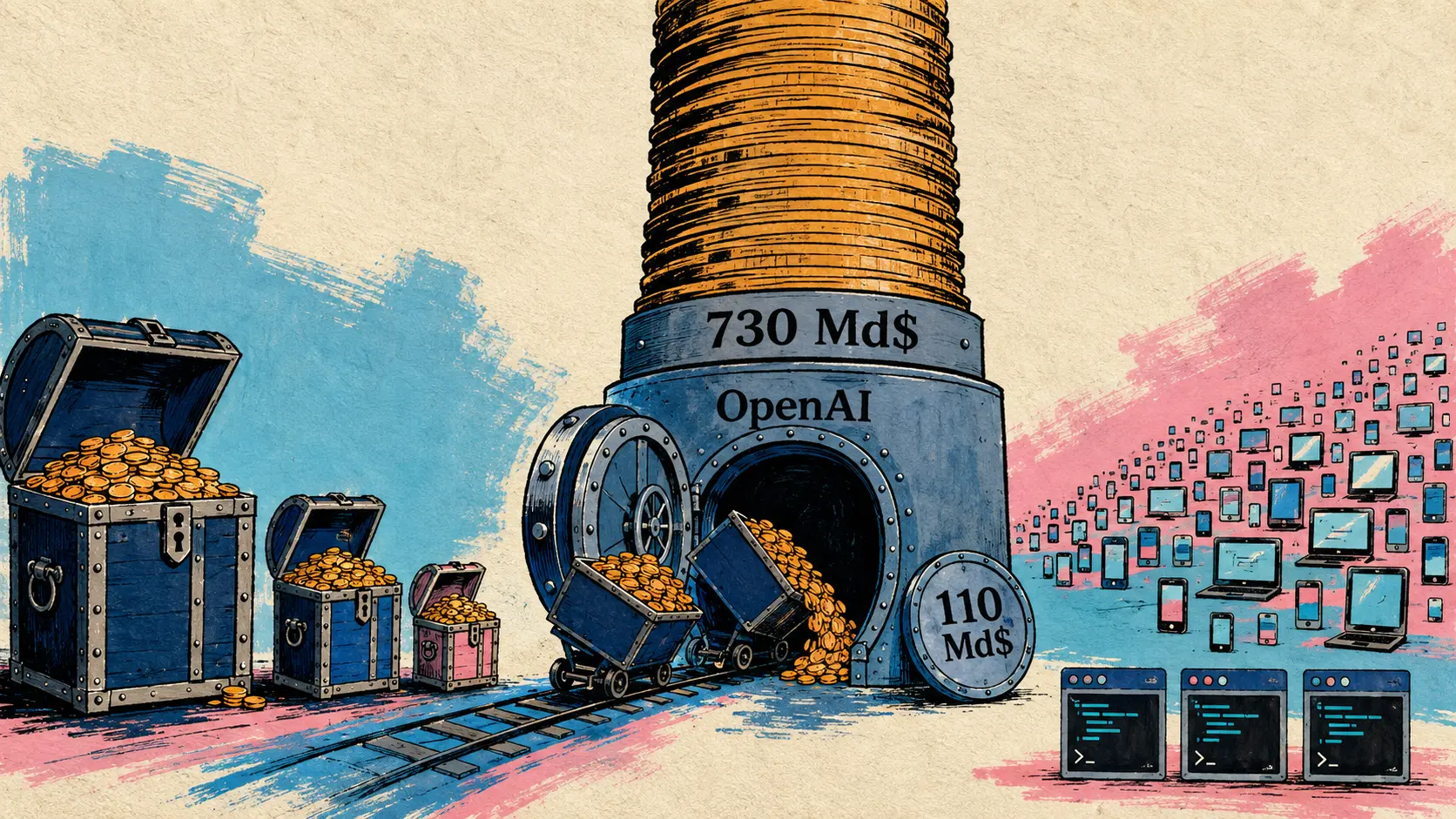
February 27, 2026 is marked by a historic financial announcement from OpenAI — $110 billion raised at a $730 billion valuation — accompanied by an exclusive cloud partnership with Amazon. On Google’s side, the February Gemini Drop delivers Lyria 3, Gemini 3.1 Pro and Nano Banana 2. GitHub launches Agentic Workflows, and Runway publishes two advances: an image model and robotics research.
OpenAI: $110B raised, $730B valuation
February 27 — OpenAI announces a $110 billion funding round at a pre-money valuation of $730 billion, with three strategic partners:
| Investor | Amount |
|---|---|
| Amazon | $50B |
| SoftBank | $30B |
| NVIDIA | $30B |
Other financial investors are expected in the following weeks. The valuation brings the value of the OpenAI Foundation’s stake to over $180 billion.
The traction figures accompanying the announcement give scale: ChatGPT counts 900 million weekly active users and 50 million consumer subscribers. Codex, the developer tool, reaches 1.6 million weekly users — a 3x increase since January 2026. January and February 2026 are described as the best historical months for new subscribers.
“Scaling AI for everyone will require deep collaboration across all levels, and we’re excited to do this together.” — Sam Altman on openai.com
The NVIDIA partnership covers 3 GW of inference-dedicated capacity and 2 GW for training on the Vera Rubin systems, in addition to the Hopper and Blackwell infrastructures already deployed at Microsoft, OCI and CoreWeave.
🔗 Official OpenAI announcement
OpenAI × Amazon partnership: AWS exclusive for OpenAI Frontier
February 27 — Alongside the funding round, OpenAI and Amazon announce a multi-year cloud partnership structured around several complementary pillars:
| Pillar | Details |
|---|---|
| Cloud distribution | AWS = exclusive provider for OpenAI Frontier (deployment of IA agent teams in enterprises) |
| Investment | $50B (initial $15B + $35B conditional) |
| Compute | ~2 GW of Trainium capacity (Trainium3 + Trainium4, T4 deliveries expected in 2027) |
| Extended agreement | Existing $38B AWS agreement extended by an additional $100B over 8 years |
| Custom models | OpenAI and Amazon co-develop models tailored to Amazon applications |
The most notable technical pillar is the Stateful Runtime Environment, co-developed with AWS and planned in the coming months on Amazon Bedrock AgentCore. This runtime is designed for agents requiring persistent context, multi-tool access and dedicated compute resources.
OpenAI × Microsoft: stateless APIs remain on Azure
February 27 — To avoid ambiguity, OpenAI and Microsoft publish a joint statement confirming that the Microsoft partnership remains unchanged despite the Amazon agreement.
The key point: Azure remains the exclusive provider for all OpenAI stateless API requests — including those that transit via collaborations with third parties like Amazon. OpenAI Frontier continues to be hosted on Azure. The two partnerships (Microsoft for stateless APIs, Amazon for Frontier distribution) are therefore complementary and covered by existing agreements.
Microsoft also retains its exclusive license on all OpenAI models, and revenue-sharing terms remain unchanged.
🔗 Microsoft-OpenAI joint statement
Gemini: Nano Banana 2, Lyria 3, Gemini 3.1 Pro
Nano Banana 2 — real-time image generation
February 26 — Google launches Nano Banana 2 (aka Gemini 3.1 Flash Image), the successor to Nano Banana Pro combining the speed of Gemini Flash and the quality of Nano Banana Pro.
| Capability | Details |
|---|---|
| World knowledge | Gemini base + real-time web search for infographics and visualizations |
| Multilingual text | Generation and translation of text within images (marketing, greeting cards) |
| Subject consistency | Maintain up to 5 characters and 14 objects in a workflow |
| Resolutions | From 512px to 4K, varied aspect ratios |
| Provenance | SynthID + C2PA Content Credentials |
At launch, Nano Banana 2 is available in the Gemini app (replaces Nano Banana Pro on Fast, Thinking and Pro), Google Search (AI Mode and Lens, 141 new countries, 8 additional languages), AI Studio, Gemini API (preview), Google Cloud/Vertex AI (preview), Flow (0 credits for everyone) and Google Ads.
Gemini Drop February 2026
February 27 — Google publishes its monthly “Drop” roundup with several bundled announcements:
- Lyria 3: new music model, generates 30-second tracks in beta from text or image. Use case: create a soundtrack matching a mood.
- Gemini 3.1 Pro: improved reasoning for demanding workflows. The Deep Think mode is available to Google AI Ultra subscribers, targeting advanced science and engineering problems.
- Veo Templates: gallery of video styles allowing selection and remixing with your own assets.
- Scientific citations: direct links to scientific papers from Gemini responses.
GitHub: Agentic Workflows, Copilot Metrics GA
GitHub Agentic Workflows
February 27 — GitHub announces Agentic Workflows: describe a workflow in Markdown, and GitHub automatically compiles it into an executable workflow. Compatible with GitHub Copilot, Claude by Anthropic and OpenAI Codex.
The “workflow-as-markdown” approach lowers the barrier to agentic automation — no need to write complex workflow code, a natural language description is enough.
Copilot Metrics GA
February 27 — GitHub Copilot Metrics becomes Generally Available after the preview shown at Universe 2025. Available features:
- Copilot usage dashboard and Code generation dashboard
- Three-tier APIs: enterprise, organization, user
- Granular access controls via custom enterprise roles
- Support for GitHub Enterprise Cloud with data residency
Access via: enterprise account → AI Controls → Copilot → Metrics.
🔗 Copilot Metrics GA changelog
Copilot Content Exclusion REST API (public preview)
February 26 — A JSON REST API is available in public preview to manage Copilot content exclusion rules at the organization and enterprise level. It enables governance at scale via GET/SET operations.
🔗 Content Exclusion API changelog
Runway: image model and robotics
Runway Nano Banana 2
February 27 — Runway announces the launch of Nano Banana 2, its new image generation and editing model, available immediately on the Runway platform. Not to be confused with Google’s model of the same name: both products were announced the same weekend but are entirely distinct.
Runway Robotics: policy simulation with World Models
February 27 — The Runway Robotics team publishes new research on using General World Models to simulate robotic policies. Runway simulated 8 robot policies inside its General World Model and observes a correlation of 0.95 with real hardware results.
“Testing robot policies on hardware is slow, expensive and hard to scale. World models offer a promising path to accelerating robot policy development.” — @runwayml on X
A 0.95 correlation between simulation and real-world behavior is a significant result to reduce the cost and time of hardware testing in robotics.
CLI updates
February 27 — Claude Code v2.1.62 fixes a regression that reduced success rates of the command suggestion cache (prompt suggestion cache). This fix improves CLI autocompletion performance and responsiveness.
February 26 — Codex app 26.226 (the web app codex.openai.com) brings new MCP shortcuts in the composer (suggestions “install” and “MCP server” submenu in “Add context”), support for @mentions and mentions of skills in inline review comments, as well as rendering fixes for MCP tool calls and Mermaid diagrams.
What it means
The OpenAI round at a $730 billion valuation marks a major symbolic and financial milestone: at this scale, OpenAI is now valued as one of the world’s largest technology companies. ChatGPT’s 900 million weekly users and Codex’s tripling demonstrate operational traction that supports these sums.
The structure of the Amazon-Microsoft partnership deserves attention: the two deals are presented as complementary (Azure for stateless APIs, AWS for Frontier distribution), but the multiplication of exclusive cloud partners creates a complex architecture to watch over time.
On Google’s side, the Gemini Drop consolidates an increasingly broad offering — text, image, video, music, scientific search models — with a monthly cadence. Lyria 3 and Nano Banana 2 position Gemini as a comprehensive creative platform.
GitHub Agentic Workflows represents an interesting evolution: making the creation of agentic workflows accessible via Markdown is a bet on democratizing AI development tools.
Sources
- OpenAI : Scaling AI for everyone
- Partenariat OpenAI × Amazon
- Communiqué Microsoft-OpenAI
- Nano Banana 2 — blog Google
- Gemini Drop février 2026
- GitHub Agentic Workflows — @github
- Copilot Metrics GA
- Copilot Content Exclusion REST API
- Runway Nano Banana 2 — @runwayml
- Runway Robotics World Model — @runwayml
- CHANGELOG Claude Code
- Codex Changelog
This document was translated from the fr version to the en language en using the gpt-5-mini model. For more information on the translation process, consult https://gitlab.com/jls42/ai-powered-markdown-translator