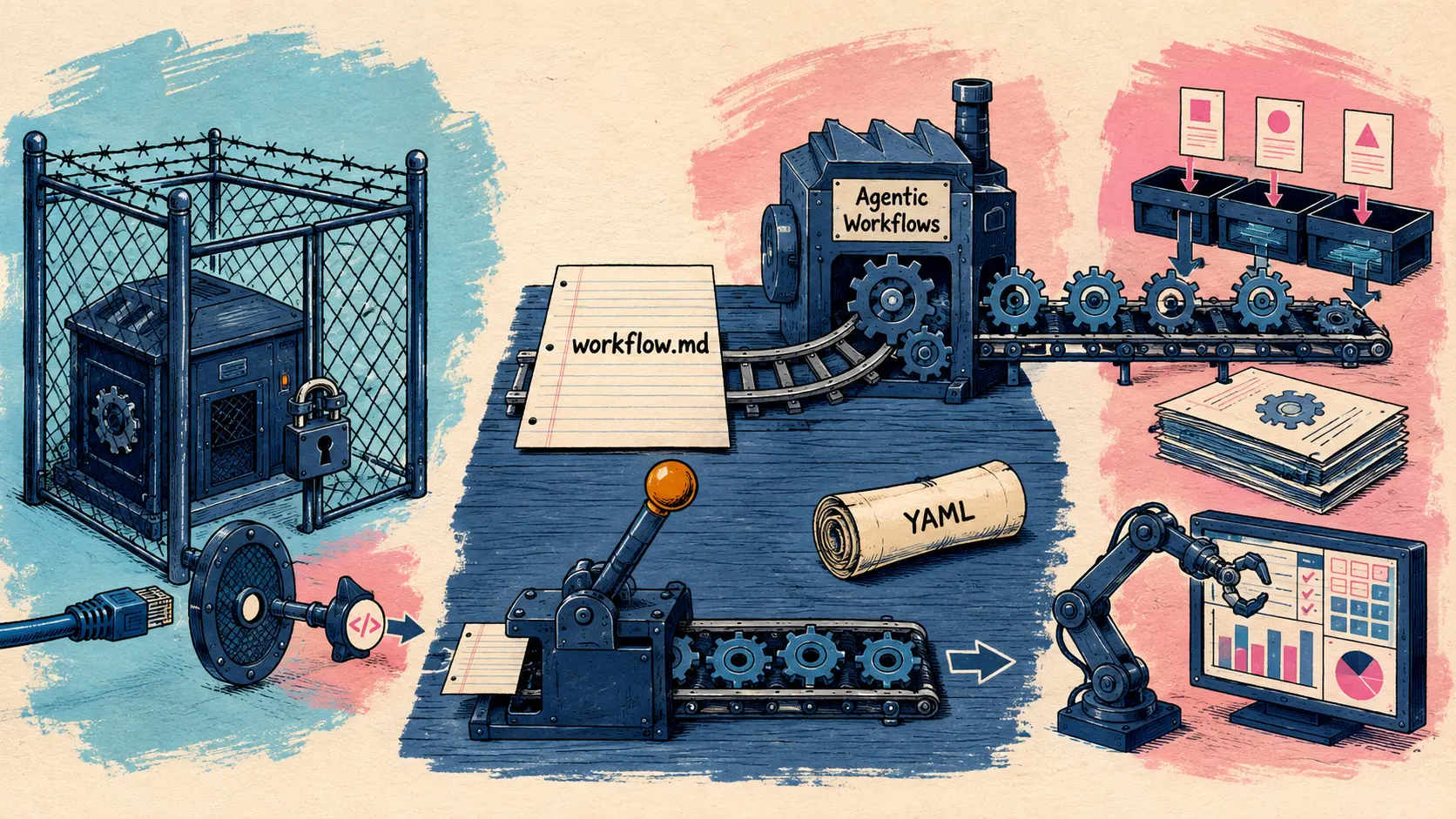
GitHub launches Agentic Workflows in technical preview, enabling automation of repository tasks via Markdown files and AI agents. On OpenAI’s side, GPT-5.2 derives a new result in theoretical physics, Lockdown Mode protects ChatGPT against prompt injections, and the scaling infrastructure for Codex and Sora is detailed. Anthropic and Google bet on education with partnerships and features dedicated to students.
GitHub Agentic Workflows in Technical Preview
February 13 — GitHub launches Agentic Workflows in technical preview, a new approach to repository automation based on AI coding agents natively integrated into GitHub Actions.
The central concept: describe automation goals in natural Markdown instead of traditional YAML. A .github/workflows/workflow.md file is enough — the gh aw CLI converts it into a standard GitHub Actions workflow, executed by an AI agent (GitHub Copilot CLI, Claude, or Codex).
| Use Case | Description |
|---|---|
| Automated Triage | Label, categorize, and route issues |
| Synchronized Documentation | Keep docs up to date with code |
| Test Improvement | Automatically increase coverage |
| CI/CD Analysis | Investigate build failures |
| Health Reports | Generate periodic insights on the repo |
Security is at the heart of the design: read-only permissions by default, sandboxing, network isolation, and tool allowlisting. Workflows have native access to the GitHub MCP server to interact with issues, PRs, Actions, and security systems. Triggers are flexible: events, schedule, manual, or via comments.
The authors (Don Syme & Peli de Halleux) recommend starting with low-risk outputs (comments, reports) before enabling pull request creation.
🔗 GitHub Agentic Workflows Announcement
GPT-5.2 derives a new result in theoretical physics
February 13 — OpenAI publishes a preprint demonstrating that GPT-5.2 proposed a formula for a gluon amplitude that physicists thought could not exist. The result, titled “Single-minus gluon tree amplitudes are nonzero”, was verified by an internal team and academic collaborators.
The paper is co-authored by researchers from the Institute for Advanced Study (IAS), Vanderbilt University, Cambridge University, and Harvard University. GPT-5.2 identified a mathematical structure in amplitude theory — a field of particle physics — that traditional approaches had not explored.
This discovery illustrates the potential of advanced AI models to contribute to fundamental theoretical research, particularly in fields where simple formulas often signal deeper structures. The preprint is available on arXiv and is being submitted for publication.
OpenAI launches Lockdown Mode and Elevated Risk Labels
February 13 — OpenAI introduces two new protections in ChatGPT to counter prompt injection attacks, a growing threat as AI systems handle tasks involving the web and connected applications.
| Protection | Description | Availability |
|---|---|---|
| Lockdown Mode | Advanced and optional security setting for high-risk users | ChatGPT |
| Elevated Risk labels | Clear labels signaling capabilities that introduce additional risks | ChatGPT, Atlas, Codex |
These protections add to existing defenses: sandboxing, protection against data exfiltration via URL, role-based access controls, and audit logs. The goal is to give users and organizations more clarity on risks and stronger controls against manipulation attempts by third parties.
Beyond Rate Limits: how OpenAI scales access to Codex and Sora
February 13 — Face to the rapid adoption of Codex and Sora exceeding forecasts, OpenAI details its real-time access engine architecture which replaces the traditional rate limits model.
The system works in a “waterfall”: instead of asking “is it allowed?”, it asks “how much is allowed, and from where?”. The layers follow one another — free rate limits, free tier, paid credits, enterprise promotions — offering a seamless continuum for the user.
| Principle | Description |
|---|---|
| Real-time | Immediate detection of limit overage and credit activation |
| Idempotency | Each debit carries a stable key, eliminating double billing |
| Audit trail | Every balance adjustment documented with attribution |
| Reconciliability | Full transparency on why a request is allowed/blocked |
OpenAI built this system internally after evaluating third-party billing platforms, which did not meet the needs for real-time accuracy and complete observability.
Anthropic partners with CodePath for AI education
February 13 — Anthropic partners with CodePath, the largest computer science training provider for US higher education students. The collaboration integrates Claude and Claude Code into CodePath’s AI curricula, expanding access to AI tools for over 20,000 students.
Over 100 students already tested Claude Code in Fall 2025 on open-source projects. Howard University redesigned its “Intro to AI” course with Claude, reducing teaching time from 4 years to 2 years. Over 40% of CodePath students come from families earning less than $50,000/year — a strong signal of democratizing access to AI tools.
This partnership is part of Anthropic’s broader commitment to AI education, alongside collaborations with AFT, Iceland, and Rwanda.
Chris Liddell joins Anthropic Board of Directors
February 13 — Chris Liddell, former Deputy Chief of Staff at the White House and Vice Chairman of General Motors, joins Anthropic’s board. This appointment strengthens Anthropic’s presence in government and industrial spheres.
GABRIEL: OpenAI launches open-source toolkit for social sciences
February 13 — OpenAI’s Economic Research Team launches GABRIEL, an open-source Python library that helps social science researchers transform qualitative data into quantitative data at scale.
| Capability | Example |
|---|---|
| Qualitative Analysis | Ask a question in natural language and apply it to thousands of documents |
| Curricular Analysis | Measure attention given to different subjects in curricula |
| Merging & Deduplication | Merge datasets even without matching columns |
| De-identification | Mask personal information |
The toolkit is designed to require minimal technical knowledge, with a tutorial notebook included.
Gemini deploys 5 features for students
February 13 — Google publishes a complete guide showing how Gemini 3 helps students with 5 categories of practical features.
| Feature | Description |
|---|---|
| SAT/JEE Practice Tests | Full free tests with feedback by domain and personalized study plans |
| Canvas Writing | Collaborative space to refine writing, create presentations, debug code |
| Deep Learning | Upload images/PDFs of notes, interactive images with click-to-explain |
| Exam Prep | Personalized quizzes, Audio Overviews (podcasts), flashcards |
| Career Future | CV/cover letter review, mock interviews, pro headshots via Nano Banana |
Eligible university students benefit from 1 free year of Google AI Pro (full Gemini 3 Pro, 2 TB storage, advanced NotebookLM). The partnership with The Princeton Review ensures the rigor of SAT tests.
🔗 Gemini features for students
Qwen AI Slides: from idea to presentation in one click
February 13 — Alibaba Qwen officially launches Qwen AI Slides, a feature that automatically transforms ideas, text, or documents into professional presentations. The system combines the agent capabilities of Qwen3 with the image generation model Qwen-Image 2.0.
A Search Agent researches, organizes, and builds the narrative structure, then Qwen-Image 2.0 generates each slide as a complete visual composition (text, layout, color palette, graphics). The feature is accessible via chat.qwen.ai.
Copilot Coding Agent: network change on February 27
February 13 — GitHub implements a network architecture change for the Copilot coding agent, effective February 27, 2026. Connections will be routed to specific endpoints by subscription plan instead of the current single endpoint.
| Plan | Endpoint |
|---|---|
| Copilot Business | api.business.githubcopilot.com |
| Copilot Enterprise | api.enterprise.githubcopilot.com |
| Copilot Pro/Pro+ | api.individual.githubcopilot.com |
Teams using self-hosted runners or runners with Azure private networking must update their network configurations before the deadline. Copilot coding agent tasks will fail after February 27 without this update.
🔗 Network configuration changes
Stability AI joins the Tech Coalition
February 11 — Stability AI announces joining the Tech Coalition, a global alliance of technology companies working together to combat sexual exploitation and abuse of children online. A CSR initiative that fits into the industry’s efforts for responsible AI.
What this means
The day of February 13 marks a notable convergence: GitHub and OpenAI deepen agentic automation (Agentic Workflows on one side, Codex scaling on the other), while security takes a central place with Lockdown Mode. GPT-5.2’s contribution to theoretical physics illustrates an emerging trend: AI models no longer just summarize or generate, they begin to produce verifiable scientific results. Finally, Anthropic and Google clearly make education a strategic axis — free access, university partnerships, tools dedicated to students.
Sources
- GitHub Agentic Workflows Technical Preview
- GitHub Agentic Workflows Blog
- OpenAI — New result in theoretical physics
- OpenAI — Lockdown Mode
- OpenAI — Beyond rate limits
- OpenAI — GABRIEL toolkit
- Anthropic — CodePath Partnership
- Anthropic — Chris Liddell board
- Google — Gemini features for students
- Qwen AI Slides
- GitHub — Network configuration changes
- Stability AI — Tech Coalition