This week in AI
Busy day for the AI ecosystem: Google unveils Personal Intelligence in Gemini, enabling secure connection to Google apps for truly personalized answers. OpenAI makes GPT-5.2-Codex accessible via its Responses API, while NotebookLM rolls out Data Tables for all users.
Google launches Personal Intelligence in Gemini
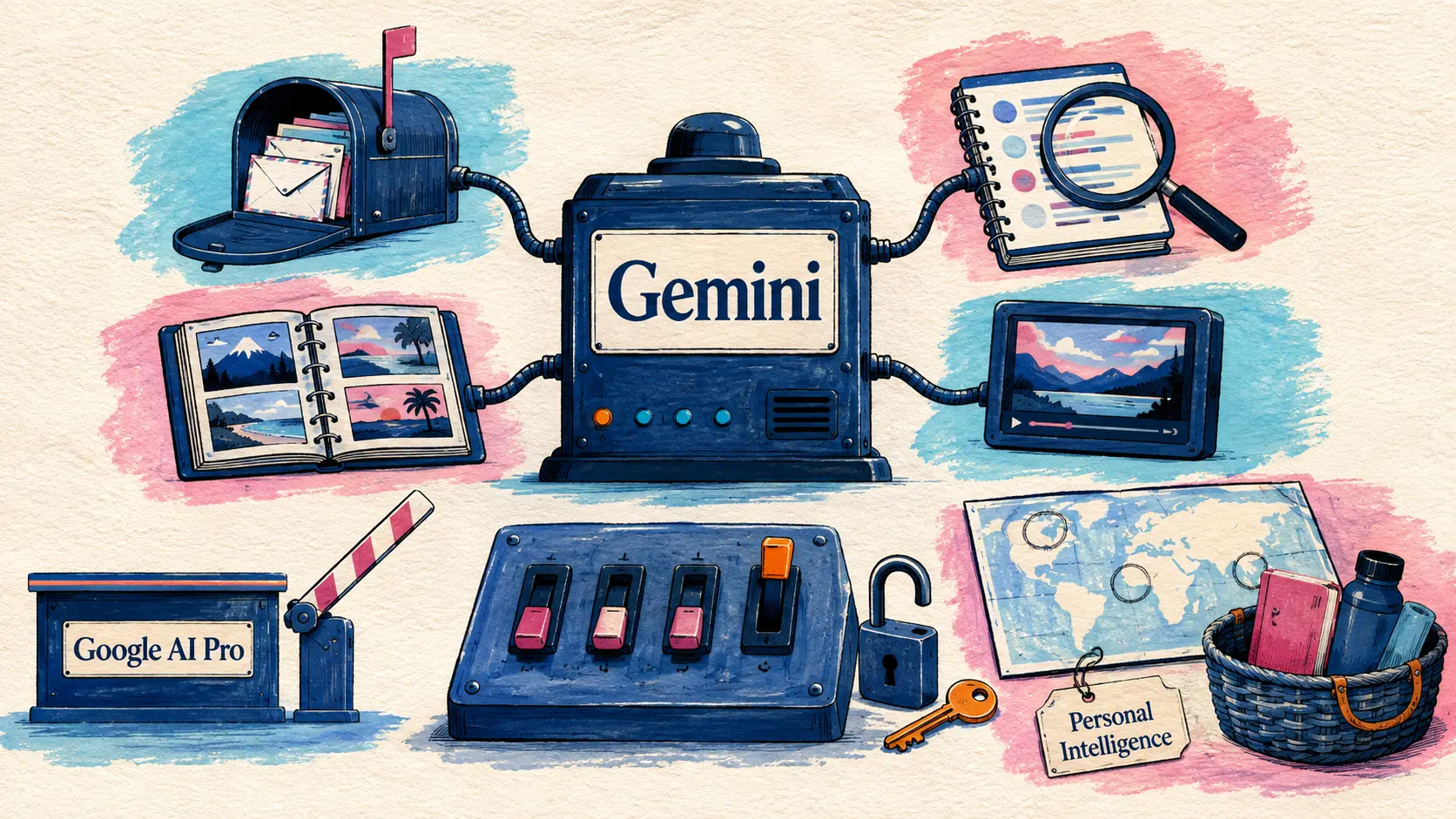
January 14, 2026 — Google announces Personal Intelligence, a new feature that allows Gemini to securely connect to user’s Google apps for truly personalized answers.
🔗 X Post @GeminiApp | Google Blog
Connectable applications
Gemini can now pull insights from:
| Application | Accessible Data |
|---|---|
| Gmail | Emails, conversations |
| Google Photos | Images, memories |
| Google Search | Search history |
| YouTube | History, preferences |
Use cases
Google highlights two concrete examples:
- Planning: Gemini suggests destinations and “hidden gems” adapted to your preferences for your professional or personal trips
- Shopping: Gemini learns your tastes and preferences to help you find items that really match you
Privacy first
Google insists on user control:
- OFF by default: the feature must be manually activated
- Granular control: you choose exactly which apps to connect
- Reversible: you can disable it at any time
Availability
| Aspect | Details |
|---|---|
| Status | Beta |
| Region | United States only |
| Subscriptions | Google AI Pro and Ultra |
| Expansion | Planned as the feature improves |
Personal Intelligence begins rolling out today as a beta to Google AI Pro and Ultra subscribers in the U.S. As the feature improves, availability will expand. — @GeminiApp
GPT-5.2-Codex available in Responses API
January 14, 2026 — OpenAI announces the availability of GPT-5.2-Codex in its Responses API, the same model used in Codex.
🔗 X Post @OpenAIDevs | Documentation
Capabilities
GPT-5.2-Codex excels in complex and long-running development tasks:
| Task | Description |
|---|---|
| Building features | Construction of complete new features |
| Refactoring | Restructuring and improving existing code |
| Bug hunting | Identification and correction of bugs |
| Security | Detection of vulnerabilities in codebases |
The most cyber-capable
OpenAI highlights that GPT-5.2-Codex is their most capable model for cybersecurity, able to:
- Find vulnerabilities in codebases
- Understand security flaws
- Suggest corrections
Context
GPT-5.2-Codex was launched on December 18, 2025, exclusively in Codex. This API opening now allows developers to integrate this model into their own applications and workflows.
NotebookLM rolls out Data Tables to everyone
January 14, 2026 — NotebookLM announces the general rollout of Data Tables, a feature that automatically transforms notes into structured tables.
Prompt examples
NotebookLM proposes templates according to use cases:
| Domain | Suggested Prompt |
|---|---|
| Work | Convert my meeting notes into a table with columns: action, category, priority, owner |
| Science | Create a table of clinical trial results: Study, Year, Method, Sample size, Statistics |
| Travel | Table of destinations: City, Best time, Estimated cost/day |
| School | Table of historical events: Name, Country, Date, Key figures, Economic consequences |
What changes
Data Tables allows moving instantly from raw notes to structured and actionable data, ideal for analysis and comparison.
Anthropic supports the ARPA-H PCX program
January 14, 2026 — Anthropic announces its support for the ARPA-H PCX (Pediatric Care eXpansion) program, a $50 million effort to improve pediatric care.
🔗 X Post @AnthropicAI | ARPA-H Release
The PCX program
| Aspect | Details |
|---|---|
| Budget | $50 million |
| Scope | 200+ pediatric hospitals |
| Initial focus | Pediatric brain cancer |
| Goal | Reduce the care journey from years to weeks |
How it works
The program aims to share data between hospitals on complex cases, allowing doctors to learn from similar cases treated elsewhere.
We’re supporting ARPA-H’s PCX program—a $50M effort to share data between 200+ pediatric hospitals on complex cases, beginning with pediatric cancer. The goal is to help doctors learn from similar cases and shorten the care journey from years to weeks. — @AnthropicAI
ElevenLabs: 230 customer interviews in 24h with Agents
January 13, 2026 — ElevenLabs shares an impressive use case of its conversational Agents: 230 customer interviews conducted in less than 24 hours for their app Eleven Reader.
🔗 X Post @elevenlabsio | Agents Documentation
The problem solved
| Approach | Advantages | Disadvantages |
|---|---|---|
| Live interviews | Deep insights | Doesn’t scale |
| Surveys | Scales easily | Loses nuance |
| Conversational Agents | Depth + Scale | Best of both worlds |
The quantified results
| Metric | Result |
|---|---|
| Completed interviews | 230 |
| Total time | < 24 hours |
| Success rate | 85% on-topic and successful |
| Average duration | 10 minutes per call |
| Time-to-production | Insights delivered the next day |
Rapid deployment
The interviewer agent was built and deployed in less than a day. ElevenLabs used the Analysis feature to evaluate each call and extract structured data from transcripts.
Key learnings
- 95% of respondents interacted naturally without recognizing they were speaking to an AI
- 21% of fiction readers asked for multi-character support for dialogues
- One user: “This customer service interview is the most remarkable AI experience I have ever had”
What it demonstrates
Conversational AI agents allow conducting user research on a global scale, 24/7, while maintaining the richness of qualitative exchanges.
What it means
Google’s Personal Intelligence represents a major evolution of AI assistants. By connecting Gemini to the user’s personal data, Google creates a truly contextual assistant. Privacy will be the key adoption factor.
The GPT-5.2-Codex API democratizes access to OpenAI’s best coding model. Developers can now build AI-augmented development tools without going through Codex. The focus on cybersecurity is notable.
NotebookLM’s Data Tables confirms Google’s strategy to transform NotebookLM into a complete productivity tool, not just an AI podcast generator.
Anthropic’s engagement in healthcare via ARPA-H shows a different approach from OpenAI: institutional partnerships vs startup acquisitions.
ElevenLabs demonstrates with concrete metrics the maturity of its conversational agents: 85% success rate, deployment in less than a day, and above all 95% of users who did not recognize speaking to an AI. It is a reproducible use case for any company looking to scale its user research.
Sources
- @GeminiApp on X - Personal Intelligence
- Google Blog - Personal Intelligence
- @OpenAIDevs on X - GPT-5.2-Codex API
- OpenAI Platform - GPT-5.2-Codex Documentation
- @NotebookLM on X - Data Tables
- @AnthropicAI on X - ARPA-H PCX
- ARPA-H - Pediatric Care eXpansion
- @elevenlabsio on X - Agents Interviews
- ElevenLabs - Agents Documentation