Busy week in the AI ecosystem
From January 9 to 15, 2026, announcements multiplied: restructuring at Anthropic, hardware and energy partnerships at OpenAI, historic Google-Apple rapprochement, and news from Qwen and ElevenLabs.
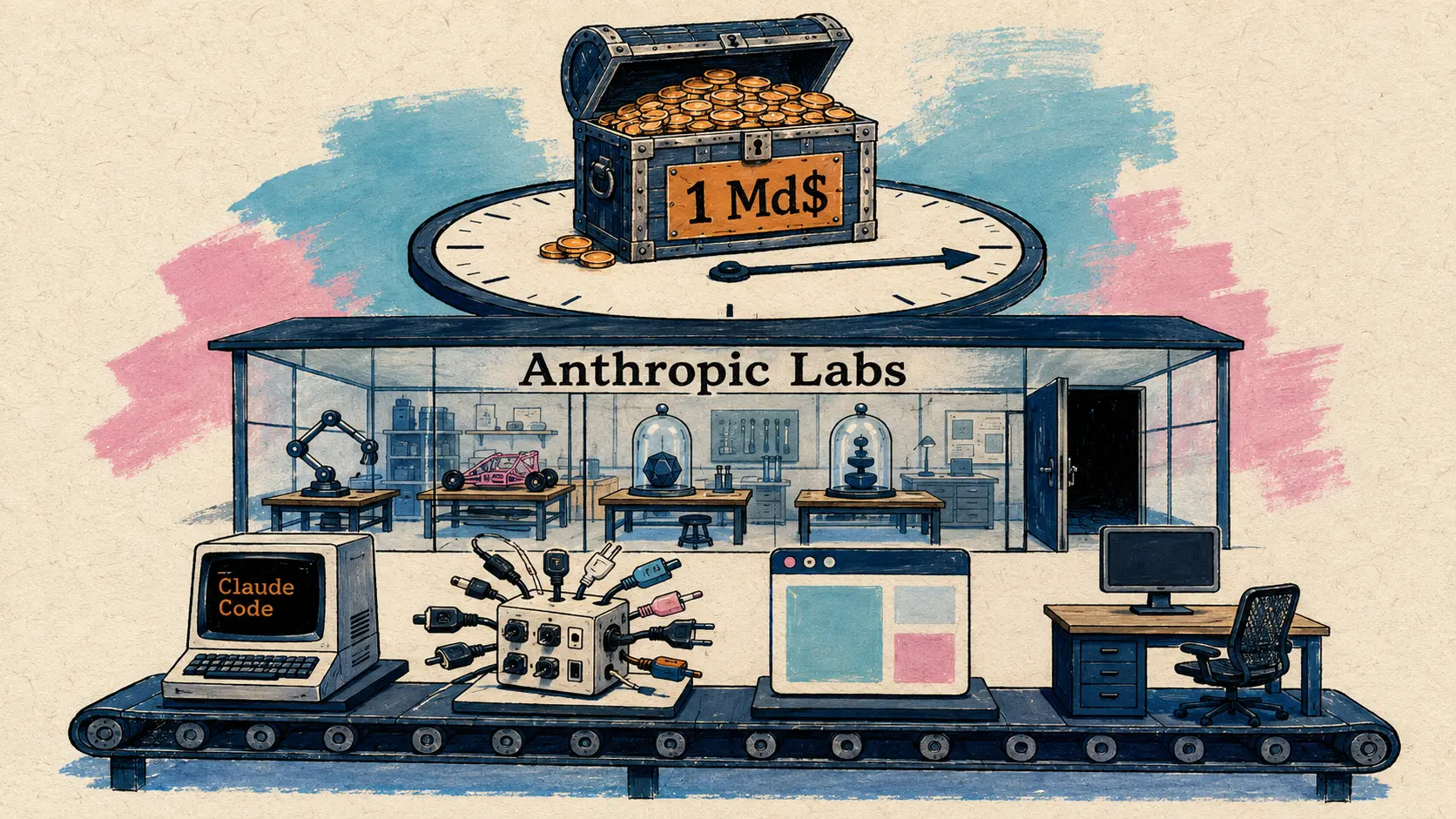
Anthropic Labs: a new product structure
January 13, 2026 — Anthropic announces the expansion of Labs, a team dedicated to incubating experimental products at the frontiers of Claude’s capabilities.
Mike Krieger, co-founder of Instagram and Chief Product Officer of Anthropic for two years, joins Labs to build alongside Ben Mann. Ami Vora takes over the Product organization, in partnership with Rahul Patil (CTO).
“The speed of advancement in AI demands a different approach to how we build, how we organize, and where we focus. Labs gives us room to break the mold and explore.” — Daniela Amodei, President of Anthropic
This structure has already produced Claude Code (which became a billion-dollar product in six months), the Model Context Protocol (100M monthly downloads), Skills, Claude in Chrome, and Cowork.
OpenAI: hardware and energy partnerships
Partnership with Cerebras
January 14, 2026 — OpenAI partners with Cerebras Systems to add 750 MW of ultra-fast inference capacity. Cerebras builds AI processors on a single giant chip, combining compute, memory, and bandwidth to eliminate traditional inference bottlenecks.
“OpenAI’s compute strategy is to build a resilient portfolio that matches the right systems to the right workloads. Cerebras adds a dedicated low-latency inference solution to our platform.” — Sachin Katti, OpenAI
Capacity will be deployed in tranches until 2028.
Investment in Merge Labs
January 15, 2026 — OpenAI invests in Merge Labs, a research lab for brain-computer interfaces (BCI). The goal: to create natural and human interfaces to interact with AI.
Co-founders include researchers Mikhail Shapiro, Tyson Aflalo, and Sumner Norman, as well as Alex Blania, Sandro Herbig, and Sam Altman (personally).
OpenAI will collaborate with Merge Labs on scientific foundational models and cutting-edge tools to accelerate research.
US AI Supply Chain
January 15, 2026 — OpenAI launches a Request for Proposals (RFP) to strengthen the US AI supply chain via domestic component manufacturing.
| Field | Components sought |
|---|---|
| Consumer Electronics | Modules, tooling, final assembly |
| Data Centers | Compute, power, cooling, hardware |
| Robotics | Gears, motors, power electronics |
This initiative is part of Stargate, the $500 billion AI infrastructure project announced in January. Deadline: June 2026.
SoftBank and SB Energy
January 9, 2026 — OpenAI and SoftBank Group each invest $500 million in SB Energy to build next-generation AI infrastructure.
Key points:
- 1.2 GW lease agreement for the first data center (Milam County, Texas)
- Multi-gigawatt campus with service entry starting from 2026
- SB Energy becomes an OpenAI customer, deploying ChatGPT for its employees
“The partnership with SB Energy allows us to combine the company’s strength in data center infrastructure and energy development with OpenAI’s deep expertise in data center engineering.” — Greg Brockman, co-founder and president of OpenAI
Google and Apple: Gemini for Apple Intelligence
January 12, 2026 — Google and Apple announce a historic multi-year collaboration: the next generations of Apple Foundation Models will be based on Gemini models and Google’s cloud technology.
What this implies:
- A more personalized Siri planned for this year
- Apple Intelligence will continue to run on Apple devices and Private Cloud Compute
- Apple’s privacy standards will be maintained
Apple determined, after evaluation, that Google’s AI technology offers the most capable foundation for Apple Foundation Models.
🔗 Joint statement Google and Apple
ElevenLabs: Deutsche Telekom partnership
January 2026 — ElevenLabs announces a partnership with Deutsche Telekom, the largest European telecom operator. The goal: to deploy AI voice agents for customer service, accessible by app and phone.
This partnership marks ElevenLabs’ expansion in Europe with a major telecommunications player.
🔗 Deutsche Telekom Announcement
Qwen: four major new features
Qwen3Guard — First safety model
January 2026 — Alibaba launches Qwen3Guard, the first safety model of the Qwen family. Built on Qwen3 foundation models, it ensures dangerous content detection for prompts and responses.
Key characteristics:
| Aspect | Details |
|---|---|
| Variants | Qwen3Guard-Gen (generative, for offline annotation) and Qwen3Guard-Stream (real-time, token by token) |
| Sizes | 0.6B, 4B, 8B parameters |
| Languages | 119 languages and dialects |
| Classification | Safe / Controversial / Unsafe (3 levels) |
The Stream model allows real-time moderation during response generation, enabling instant intervention.
Qwen-Image-Edit — Intelligent image editing
January 2026 — Qwen-Image-Edit extends Qwen-Image capabilities to image editing. The 20B parameter model excels in:
- Semantic editing: style modification, object rotation (up to 180°), IP creation, Ghibli style
- Appearance editing: addition/removal of elements with realistic reflections, change of clothes, backgrounds
- Text editing: precise modification of text in images (Chinese and English), calligraphy correction in successive steps
Qwen-MT — High-performance translation
January 2026 — Qwen-MT (qwen-mt-turbo) is a translation model supporting 92 languages. Based on Qwen3 with a lightweight MoE architecture, it offers:
- Reduced cost: $0.5 per million output tokens
- Customization: terminology intervention, domain prompts, translation memory
- Performance: outperforms GPT-4.1-mini and Gemini-2.5-Flash on translation benchmarks
🔗 Qwen-MT
GSPO — New RL algorithm
2025 — Qwen publishes GSPO (Group Sequence Policy Optimization), a new reinforcement learning algorithm that solves GRPO stability issues.
Advantages:
- Optimization at the sequence level rather than token level
- Remarkable stability for RL training of MoE models
- More tolerant to precision deviations, simplifying infrastructure
This algorithm powers the latest Qwen3 models (Instruct, Coder, Thinking).
What this means
This week illustrates several trends:
- Product restructuring: Anthropic creates a structure dedicated to rapid innovation with Labs
- Race for hardware: OpenAI multiplies partnerships (Cerebras, SB Energy) and investments to secure infrastructure
- Convergence of giants: Google and Apple ally on Gemini for Siri — a historic rapprochement
- Future interfaces: Investment in Merge Labs (BCI) shows interest in brain-computer interfaces
- AI Safety: Qwen3Guard shows that safety models are becoming essential in the ecosystem
- European expansion: ElevenLabs continues its growth with Deutsche Telekom