ai-powered-markdown-translatorArticle translated from fr to en with gpt-5.4-mini.
Meta opens a new front with its first in-house media models, NVIDIA details the architecture of its Vera CPU designed for AI agents, and Claude Cowork expands to mobile and web. Added to this are the opening of the GitHub Copilot app to all plans, a new speech recognition model for Arabic at Cohere, and a wave of updates from Anthropic, Google, OpenAI, and xAI (now SpaceXAI).
Meta launches Muse Image and Muse Video, its first media models
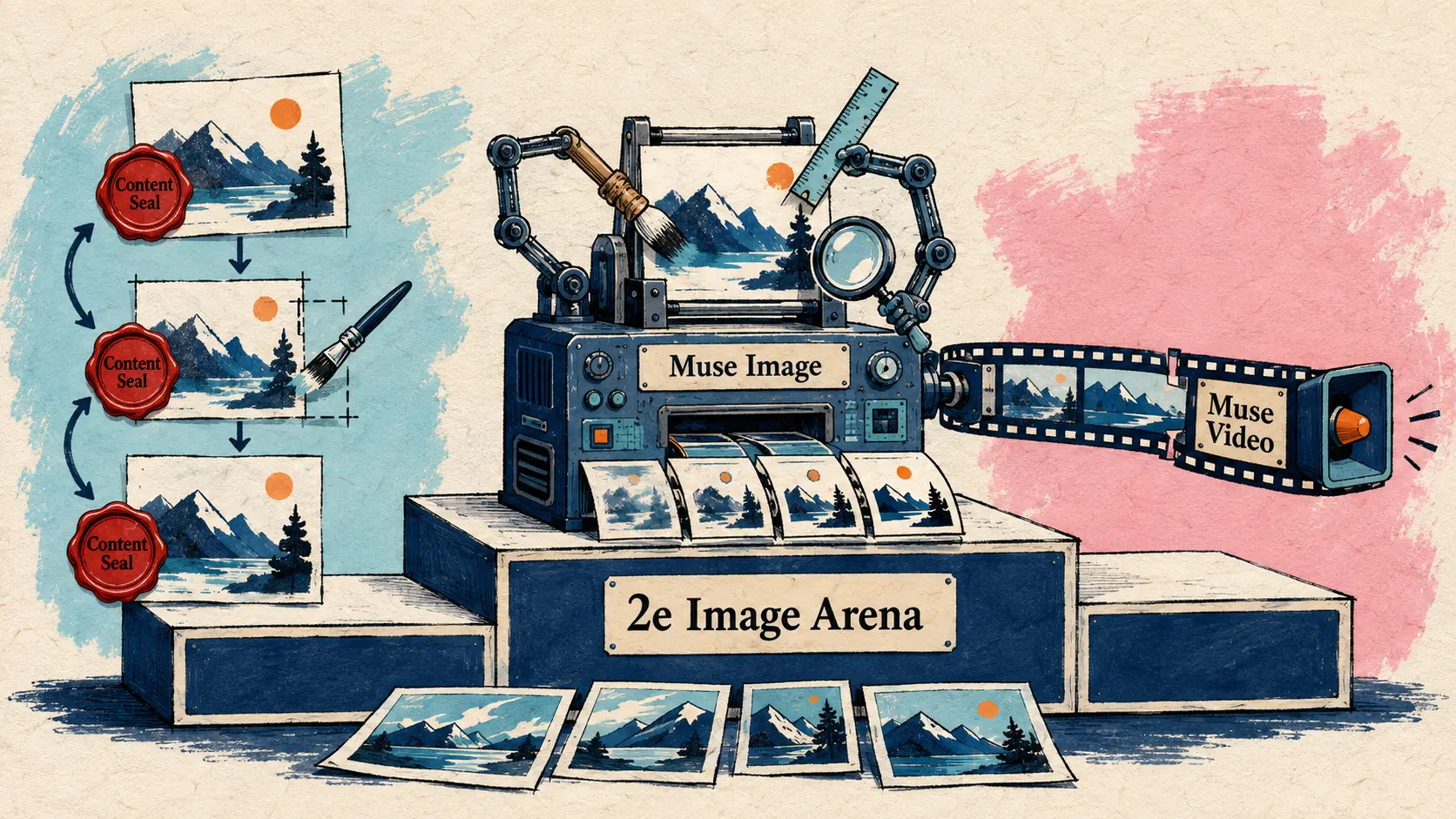
July 7 — Meta Superintelligence Labs presents Muse Image and Muse Video, the very first media generation models developed in-house by the division. Muse Image is described as the most advanced image model ever produced by Meta: it follows instructions closely, enables precise editing, composes from multiple simultaneous references, and draws on Instagram’s social context. Notably, it works like an agent rather than a simple text-to-image converter: it invokes tools, self-refines, and improves its output as more compute is allocated to it at inference time — behavior that emerged spontaneously during reinforcement learning (Reinforcement Learning), with the models learning this strategy to optimize image quality. The model integrates with Muse Spark, Meta’s collaborative media generation tool.
Muse Video, presented in early preview, shares the same pre-training base as Muse Image. It offers high visual fidelity and native audio support, even though Meta acknowledges it is still working on certain gaps, notably audio-video synchronization. The two models are being rolled out on the Meta AI app and web, as well as on Instagram Stories and WhatsApp — initially in a limited number of countries, with broader availability planned. Each generated image includes a Content Seal, a hidden provenance signal that remains intact even after editing.
On the competitive side, a third-party count from Image Arena already ranks Muse Image in 2nd place, behind GPT Image 2 from OpenAI but ahead of Nano Banana (Google), Grok Imagine (xAI), and MAI Image (Microsoft).
NVIDIA Vera — a CPU built for the agentic loop
July 7 — NVIDIA details the architecture of Vera, a new class of CPU designed specifically for the agentic loop — the sequence of tool calls, code execution, and data processing between two prompts to a model. Unlike classic data center CPUs, optimized to maximize the number of rentable cores, Vera focuses on maximum single-core performance.
The CPU is based on Olympus, NVIDIA’s in-house core, which delivers 50% more instructions per cycle (IPC) than Grace, its previous generation, and includes 88 cores connected by a monolithic compute chip.
Perplexity tested Vera on its real-world agentic workloads: a repository cloning flow followed by test execution in sandboxes runs about 1.5x faster than on x86, and concurrent sandbox startup is up to 1.9x faster. The company is considering deploying Vera in production.
| Characteristic | NVIDIA Vera |
|---|---|
| Core | Olympus (+50% IPC vs Grace) |
| Number of cores | 88 |
| Memory bandwidth | 1.2 TB/s LPDDR5X (< 40 W) |
| Core-to-core bandwidth | 3.4 TB/s (3x the competition) |
| Agentic gain (Perplexity) | 1.5 to 1.9x faster than x86 |
| SQL gain (Starburst) | 3x faster |
| Latency gain (Redpanda) | up to 6x less |
NVIDIA also confirms its roadmap: the next generation, Rosa, will feature the Rigel core (Arm v9.2 architecture), with even higher IPC, a larger L2 cache, and more efficient memory management, at the same silicon footprint. Vera also hosts the GPUs in the NVIDIA Vera Rubin platform and powers the BlueField-4 STX storage processor.
“The world counts in seconds. Agents count in nanoseconds. NVIDIA Vera is built for this new category — and speed — of work.” — Ian Buck, NVIDIA
🔗 Official NVIDIA Blog article
Claude Cowork arrives on mobile and web
July 7 — Anthropic announces the expansion of Claude Cowork to mobile and web. The idea: assign Claude a task from your workstation, then track its progress and retrieve the result from your phone — with the stated goal of being able to close your laptop while Claude keeps working in the background.
On web and desktop, Chat and Cowork now merge into a shared space: one place to find projects and artifacts from both modes, and starting a task for Claude works the same way as starting a regular conversation — no need to switch between two separate interfaces depending on whether you’re chatting with Claude or delegating deeper work to it. The rollout is taking place in a gradual beta over several weeks, starting with the Max plan before expanding to the other subscription tiers.
To support the launch, Anthropic is temporarily doubling Cowork usage limits until August 5, in order to let users delegate larger tasks to Claude during this transition period without prematurely consuming their usual quota. A dedicated article, “Claude Cowork on web and mobile: hand off work anywhere,” is published in parallel on claude.com. This mobile extension positions Cowork as the asynchronous counterpart to classic Chat: where conversation remains centered on real-time exchange, Cowork becomes the space where you follow, remotely, the progress of work assigned earlier in the day.
GitHub opens its Copilot app to all plans
July 7 — GitHub opens its Copilot desktop app — the agentic development hub launched in late May/early June, previously reserved for part of its user base — to all users. Available on macOS, Windows, and Linux, it becomes accessible on all Copilot plans, including the free tier (Copilot Free) and the GitHub Education offering, two tiers that had not been eligible until now.
Another notable change: even without a Copilot subscription, it remains possible to use the app by bringing your own key (Bring Your Own Key, BYOK) to the model provider of your choice — a no-commitment entry point with no direct financial obligation to GitHub, which broadens the app to developers already equipped with third-party API access. On Business and Enterprise plans, access still depends on the administrator enabling Copilot CLI in policy settings, with GitHub thus retaining a control lever for enterprise deployments.
Confirmed by a tweet from the official @github account posted one hour before the changelog update, this opening greatly expands the app’s potential audience, a little over a month after its preview launch. It fits the same logic as recent Copilot billing changes (cost centers, per-user budgets): making the tool accessible to as many people as possible while keeping safeguards for organizations.
Anthropic rounds out its weekly news
Claude for Open Source expanded to maintainers
July 7 — Anthropic expands its Claude for Open Source program, which offers 6 months of free Claude Max 20x, to a broader audience of contributors: project maintainers, regular contributors (core contributors), people who carry pull requests across the ecosystem to completion, or who maintain a critical package. Applications are open via a dedicated page on claude.com. This is an expansion of an existing program rather than a brand-new launch, but opening it to a wider group of maintainers makes it a notable announcement for the open source developer community.
Claude Code v2.1.202 and v2.1.203 — changelog catch-up
July 7 — Two Claude Code releases catch up after v2.1.201 from July 4. v2.1.203 brings a broad set of reliability fixes for background agents: sessions stuck for 15 to 20 seconds at startup on macOS, agents that silently lost their work when returning to claude agents, memory/CPU regression tied to re-parsing the transcript on every turn. Notable security point: one fix closes a potential leak of the ANTHROPIC_BASE_URL variable, which could have sent API keys to the default endpoint in background sessions. The release also reduces the binary size by about 7 MB.
v2.1.202, meanwhile, adds a “Dynamic workflow size” setting in /config to tune the number of agents generated in a workflow, OpenTelemetry attributes to trace their activity, and several fixes for Remote Control on mobile/web and voice dictation.
Hugging Face joins Azure, Sakana AI publishes at ICML 2026
Hugging Face lands on Microsoft Foundry Managed Compute
July 7 — Hugging Face details its partnership with Microsoft: a curated collection of open-weight models, refreshed weekly, joins the Microsoft Foundry Managed Compute catalog, a managed GPU platform (PaaS). The weights are pre-hosted on Azure, with ready-to-use runtimes — vLLM, SGLang, TensorRT-LLM, NIM, TEI, llama.cpp, and hf-serve, Hugging Face’s own multi-model server for non-LLM/embeddings modalities.
The curation pipeline enforces compliance, licensing, and security review before publication: only SafeTensors weights are accepted, with no unreviewed untrusted code (trust_remote_code), and images are scanned for CVEs. Deployment happens in 5 steps, on NVIDIA A100, H100, or AMD MI300X accelerators. The feature is in preview now; the roadmap includes broader coverage and support for Bring Your Own Weights.
Sakana AI publishes Sheaf-ADMM, transparent multi-agent coordination
July 5 — Sakana AI introduces Sheaf-ADMM, a framework accepted at ICML 2026 that combines distributed optimization (ADMM) and sheaf theory (sheaves, applied topology) to make multiple AI agents cooperate with limited information, without relying on opaque message passing in hidden states. The task is broken into overlapping pieces, one agent per piece, and the agents negotiate in three steps — local proposals, seeking common ground with neighbors, remembering disagreements — until they reach an interpretable global consensus.
On a multi-agent Sudoku where each agent sees only a row, a column, or a block, the method reaches 93% solved versus 11% for a message-passing baseline with equivalent parameters. On an MNIST classification task with domain shift, it retains 86% accuracy where a standard CNN drops to 11%. On a maze, it matches a classic baseline while communicating over a channel that is 8x smaller.
Google Gemini: from antiquity to small businesses
Gemini anchored in the Aeneas and Ithaca models for historians
July 7 — Google DeepMind launches “Predicting the Past,” a new Skill in Google Antigravity that anchors Gemini in its expert models Aeneas (Latin inscription deciphering) and Ithaca (ancient Greek texts). The goal: let historians and epigraphers explore ancient texts in plain English, without coding skills — the Skill combines Gemini’s reasoning with the deep expertise of these two specialized models to create custom analyses and visuals, and to identify large-scale patterns across sources.
The project is based on a research partnership with historian Thea Sommerschield, who worked with Google DeepMind on several case studies documented in the article “Workflows — Conversing with antiquity.”
Gemini App — Business notebooks and Google Business Profile integration
July 6 — Gemini launches new tools for solopreneurs and small businesses: connect your Google Business Profile directly to Gemini, or add it to a business notebook, to get personalized insights and concrete actions without having to re-explain your business context in every conversation. Business notebooks let you add sources or older conversations to build a persistent knowledge base, rather than starting from a blank page each time. Google presents these tools as a way to turn Gemini into a partner that deeply understands the user’s brand. The feature is available globally, except in the European Economic Area and the United Kingdom.
Runway generates presentations, xAI/SpaceXAI enriches Grok Voice
Runway launches Slide Maker
July 7 — Runway adds Slide Maker to its app: from a simple text description, the tool generates a fully designed presentation slide, without going through a preset template. Runway presents the tool as a way to get a polished visual result simply by describing the idea, rather than starting from a generic default template. This expansion fits into Runway’s broader enterprise use cases beyond pure video and image generation, alongside Agent 2.0, launched on June 25 to automate marketing briefs — two tools now aimed at creative and office teams, not just video content creators.
21 new voices for Grok Voice (xAI/SpaceXAI)
July 6 — xAI — now rebranded SpaceXAI (see Briefs) — launches 21 new voices for Grok Voice, joining the five original voices. All are multilingual and available immediately in the real-time Voice Agent API, the Text-to-Speech API, and the new Grok Voice Agent Builder, launched on July 1. Each voice is “cast” for a specific use — customer support, characters, commentary, advertising, education — and supports diction control tags (pause, whisper, emphasis). The five original voices have also been retrained for more natural phrasing. Developers can also clone a custom voice from about one minute of audio.
OpenAI: Codex Remote on iOS and a new economical voice model
Codex Remote gets a raft of new features in ChatGPT for iOS
July 6 — ChatGPT for iOS version 1.2026.181 brings a wave of new features to Codex Remote, the code agent variant accessible from the mobile app. It is now possible to create, search, open, duplicate (fork), and manage Codex tasks directly from a conversation, with diff filters by status (indexed, unindexed), by branch, or by last turn. The app also adds image and attachment previews before sending, private-key SSH support, and usage limits and credits displayed in the task menu.
“Big release for Codex Remote in the latest ChatGPT iOS update! We added many things. Threads management tools are now available (hello Chief of Staff). You can now filter your diff with unstaged, staged, branches, etc. Support for SSH keys login, and much, much more!” — @Dimillian
GPT-Realtime-2.1-mini available in the API
July 7 — OpenAI is launching GPT-Realtime-2.1-mini in the API, a new version of its budget voice model that introduces reasoning and tool use — capabilities previously reserved for higher-end Realtime models — while keeping the same price as GPT-Realtime-mini. This budget range targets cost-sensitive deployments measured by the minute, such as high-volume voice agents. The announcement tweet drew significantly more engagement than the other posts of the day (361,000 views), a sign of strong interest from the developer community.
Replit wraps up its July 3 changelog
July 3 — Replit published a product changelog that had remained under the radar of previous scans, hosted on docs.replit.com/updates rather than on the main blog that is usually monitored. Three new features: a complete overhaul of the desktop app (Replit Desktop App), which brings the web experience while adding native functions — working on multiple apps in parallel, being notified at a glance when the agent needs intervention, previewing open apps without switching windows.
Whop payments integration is now controllable by the conversational agent: just ask it to add payments and it will create a Whop account, connect it, and build the payment module, with no external setup or API key to copy and paste. Finally, it is possible to downgrade from the Pro plan to the Core plan in a single step, without going through an intermediate cancellation.
Cohere launches a state-of-the-art open-source ASR model for Arabic
July 7 — Cohere launches Cohere Transcribe Arabic, an open-source Automatic Speech Recognition (ASR) model dedicated to Arabic, derived from its 2-billion-parameter “frontier” ASR model published in March 2026. The goal: close the Arabic coverage gap in AI voice systems, as the language has more than 300 million native speakers spread across around thirty dialectal variants.
The model takes the lead on the Open Universal Arabic ASR Leaderboard on Hugging Face, with an average Word Error Rate (WER) of 25.87 — ahead by 2.45 points of the previous leader (Meta’s OmniASR-LLM-7B) and by 11 points of OpenAI’s Whisper Large V3. In comparative evaluations conducted by native speakers, it is preferred to Whisper in 95.8% of cases. Optimized on vLLM, it reaches a throughput (RTFx) of 525, compared with 146 for Whisper Large V3 and 66 for OmniASR 7B-LLM.
| Arabic ASR model | Average WER | RTFx (throughput) |
|---|---|---|
| Cohere Transcribe Arabic | 25.87 | 525 |
| OmniASR-LLM-7B (Meta) | +2.45 pts vs Cohere | 66 |
| Whisper Large V3 (OpenAI) | +11 pts vs Cohere | 146 |
The weights are released under the Apache 2.0 license on Hugging Face, with additional access via the Cohere API or Model Vault.
“We’ve built Cohere Transcribe Arabic, the world’s most accurate open-source model for Arabic speech recognition. Available under Apache 2.0” — @cohere
Briefs
- Fable 5 extended to all paid plans until July 12 — Anthropic is temporarily expanding access to Claude Fable 5: up to 50% of the weekly usage limit can be used on this model, then it switches to usage credits or another model. 🔗 source
- “The Making of Claude Code” — official mini-documentary — Anthropic recounts the history of Claude Code, from an internal CLI to a flagship coding agent, told by researchers and early users. 🔗 source
- Gemini Spark follows topics in real time — the feature (macOS beta since July 1) can now react to events, for example by automatically sending a match analysis after each game by a followed team. 🔗 source
- NotebookLM Short Video Overviews in general availability — the 60-second vertical videos, in beta since June 30 for Ultra/Pro subscribers, are moving to general availability on mobile and web for all English-speaking users. 🔗 source
- Gemini CLI — nightlies from July 5 to 7 — version v0.51.0-nightly.20260707 makes
~/.gitconfigread-only in the macOS sandbox and preserves escape sequences in string literals. 🔗 source - Elastic TPU training with MaxText/Pathways — Google explains how its JAX/Pathways ecosystem turns a TPU failure into a catchable Python exception, replaces the failing worker, and resumes training in under two minutes. 🔗 source
- Per-user AI budgets built into GitHub billing UI — the per-user budgets feature for cost centers, previously accessible only via the REST API, is now configurable directly in the Enterprise Cloud billing interface. 🔗 source
- The Copilot Billing Preview app will be removed on August 3 — GitHub is redirecting users to the tracking now built into billing settings (AI usage, budgets, cost centers). 🔗 source
- Suno and Wan ride the World Cup wave — Suno lets users create a personalized supporter anthem on mobile, while Wan launches the “Superstar Poster” Skill to generate a football poster from a portrait and a jersey. 🔗 source
- NVIDIA reviews its presence at ICML 2026 — 74 accepted NVIDIA papers, about 2,000 papers citing NVIDIA GPUs, and 145 papers citing Nemotron as a research foundation. 🔗 source
- xAI becomes SpaceXAI — the X account @xai and the website x.ai formalize the rebrand under the SpaceXAI name, confirming SpaceX’s acquisition of xAI, already announced in April 2026. 🔗 source
- Realtime latency reduced by at least 25% — OpenAI announces a drop in p95 latency across all Realtime voice models thanks to improved caching. 🔗 source
What it means
On the media-generation front, Meta is coming in strong with Muse Image and Muse Video, its very first in-house models, immediately ranked 2nd in the Image Arena behind OpenAI’s GPT Image 2. The fact that Muse Image adopts agentic behavior — self-refinement, tool use, compute scaling at inference time — illustrates a broader trend: even image generation, long thought of as a simple prompt-to-image round trip, is becoming an iterative agent-driven task. Runway, for its part, is expanding into office productivity with Slide Maker, while Suno and Wan are capitalizing on sports news to push their consumer tools.
On the infrastructure side, NVIDIA is formalizing an idea that has quietly been spreading through the industry for several months: the agentic loop does not have the same needs as model training. Vera is betting on single-core performance rather than core density, and Perplexity’s real-world figures (up to 1.9x faster than on x86) give that argument weight. Hugging Face is following a complementary software approach, making its catalog of open weights deployable in one click on Microsoft’s Azure infrastructure — two different ways to remove friction between a model and its production execution.
Developer tooling continues its march toward agent ubiquity. Claude Cowork is expanding to mobile so it can track a delegated task from a phone, GitHub is opening its Copilot app to all plans including free ones, and Codex Remote is becoming more mature in ChatGPT for iOS with thread management and SSH support. Combined with the Replit desktop app redesign and its agent-driven payments, this week confirms that the reference interface for coding with AI is no longer just the terminal or the IDE, but increasingly mobile and third-party integrations.
Finally, two announcements remind us that generative AI is not limited to English or to single-agent systems. Cohere is filling a real blind spot with a state-of-the-art speech recognition model for Arabic, a language spoken by more than 300 million people but historically underserved by systems designed first for English; xAI, now SpaceXAI, follows a similar logic with 21 new multilingual voices for Grok Voice. On the research side, Sakana AI’s Sheaf-ADMM framework tackles a different but related problem: how to get multiple agents with limited information to cooperate without a black box — a prerequisite for reliable multi-agent systems as they become more widespread.
Sources
- Meta launches Muse Image and Muse Video
- NVIDIA Vera — CPU for agentic AI
- Claude Cowork on mobile and web
- GitHub Copilot app available to everyone
- Claude for Open Source
- Claude Code CHANGELOG.md
- Hugging Face on Microsoft Foundry
- Sakana AI — Sheaf-ADMM
- Google Antigravity — Predicting the Past
- Gemini App — Business notebooks
- Runway — Slide Maker
- xAI — 21 new Grok Voice voices
- Codex Remote — iOS update
- Official Codex changelog
- GPT-Realtime-2.1-mini
- Replit — July 3 changelog
- Cohere Transcribe Arabic — official blog
- Cohere Transcribe Arabic — X announcement
- Fable 5 — expanded access
- The Making of Claude Code
- Gemini Spark — real-time tracking
- NotebookLM Short Video Overviews GA
- Gemini CLI — nightly 20260707
- Google Developers Blog — elastic TPU
- GitHub — per-user budgets (UI)
- GitHub — Copilot Billing Preview removal
- Suno — Release Notes
- NVIDIA — ICML 2026 review
- xAI becomes SpaceXAI
- OpenAI — reduced Realtime latency