ai-powered-markdown-translatorArticle translated from fr to en with gpt-5.4-mini.
This week, Google DeepMind takes a major step in mathematical research with AlphaProof Nexus, an agent capable of solving open problems that have stood for decades. On Anthropic’s side, Claude Code auto mode is opening up to the Pro plan and adding Sonnet 4.6. GitHub open sources the Copilot plugin for Eclipse, and Alibaba enables implicit caching on Qwen3.7-Max.
AlphaProof Nexus — An AI agent solves mathematical problems open for decades
May 25, 2026 — Google DeepMind announced AlphaProof Nexus, an agentic framework for formal proof research powered by Gemini, accompanied by a paper submitted to arXiv on May 21 (arXiv:2605.22763).
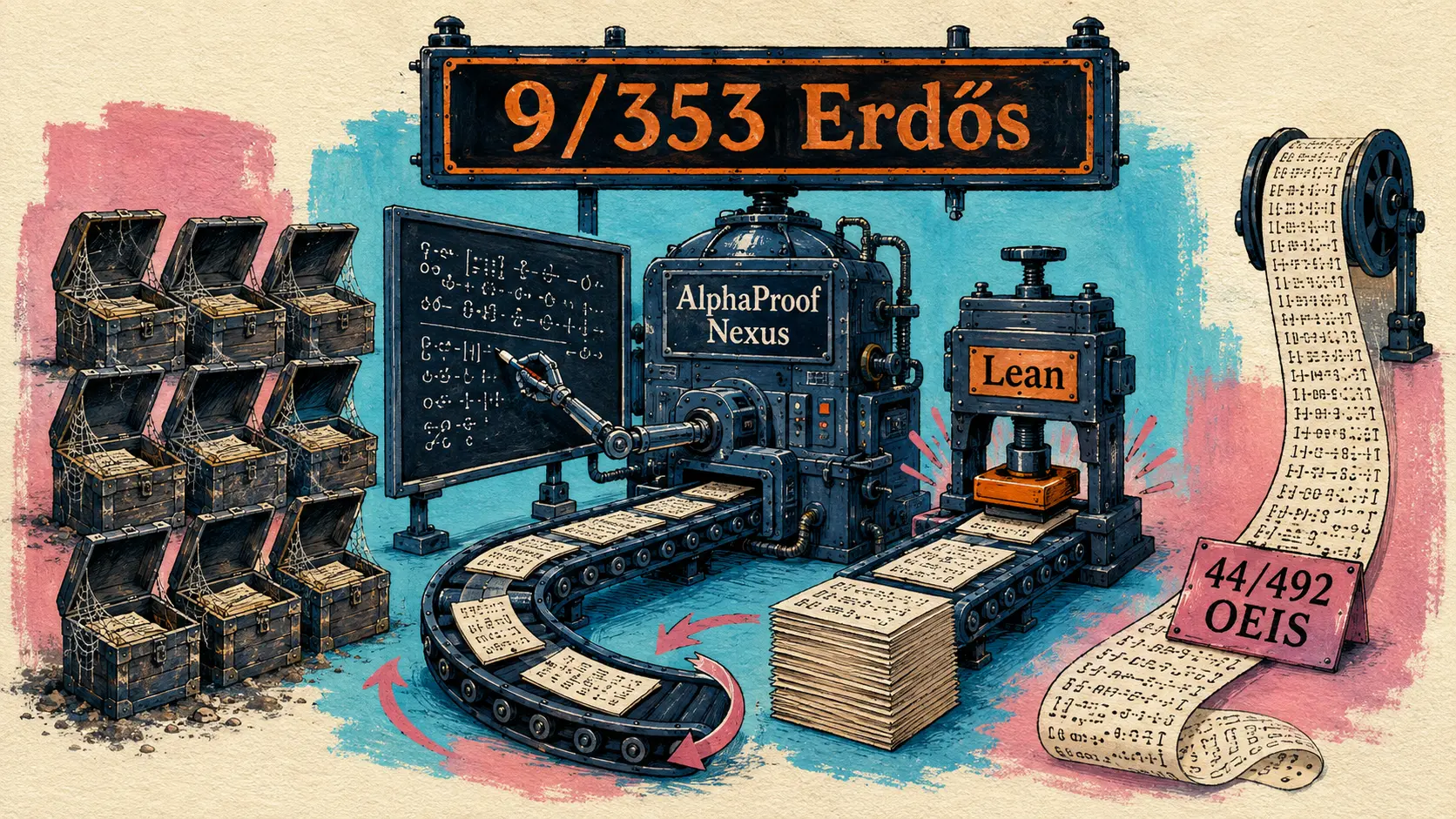
The agent is based on a loop alternating generation via Gemini and formal verification via the proof language Lean. This combination guarantees the mathematical rigor of the proofs produced: the LLM proposes, Lean validates or rejects, and the agent iterates.
Published results:
| Domain | Results | Context |
|---|---|---|
| Erdős open problems | 9 solved out of 353 evaluated | Including 2 open for 56 years |
| OEIS conjectures | 44 solved out of 492 | Online Encyclopedia of Integer Sequences |
| Algebraic geometry | 1 open problem solved | Open for 15 years |
| Min-max optimization | 1 open question solved | Open for 7 years |
The cost per solved problem is a few hundred dollars — an order of magnitude that illustrates the economic efficiency of the agentic approach for formal mathematical research.
AlphaProof Nexus is already being deployed in collaboration with mathematicians across several fields: combinatorics, graph theory, algebraic geometry, and quantum optics. This work follows on from AlphaProof (2024), which targeted olympiad-level problems. AlphaProof Nexus aims at open research problems, marking a step toward using AI as a tool for autonomous mathematical discovery.
“AI agents are advancing research-level math.” — Pushmeet Kohli, VP Research, Google DeepMind on X
Claude Code v2.1.149 — /usage detail by category and 25+ fixes
May 23, 2026 — Claude Code version 2.1.149 has been released, delivering the /usage breakdown by category announced by Boris Cherny the previous week.
| Feature | Detail |
|---|---|
/usage breakdown | Consumption detail by category: skills, subagents, plugins, MCP server |
/diff navigation | Keyboard navigation: arrows, j/k, PgUp/PgDn, Home/End |
| GFM task lists | Markdown checkboxes ([ ] / [x]) displayed correctly |
| Enterprise | New managed parameter allowAllClaudeAIMcps for managed-mcp.json |
The release also fixes around twenty bugs: PowerShell permission workaround in cd, vnode table exhaustion on macOS with find, managed-settings dialog freeze, ghost changes in /config, crash in /insights on missing optional fields, and a reflection spinner that stayed amber between tool calls.
Version 2.1.150, released the same day, brings only internal infrastructure improvements with no visible changes.
Claude Code Auto Mode — Available on Pro, Sonnet 4.6 integrated
May 23, 2026 — Anthropic announces two extensions to Claude Code auto mode:
“Two updates to auto mode: · Now available on the Pro plan · Sonnet 4.6 is now supported, alongside Opus 4.7. Shift+tab, and let Claude run.” — @ClaudeDevs on X
Auto mode, enabled via Shift+Tab, allows Claude to perform actions autonomously without manual validation at each step. Previously limited to higher-tier plans, it is now available to Pro subscribers. The addition of Sonnet 4.6 provides a more economical option than Opus 4.7 for long sessions, reducing credit consumption in autonomous mode.
To access these changes: claude update or update the Claude desktop app. The announcement generated 1.18 million views on X.
GitHub Copilot for Eclipse — Open source under the MIT license
May 21, 2026 — GitHub has open sourced the GitHub Copilot plugin for Eclipse, available on GitHub under the MIT license at github.com/microsoft/copilot-for-eclipse.
The full feature set is exposed for community contributions:
| Feature | Status |
|---|---|
| Code completion | Open source |
| Next Edit Suggestions (NES) | Open source |
| Chat (conversation flow, tool calls) | Open source |
| Agent mode (multistep agentic workflows) | Open source |
| Skills and prompt files | Open source |
| BYOK (Bring Your Own Key) | Open source |
| Custom agents, subagents, agent plan, MCP | Open source |
The motivation is transparency and community-driven innovation in the spirit of Eclipse’s open ecosystem. Contributions have already been received from the community since launch.
🔗 GitHub Changelog announcement
Qwen3.7-Max — Implicit caching enabled in production
May 25, 2026 — Alibaba enables implicit caching on Qwen3.7-Max, its flagship agent-oriented model.
The cache activates automatically for all API requests — no code changes required. Developers immediately benefit from faster and cheaper requests on repetitive contexts. For higher and deterministic cache hit rates, Alibaba recommends explicit caching, documented on Alibaba Cloud.
Briefs
-
MiniMax Hailuo AI at the Hong Kong AIFF (HKUST) — The 2nd AI Film Festival organized by HKUST received 1,300 submissions from 80 countries. Hailuo AI was represented there alongside Tencent and Z.ai during a panel on democratizing AI cinema. 🔗 minimax.io
-
NVIDIA DGX Spark — 16 simultaneous local AI agents — Community demo retweeted by @NVIDIAAI: 2x DGX Spark (GB10) + MiniMax M2.7 NVFP4 run 16 AI agents in simultaneous streaming, with no cloud APIs. 🔗 @NVIDIAAI on X
What this means
A turning point for formal mathematical research. AlphaProof Nexus marks a break: AI is no longer limited to contest problems or academic benchmarks; it is tackling open problems that mathematicians have been unable to solve for decades. The Gemini + Lean combination creates a formal verification loop that ensures the proofs are correct, not merely plausible. The cost of a few hundred dollars per solved problem suggests that this approach is becoming accessible to research labs, not just industry giants.
The maturity of agent tooling on the Anthropic side. The arrival of auto mode on the Pro plan and the integration of Sonnet 4.6 signal that Anthropic considers autonomous agentic use stable enough for the general public. Version 2.1.149, with its category /usage breakdown, addresses a concrete need for developers building complex multi-agent systems: understanding precisely what consumes their quota in order to optimize their architectures.
Open source vs software sovereignty. Open sourcing Copilot for Eclipse under MIT and enabling implicit caching on Qwen3.7-Max illustrate two different strategies for winning over developers. GitHub is betting on transparency and the Eclipse ecosystem to broaden Copilot adoption in enterprise Java environments. Alibaba is betting on automatic cost reduction without friction to make Qwen3.7-Max more competitive against cloud alternatives.
The industrialization of generative media is advancing. MiniMax’s participation in Hong Kong’s AIFF — 1,300 submissions from 80 countries — and NVIDIA’s demonstration of 16 simultaneous local agents on DGX Spark sketch an ecosystem where AI video creation is entering professional film workflows, both at festivals and in local infrastructure.