April 25, 2026 brings major announcements on frontier models and developer tools. DeepSeek-V4 is launched open source and available for free on NVIDIA Blackwell. GPT-5.5 reaches general availability in GitHub Copilot and the OpenAI API. The Cohere + Aleph Alpha merger, backed by USD 600 million from Schwarz Group, lays the groundwork for transatlantic sovereign AI. On the tools side, Claude Code v2.1.119 and Codex’s Auto-review mode extend developer agent autonomy.
DeepSeek-V4 available everywhere
Launch and open source
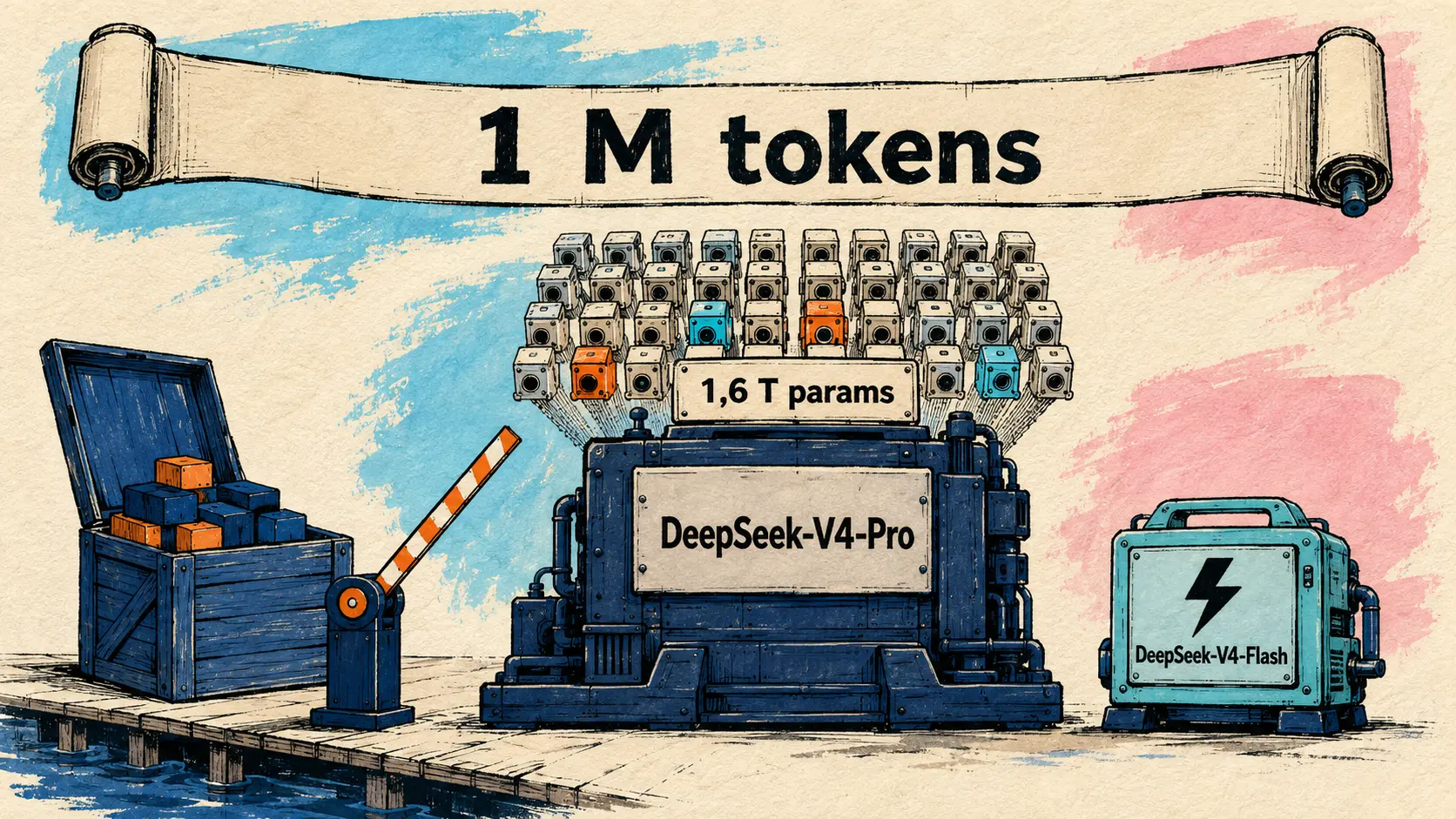
24 April — DeepSeek simultaneously announces DeepSeek-V4-Pro and DeepSeek-V4-Flash. V4-Pro is a mixture-of-experts model with 1.6 trillion parameters (49 billion active), a one-million-token context window, and performance reported to be comparable to the best closed models. V4-Flash, more compact (284B/13B active), targets low-latency use cases. Both models are open source from day one, with API and demo available immediately, and the technical report published on Hugging Face.
API promotion and integrations
25 April — DeepSeek announces a 75% discount on the V4-Pro API until May 5, 2026 (15:59 UTC). The Claude Code, OpenCode, and OpenClaw integrations have been updated to support the new model.
🔗 DeepSeek-V4-Pro API promotion
DeepSeek-V4-Pro on NVIDIA Blackwell, for free
24 April — NVIDIA makes DeepSeek-V4-Pro freely accessible via the NVIDIA NIM API interface on Blackwell, on build.nvidia.com. The announcement generated 160,000 views. NVIDIA also publishes the first performance curves (Pareto frontier) for DeepSeek-V4-Pro on Blackwell Ultra with vLLM — an early benchmark for high-performance deployments.
25 April — NVIDIA also highlights the limits of classic inference for development agents: “Traditional inference wasn’t built for agentic coding”, referring to the hundreds of API calls generated by modern agentic tools.
🔗 DeepSeek-V4-Pro on NVIDIA NIM 🔗 Blackwell Ultra Day 0
GPT-5.5 comes out of preview
General availability in GitHub Copilot
24 April — GPT-5.5 is gradually rolled out in GitHub Copilot for Pro+, Business, and Enterprise plans. Availability covers VS Code, Visual Studio, Copilot CLI, cloud agent, github.com, the mobile app (iOS and Android), JetBrains IDEs, Xcode, and Eclipse. The promotional multiplier is set at 7.5×. Enterprise and Business administrators must enable the policy in settings to benefit from it.
🔗 GitHub Copilot changelog — GPT-5.5 GA
Developer API access
24 April — The day after the public launch, OpenAI opens access to GPT-5.5 in the API. The model is available via the Responses API and the Chat Completions API, with a one-million-token context window. The GPT-5.5-Pro variant, for high-precision work, is accessible only via the Responses API.
“GPT-5.5 is available in the Responses and Chat Completions APIs with a 1M context window. GPT-5.5-pro is also available in the Responses API for higher-accuracy work.” — @OpenAIDevs
GPT-5.5 on Perplexity Max and Personal Computer
24 April — GPT-5.5 is accessible to Max subscribers on Perplexity and deployed as the default orchestration model in Personal Computer for Pro and Max plans.
Bio Bug Bounty — biosafety security program
23 April — OpenAI opens a bug bounty program dedicated to GPT-5.5 biosafety. AI security or biosafety researchers are invited to find a universal jailbreak bypassing the model’s biological safeguards. The main reward is USD 25,000 for the first success. Applications are open until June 22, 2026; testing will run from April 28 to July 27, 2026, exclusively on GPT-5.5 in Codex Desktop, by invitation with a confidentiality agreement.
Developer tools: autonomy extended
Claude Code v2.1.119
25 April — Anthropic releases Claude Code v2.1.119, a substantial CLI update with more than forty changes.
| Domain | Change |
|---|---|
| Config | persistent /config in ~/.claude/settings.json |
| PR | --from-pr supports GitLab, Bitbucket, GitHub Enterprise |
| Hooks | PostToolUse + duration_ms field |
| PowerShell | Auto-approval in permission mode |
| MCP | Parallel subagent server connection |
| Fixed bugs | 40+ |
Persistence of /config settings is the most visible change: theme preferences, editor mode, or verbose level survive restarts. The --from-pr setting now accepts GitLab merge-request, Bitbucket pull-request, and GitHub Enterprise URLs, extending the workflow to teams that do not use GitHub.com. The PostToolUse and PostToolUseFailure hooks now receive the duration_ms field, useful for CI/CD monitoring. MCP server connection now happens in parallel, reducing startup times for multi-server workflows.
Codex Auto-review — extended autonomy with a safety net
24 April — OpenAI announces Auto-review, a new execution mode for Codex. This mode allows Codex to make progress on long tasks without asking for approval at every step. A separate agent evaluates high-risk steps before execution, which makes it possible to streamline testing, compilation, and long automations workflows without sacrificing safety.
Copilot for JetBrains: Inline Agent Mode in preview
24 April — The update to the Copilot plugin for JetBrains IDEs brings several features: public preview inline agent mode (shortcut Shift+Ctrl+I or Shift+Cmd+I), improved Next Edit Suggestions (NES) with watermark previews and remote edits, and global auto-approval for agent tool calls.
NVIDIA Dynamo — inference rethought for agents
25 April — NVIDIA introduces Dynamo, a redesign of the inference stack to match the workload profiles of agentic tools. Agents like Claude Code, Codex, or Copilot chain together hundreds of API calls per session with context recomposed at each step, creating bottlenecks that drive up cost per token. Dynamo combines four components: cache-aware routing, agent-oriented scheduling, multi-level caching, and unified orchestration. NVIDIA announces up to 7× more throughput with higher cache hit rates and reduced latency.
🔗 NVIDIA Dynamo — agentic inference
Sovereignty and enterprise partnerships
Cohere + Aleph Alpha: transatlantic merger with USD 600 million from Schwarz Group
24 April — Cohere (Canada) and Aleph Alpha (Germany) announce their merger project. Schwarz Group — the group that owns Lidl and Kaufland — invests USD 600 million (about EUR 500 million) in structured financing for Cohere’s Series E. The combined platform will be hosted on STACKIT, Schwarz Digits’ sovereign cloud.
“Sovereign AI for the world. Cohere & Aleph Alpha form transatlantic AI powerhouse anchored in Canada & Germany!” — @cohere on X
The agreement targets regulated sectors, governments, and a sovereign AI market estimated at around USD 600 billion. It remains conditional on approval by Aleph Alpha shareholders.
Anthropic and NEC: first global Japanese partnership
24 April — Anthropic announces a strategic partnership with NEC Corporation, which becomes Anthropic’s first global Japanese partner. NEC will deploy Claude to around 30,000 employees of the group worldwide.
| Aspect | Detail |
|---|---|
| Employees affected | ~30,000 (global NEC Group) |
| Products deployed | Claude, Claude Opus 4.7, Claude Code, Claude Cowork |
| Target sectors | Finance, manufacturing, cybersecurity, local government |
| Program | NEC BluStellar Scenario |
Internally, NEC is setting up a Center of Excellence to train a large-scale AI engineering team as part of the “Client Zero” initiative. For its clients, NEC and Anthropic will jointly develop solutions for the finance, manufacturing, and Japanese local government sectors.
Meta partners with AWS for agentic AI at billions of users
24 April — Meta announces an agreement with AWS to integrate tens of millions of Graviton5 cores into its infrastructure. The goal is to support the CPU-intensive workloads of agentic AI for billions of users.
Gemini: product updates and research
April 2026 Gemini Drops — Lyria 3 Pro, Gemini Live v3.1
24 April — Google publishes the 10th edition of Gemini Drops. Lyria 3 Pro makes it possible to create music tracks up to 3 minutes directly in Gemini, available to Plus, Pro, and Ultra subscribers. Gemini Live v3.1 is 20% faster and offers twice as much remembered context. Personal Intelligence expands internationally (excluding the European Economic Area, Switzerland, the United Kingdom, South Korea, Australia, and Nigeria). The branching conversation feature is rolled out to 20% of users.
Gemini Embedding 2 in general availability
22 April — Gemini Embedding 2 reaches general availability (GA) in the Gemini API and Vertex AI. The vector representation model targets semantic search, retrieval-augmented generation (RAG), and classification.
Decoupled DiLoCo — multi-region distributed training
23 April — Google DeepMind publishes Decoupled DiLoCo, a distributed training method over low-bandwidth networks. Gemma 12B was trained across 4 US regions with a mix of TPU6e and TPUv5p. The method opens the way to global decentralized model training without requiring the high-speed interconnects usually needed.
🔗 Decoupled DiLoCo — Google DeepMind
Alternative models: Qwen and Grok
Qwen3.6-27B — flagship dense model for agentic coding
22 April — Alibaba releases Qwen3.6-27B, an open-source dense model with 27 billion parameters under the Apache 2.0 license. Despite its compact size, it outperforms Qwen3.5-397B-A17B — a MoE model with 397 billion parameters of which 17 billion are active — on the main agentic coding benchmarks, with a SWE-Bench Verified score of 77.2% versus 76.2% for its predecessor. The announcement highlights three axes: agentic coding that outperforms the previous generation on all major benchmarks, strong text and multimodal reasoning, and dense deployment without MoE complexity.
The model supports both thinking and non-thinking modes in a single checkpoint. It is available on Hugging Face (Qwen/Qwen3.6-27B, FP8 variant included) and ModelScope, with a dedicated technical blog and GitHub. The announcement generated 3.5 million views on X.
Qwen-Image-2.0-Pro — #9 global Text-to-Image
25 April — Alibaba Qwen releases Qwen-Image-2.0-Pro, which reaches 9th place globally in the Text-to-Image Arena ranking and 6th place in portrait. The model is available via the Alibaba Cloud API and ModelScope.
Grok Voice Think Fast 1.0 — #1 Tau Voice Bench
23 April — xAI launches the grok-voice-think-fast-1.0 model via the xAI Console API. The model claims first place on the Tau Voice Bench, with integrated reasoning and no added latency. It is already deployed in production at Starlink for customer support. The architecture is unified, distinct from the Grok STT/TTS APIs announced in April.
Grok Imagine — lip sync improvement
25 April — Grok Imagine announces an improvement in lip sync and audio quality for all image-to-video generations.
Media generation and voice agents
Kling AI 4K — native upscaling from low resolution
24 April — Kling AI launches Kling 4K, a native 4K image upscaling feature from low-resolution sources. The announcement summarized as “Blurry in. 4K out.” generated 5.82 million views. This feature is distinct from Kling Video 3.0.
Runway integrates GPT Image 2
24 April — Runway integrates OpenAI’s GPT Image 2 into its video creation platform.
ElevenLabs × Customers Bank — banking voice agents
April 24 — ElevenLabs announces a deployment of ElevenAgents at Customers Bank (USD 25 billion in assets). Three agents are deployed: 24/7 customer support, onboarding new customers, and real-time coaching for advisors.
ElevenLabs — Ambassador Program
April 23 — ElevenLabs opens applications for its ambassador program, which includes two tiers: Community Builders and Ambassadors, with credits, swag, and early access to new features. The announcement generated 116,000 views.
🔗 ElevenLabs Ambassador Program
Anthropic research: safety and agents
Election safeguards — evaluation results
April 24 — Ahead of the 2026 U.S. midterms, Anthropic publishes an update on its election safeguards. Claude Opus 4.7 and Sonnet 4.6 score 95% and 96% respectively in evaluations measuring the balance of political responses.
| Model | Political compliance | Refusal of influence operations | Web search enabled |
|---|---|---|---|
| Opus 4.7 | 100% | 94% | 92% |
| Sonnet 4.6 | 99.8% | 90% | 95% |
A TurboVote banner (a nonpartisan Democracy Works resource) will be displayed on Claude.ai to direct users to reliable information on voting in the 2026 midterms.
🔗 Election safeguards update — Anthropic
Project Deal — Claude agents as negotiators
April 24 — Anthropic publishes the results of Project Deal, an internal experiment on AI agents in a Craigslist-like marketplace. For one week, Claude agents represented employees in the San Francisco office to buy and sell items among colleagues. In total, 186 deals were completed across four model configurations running in parallel.
| Metric | Value |
|---|---|
| Duration | 1 week |
| Configurations | 4 (all-Opus 4.7, all-Haiku, 2 mixes) |
| Deals completed | 186 |
| Opus vs Haiku advantage | +2 deals on average, higher prices |
| Effect of aggressive prompts | Not statistically significant |
“New Anthropic research: Project Deal. We created a marketplace for employees in our San Francisco office—like Craigslist—where Claude agents negotiated deals on their behalf.” — AnthropicAI on X
The most notable finding: aggressive instructions (“negotiate hard”) had no statistically significant effect on the results — not because the instructions were poorly followed, but because of the constraints inherent to the market.
What it means
April 25 illustrates a rapid consolidation around a few major trends. On frontier models, DeepSeek-V4 and GPT-5.5 establish a new floor for freely accessible capabilities: a million tokens of context is no longer a premium differentiator. The arrival of DeepSeek-V4-Pro for free on NVIDIA Blackwell, combined with the -75% API promotion, signals direct price competition with closed models.
On the developer tools side, the extension of agentic autonomy is taking shape on several fronts simultaneously — Claude Code v2.1.119, Codex Auto-review, Inline Agent Mode in JetBrains. These updates converge on the same goal: reduce human interruptions in long pipelines while maintaining checkpoints for risky operations. The legal framework question for agents acting on our behalf, raised by Project Deal, takes on particular resonance in this context.
The Cohere + Aleph Alpha merger with USD 600 million from Schwarz Group is the most structuring signal for European sovereign AI. It creates a transatlantic player positioned on governments and regulated sectors, with dedicated cloud infrastructure (STACKIT), in a market estimated at USD 600 billion. The parallel Anthropic + NEC partnership shows that the same sovereignty logic extends to Asia.
Sources
- Claude Code v2.1.119 changelog
- Anthropic and NEC
- Election safeguards — Anthropic
- Project Deal — Anthropic
- GPT-5.5 API OpenAI
- Codex Auto-review
- GPT-5.5 Bio Bug Bounty
- Gemini Drops April 2026
- Gemini Embedding 2 GA
- Decoupled DiLoCo — Google DeepMind
- DeepSeek-V4 launch
- DeepSeek-V4-Pro API promotion
- Meta × AWS Graviton5
- Qwen-Image-2.0-Pro
- Grok Voice Think Fast 1.0
- Grok Imagine lip sync
- Qwen3.6-27B
- GPT-5.5 GA GitHub Copilot
- Copilot JetBrains Inline Agent Mode
- GPT-5.5 on Perplexity Max
- Cohere × Aleph Alpha
- DeepSeek-V4-Pro on NVIDIA NIM
- NVIDIA Blackwell Ultra Day 0
- NVIDIA Dynamo — agentic inference
- Runway × GPT Image 2
- Kling AI 4K
- ElevenLabs × Customers Bank
- ElevenLabs Ambassador Program
This document was translated from the fr version into the en language using the gpt-5.4-mini model. For more information about the translation process, see https://github.com/jls42/ai-powered-markdown-translator