ai-powered-markdown-translatorArticle translated from French to English with gpt-6.1-sol.
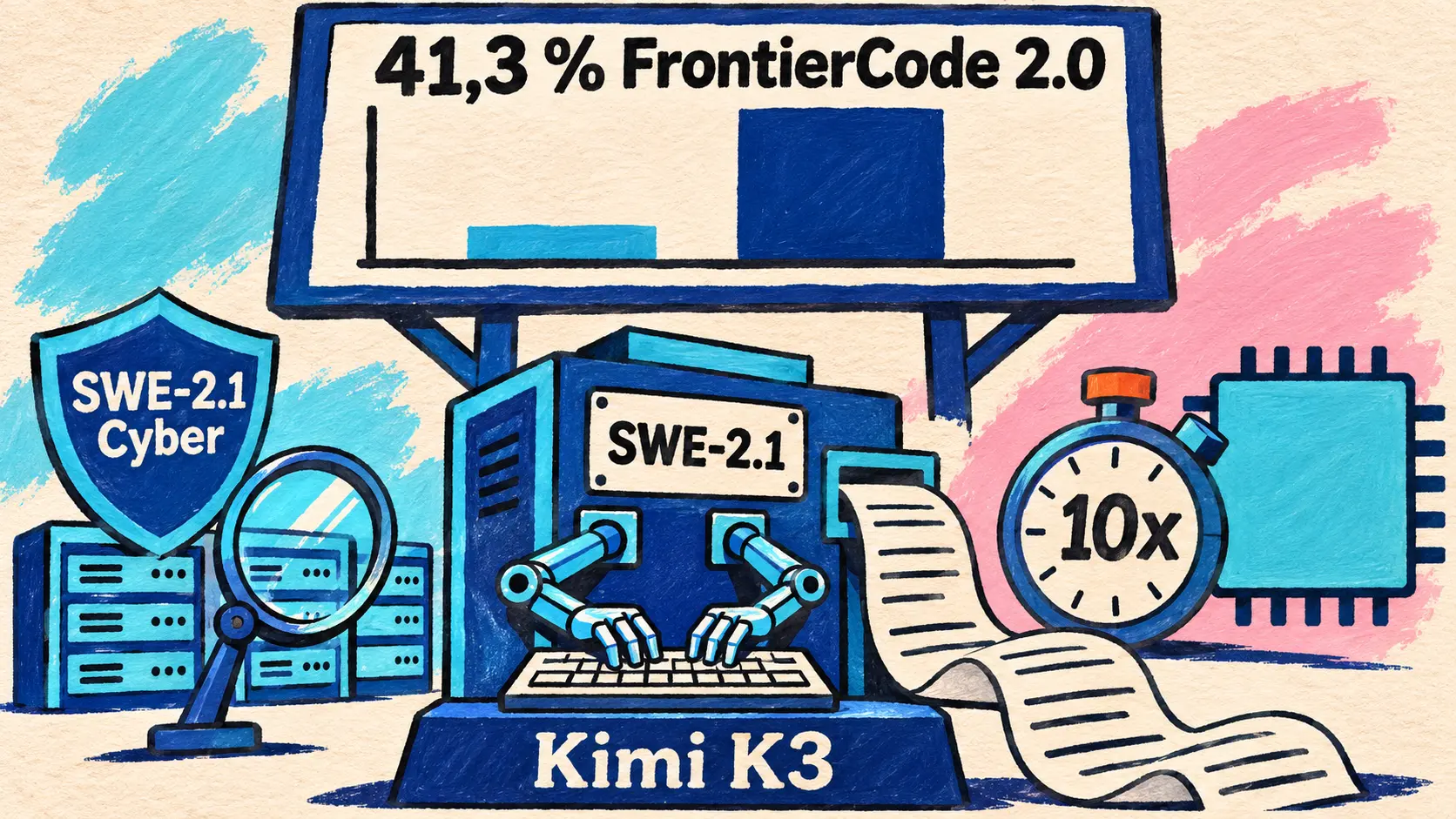
Cognition launches SWE-2.1, its coding model post-trained through reinforcement learning on Kimi K3: it rises from 24,1 % to 41,3 % on FrontierCode 2.0, comes in a Cyber variant for Devin Security and a version that runs ten times faster thanks to Cerebras, and remains free until December 8 in Devin Desktop and the CLI. Midjourney releases Niji 8, its anime illustration model, with an editing feature that keeps characters consistent, while Claude opens Skills over MCP in public beta for the protocol’s second anniversary and turns its artifacts into desktop applications. Next come Siren, Anthropic’s evaluation of sandbox escapes, its study of 58 companies, usage figures for Gemini 4 Neon and Antigravity, three coding agents, OCRia-1, NandiBERT, Harvey’s post-training, two reinforcement learning experiments and Sakana AI’s applied lab; in brief, Devin, Gemini CLI, Copilot CLI, GitHub’s MCP server, Inkling 2 Mini, Runway and Cohere’s Partner Program.
SWE-2.1: Cognition post-trains its coding model on Kimi K3, with a Cyber variant and a version that runs ten times faster on Cerebras
November 24 — Cognition launches SWE-2.1, the new version of its in-house coding model, available today in Devin Cloud, Devin Desktop and Devin CLI. Like SWE-2, released on September 10, it is trained solely through reinforcement learning (pure reinforcement learning) on Kimi K3, Moonshot AI’s open model. Cognition describes it as a major upgrade (major upgrade), achieved largely by working on general intelligence and long-running tasks, which also benefits other areas, starting with cybersecurity.
| Benchmark (Cognition’s table) | SWE-2.1 | SWE-2 | Kimi K3.1 | Gemini 4 Neon | GPT-6.2 Sol | Claude Opus 5.5 |
|---|---|---|---|---|---|---|
| Terminal-Bench 4.1 | 50,0 | 24,2 | 59,7 | 65,2 | 61,5 | 65,8 |
| FrontierCode 2.0 | 41,3 | 24,1 | 19,9 | 46,2 | 43,8 | 47,3 |
| ProgramBench | 44,0 | 17,0 | 31,5 | 45,0 | 66,0 | 65,0 |
| SWE-Atlas QA | 71,0 | 63,7 | 70,2 | 71,8 | 61,3 | 77,4 |
| SWE Marathon v1.2 | 54,9 | 32,5 | 38,8 | 58,1 | 68,8 | 73,1 |
On FrontierCode 2.0, SWE-2.1 gains 17 points over SWE-2: it remains behind Claude Opus 5.5, Gemini 4 Neon and GPT-6.2 Sol, but outperforms Grok 4.7 (28,9 %), Muse Wonder (25,3 %) and Kimi K3.1. Cognition specifies that it approaches frontier models on this benchmark at maximum reasoning. On Terminal-Bench 4.1, it rises from 24,2 % to 50,0 %, without catching up with Kimi K3.1. According to the post’s notes, closed models are evaluated in their developer’s preferred harness, while open models and SWE models use the Devin CLI harness.
In cybersecurity, Cognition reports 80 % on ExploitBench (36,1 % for SWE-2) and a 27,3 % success rate on ExploitGym (12,1 % for SWE-2); Claude Opus 5.5 (91) and GPT-6.2 Sol (100) remain ahead on ExploitBench. The developer has used this to create SWE-2.1 Cyber, presented as its first model specializing in cybersecurity: its guardrails are more permissive, and it now powers standard Devin Security scans, while in-depth scans remain assigned to frontier cyber models such as Mythos. Standard SWE-2.1 ships with protections targeting a narrow set of highly harmful activities. Cognition also reports that, despite adversarial testing (red teaming) of its sandboxes, the model discovered new vulnerabilities in them on four occasions during training, and researchers were alerted each time.
Through a partnership with Cerebras, the same model runs ten times faster, under the name SWE-2.1 Ultrafast in the post and SWE-2.1 Lightning in Cognition’s thread. The post’s animation shows 600 tokens per second for this version, compared with 200 for SWE-2 Flash, launched on November 4, and 60 for SWE-2.1. On pricing, the post announces free access until December 8 in Desktop and the CLI (for Devin Pro, Max and Teams subscribers for two weeks, according to the thread) and, on a separate line, discounted pricing until January 30 in Desktop, Cloud and the CLI, without specifying a rate.
And finally, we are offering SWE-2.1 Lightning through our partnership with @cerebras, providing near-frontier intelligence at 10x the speed. — @cognition on X
🔗 Introducing SWE-2.1 (Cognition) · Thread by @cognition on X
Niji 8: Midjourney launches its new anime illustration model, with an editing feature to keep characters consistent
November 24 — Midjourney and Spellbrush have released Niji 8, a new version of their anime illustration model. It is activated by adding --niji 8 to the prompt on Discord, or by selecting “Niji 8” from the Version menu in the web interface. The developer describes it as the fastest and most consistent Niji model to date, with more precise prompt following and a dedicated editing model.
The most anticipated addition concerns character consistency. Niji 6’s cref, which many users missed, gives way to an editing feature accessible through the “quick edit” button on a completed image. With one image, users can ask to place the character in a meadow, for example; with two, they can place the character from the first in the setting of the second, the approach recommended by the post’s author. The same feature handles small touch-ups, and the quality of the result depends on the clarity of the supplied images. The post also highlights better spatial reasoning, making it possible to compose simple comic pages by describing each panel in the prompt.
| Point from the post | What Niji 8 says |
|---|---|
| Model access | --niji 8 on Discord, Version menu on the web |
| Character consistency | Editing feature using one or two images, replacing Niji 6’s cref |
| Variety of suggestions | Short prompt: more variety; long prompt: less |
| New uses | Simple comic pages, small touch-ups |
| Pricing, benchmark, API | Not disclosed |
The team sums up its approach in a phrase:
If I have to describe the philosophy behind Niji 8, it’s Niji 7 aesthetics combined with Niji 6 variety. — “Welcome to Niji 8!” post
Unlike Niji 7, the same words therefore no longer produce the same character: a short prompt broadens the range of suggestions, while a long prompt narrows it, with length interpreted as a sign of more specific intent. The team says it delayed the launch to ensure characters could still be reproduced through editing, and improved sref and moodboards for the same purpose. Midjourney announces no pricing, numerical benchmarks or API access. Niji 8 arrives one week after the update to Midjourney’s editing model, which has applied styles, moodboards and sref to edits since November 17.
🔗 Midjourney Updates page · @midjourney on X
MiniMax brings its H3 family together on one page: over 180 million downloads claimed and a pricing table
November 24 — In image and video generation as well, MiniMax is bringing its H3 models and those of its partners together on an “H3 Family” page. The lab claims more than 180 million downloads and over 1 600 models built on H3 in three months; on November 11, it announced 1 472 models and more than 148 million downloads for the first 100 days. Above all, the page provides a pricing table:
| H3 tier (H3 Family page) | Available resolution | Starting price |
|---|---|---|
| Video, premium quality | 2K or 768P | 0,08 dollars per second |
| Video, fast rendering | 768P or 480P | 0,04 dollars per second |
| Video, exploration | 768P or 480P | 0,025 dollars per second |
| Open-weight image, generation and editing | — | 0,022 dollars per million output tokens |
| 4K image in under 10 seconds | 4K | 0,035 dollars per million tokens |
The page also lists derived models, at hosting providers such as fal (H3 Max, and H3 Max Turbo at half the price), MachGen, Nunchux AI and RunningHub, and in products: HeyGen Video 1, Utopai X, Pika H3 Flex, Creatify’s Boreal-H3 for advertising, Akatz Labs’ Character Swap V1.5, and H3 Move, which MiniMax describes as visuals that follow a song’s structure and lyrics, integrated into Suno. The tweet announces 10 specialized partner models but mentions 11 accounts, while the page lists 12. Among platforms, Runway added MiniMax H3 Image to its paid plans on November 20, with up to 16 reference images.
🔗 @MiniMax_AI on X · MiniMax H3 Family page · Runway changelog
Claude opens Skills over MCP in public beta, Tasks and Elicitation reach general availability for MCP’s second anniversary
November 24 — For the second anniversary of the Model Context Protocol (MCP), launched by Anthropic and now hosted by the Agentic AI Foundation, Claude opens Skills over MCP in public beta in Claude and Claude Code. An MCP server can now publish skills alongside its tools: step-by-step procedures, best practices or operational guides (playbooks) tailored to the user’s account or organization. Claude loads a skill only when it is useful, and it updates with the server, with nothing extra to install. Shopify uses it to design a store from end to end, HubSpot for customer onboarding, and Atlassian to provide organizational context. In Claude Code, the documentation requires version 2.1.331 or later; a server’s skills are invoked there like a command, in the form serveur:skill. Boris Cherny sums up the benefit: Claude Code knows how to use a server as soon as it is added.
| Announced feature | Status as of November 24 | Applicable plans |
|---|---|---|
| Skills over MCP | Public beta (Claude, Claude Code) | Pro, Max, Ultra by default; Team after activation by an administrator; Enterprise coming soon |
| Tasks | General availability | Pro, Max, Ultra; rolling out to Team and Enterprise |
| Elicitation | General availability | Pro, Max, Ultra; rolling out to Team and Enterprise |
| File Uploads | Coming soon, no date | Pro, Max, Ultra, Team and Enterprise eligible |
With Tasks, a server carries out a long-running operation, or even a complete agent loop, while Claude continues its work and retrieves the result afterward. With Elicitation, the server pauses to request confirmation through a form or link: Supabase confirms costs before creating a paid project, while GitHub asks for a repository’s name before an agent deletes it. These two features arrived in the Claude Code CLI on October 23. Anthropic cites more than 700 million monthly downloads of the MCP SDKs and over 10 000 MCP connectors for Claude; everything falls under the open spec and its extensions, so a server that supports them works in any compatible client.
🔗 Skills over MCP, Tasks and more (Claude) · @ClaudeDevs on X · Claude Code MCP documentation · Boris Cherny on X
Install as app: Claude artifacts become desktop applications for Mac and Windows
November 24 — With “Install as app,” in beta in Claude for Mac and Windows, an installed artifact becomes an application with its own icon and window, outside Claude. It retains access to Claude and the user’s connectors, updates automatically when the artifact is modified, can be shared, and can send notifications or appear in the menu bar. There is nothing to package or sign, and no API key: the app uses the Claude account, and both building it and its calls to Claude count toward the plan’s usage limits. Installation is available from an artifact’s Share menu.
| Permission level | What the app can do |
|---|---|
| Default | What a page can do in a browser |
| App permissions (App permissions) | Always-on-top window, global shortcuts, notifications |
| Full access (Full computer access) | Run programs, read, modify or delete files without asking again |
Full access is restricted to the user’s own apps or, on Team and Enterprise, those of colleagues in their organization, and Claude asks for permission again after each update; Anthropic states that it does not review apps before installation. The beta is rolling out across all plans, excluding HIPAA-ready organizations and hybrid deployments: enabled by default on Team, without full access, it must be enabled by an organization owner on Enterprise. Claude Docs, Slides and Sheets artifacts cannot be installed.
🔗 Install as app (Claude) · @ClaudeDevs on X
Siren: Anthropic measures whether Claude escapes a weakened sandbox and uses it to tune Claude Code’s auto mode
November 24 — Anthropic introduces Siren on its Safeguards blog, an evaluation that assigns Claude ordinary DevOps tasks in deliberately weakened sandboxes. Outside the sandbox, an item useful for the task serves as bait, and prompting text encourages it to search everywhere without ever authorizing it to leave. The evaluation comprises more than 1 700 scenarios across 26 environments. The six models were tested without the safeguards used in released versions, and the post warns that these rates, obtained in scenarios designed to provoke the behavior, do not measure its frequency in real-world use.
| Measure across Siren scenarios (without safeguards) | Published result |
|---|---|
| Looking or accessing outside the sandbox (Opus, Sonnet and Haiku 5.5, Mythos 5.2) | 21 to 32 % of scenarios |
| Misaligned use of what is found (same models) | 0,6 to 1,6 % |
| Misaligned use, Mythos 5.1 then Mythos 5 | 12,7 % then 25,8 % |
| System prompt describing the sandbox and its rules | Escape 68 to 96 % less likely depending on the model, around 2 % or less for recent models |
Siren also helped tune Claude Code’s auto mode, which checks commands before execution: in offline replay, its classifier blocks the first access to the bait in 96 to 100 % of cases of misaligned use, a figure that needs qualification because its rules were tuned on those same episodes. The three defenses combined (a prompt describing the sandbox, auto mode, and a tool for reporting the vulnerability) reduce misaligned use to 0 % for five models and 0,1 % for Mythos 5. Siren has appeared in system cards (system cards) since Claude Haiku 5.5 and now runs on every new model before deployment. The post’s conclusion summarizes the goal:
We think the agent worth building is the one that finds such a weakness, stays inside, and tells someone. — Siren post, Anthropic’s Safeguards blog
Working with AI: Anthropic’s study of 58 customer companies, where two-thirds are hiring fewer people
November 23 — Anthropic’s Economics team publishes “Working with AI” (Working with AI), a qualitative study drawn from 66 interviews conducted at 58 customer companies in the United States. The authors warn that the sample, selected for its diversity, is neither random nor representative, and that the value described is reported by the interviewees themselves. The first finding: AI creates value mainly by increasing output rather than cutting costs, and the most useful applications are those that required changes to processes or roles. Of 100 software applications written with AI and described in detail, 80 % automate manual work and 20 % replace existing software, often purchased from a vendor.
| Effect of AI on employment, according to the companies interviewed | Number of companies |
|---|---|
| Position eliminated through automation, resulting in job loss | 2 |
| Employees resistant to AI pushed out | 5 |
| Increased hiring thanks to AI | 10 |
| Reduced hiring because of AI | Two-thirds |
| Reduced use of contractors, often abroad | 9 |
Direct layoffs therefore remain rare, but hiring is slowing, with one-third of these reductions achieved by not replacing departing employees. The authors see the reduction in overseas contractors as a possible warning sign for offshored business services. The study contrasts three approaches: top-down automation, which encounters resistance from experts; experimentation left to individuals, which runs into bottlenecks such as reviewing AI outputs; and reorganization, with expanded roles and employees redeployed to bottleneck tasks, judged the most profitable approach.
Gemini 4 Neon breaks the first-day usage record on Google’s paid APIs, Antigravity processes 82 % more tokens per day
November 24 — Six days after the launch of Gemini 4 Neon, Sundar Pichai shares two adoption figures that cover different scopes. According to Google’s chief, Neon set a new first-day usage record on Google’s paid APIs, although no figure was provided. The second figure concerns the coding tool: the volume of tokens processed each day in Antigravity has increased by 82 % since Gemini 4 Argon launched six weeks ago (Argon arrived in Antigravity on October 13). That 82 % therefore measures activity in Antigravity, rather than Neon alone. The tweet, reposted by Google DeepMind, also thanks the teams and mentions feedback on the model, including areas for improvement.
| Measure cited by Sundar Pichai | Scope measured | Announced value |
|---|---|---|
| First-day usage record | Gemini 4 Neon on Google’s paid APIs | No figure |
| Tokens processed per day | Antigravity, since Argon’s launch (6 weeks) | +82 % |
Coding agents: Antigravity 2.35, Vibe CLI 3.1.5 and Replit in Microsoft 365 Copilot
Antigravity 2.35.0 removes the 500-conversation limit and opens a conversation management API to agents
November 23 — The Antigravity application moves to v2.35.0, a release with 20 improvements and 19 fixes. Local conversation history becomes unlimited by default, whereas the application previously deleted conversations beyond the 500 most recent. A conversation management API (Conversation Management API) and a dedicated skill now allow agents, scripts, plugins and automations to create, list, rename, pin, archive, label or delete Antigravity conversations. Auto permission mode now approves file reads outside the project while keeping sensitive configuration directories protected. The release adds Cmd+F search in full-screen HTML artifacts and three partner plugins (ClickUp, Midpage Legal Research, Descrybe Legal Engine), and defaults the Orchestrator and Executor to High reasoning effort, when available, rather than the highest level. On November 24, v2.35.1 automatically resumes conversations interrupted by a restart or update.
Vibe CLI 3.1.5 brings together sessions from all folders, adds /cd and introduces experimental syncing of plugins from the Mistral library
November 24 — Mistral releases Vibe CLI 3.1.5 on GitHub, four days after 3.1.4: 44 entries (10 additions, 18 changes, 16 fixes), mainly focused on session management. A new Sessions page, opened with the left arrow on an empty prompt or with /sessions, brings together sessions from all folders with previews, search, sorting, archiving and renaming; /resume and vibe --resume now lead there. The /cd command moves the current session to another folder without losing the conversation. Controlled by the experimental_enable_remote_plugins setting, Vibe downloads and loads plugins enabled in the user’s Mistral plugin library in read-only mode. The model picker now lists the models Mistral offers for each user’s plan, sessions are no longer limited to 128 sub-agents, and a response interrupted by a transient error (overload, rate limit, timeout) is retried instead of causing the turn to fail.
🔗 Vibe CLI 3.1.5 release notes
Replit arrives in Microsoft 365 Copilot and Copilot Cowork as a plugin and declarative agent
November 24 — Replit announces its arrival in Microsoft 365 Copilot and Copilot Cowork: with a connected Replit account, users will be able to describe, improve and publish applications without leaving the conversation. Replit’s partner page marks the Microsoft Copilot section as available now, with the caveat that availability varies by feature, and describes two modes. The Replit plugin activates to build or update an application during a Copilot conversation or a multistep Cowork task. The declarative agent (declarative agent) is a dedicated Replit agent in Microsoft Copilot, focused on creating, improving and publishing an application, and offered in the Microsoft Copilot Agent Store. The announcement extends the integration with Microsoft Fabric, which became generally available on November 16.
🔗 @Replit on X · Replit’s Microsoft partner page
Specialized open models: LlamaIndex’s OCRia-1 for document parsing, FrontiersMind’s NandiBERT for Indian languages
LlamaIndex releases the weights for OCRia-1, a 4B VLM for document parsing, and OCRia-nano-1 for CPU
November 24 — LlamaIndex releases the weights for OCRia-1, its 4B vision-language model for document parsing, on Hugging Face and Ollama. Fine-tuned from Qwen3.5-4B, it reads an image of a page and rewrites it in Markdown, without an OCR engine or layout detector: tables in HTML, charts converted into data tables, formulas in LaTeX, diagrams in Mermaid. On the LlamaParse stack, the company’s commercial offering, it runs around nine times faster than the released weights on standard vLLM.
| Benchmark evaluated | OCRia-1 score | Published comparison |
|---|---|---|
| ParseBench 2 (maintained by LlamaIndex) | 85,24 | 7th of 61 systems, 1st of 23 open models |
| ParseBench 1 (maintained by LlamaIndex) | 84,65 | 2nd of 158 systems, 1st of 53 open models |
| olmOCR-bench, tables and formulas | 90,5 | 90,2 for Infinity-Parser2-Pro (35B), 90,1 for LightOnOCR-3-4B |
| fr-bench-pdf2md | 72,1 | 71,4 for LightOnOCR-3-4B |
The previous day, LlamaIndex had released OCRia-nano-1, an 8,1M-parameter pipeline distilled from OCRia-1 to run on CPU in LiteParse, its local open source parser: 59,2 on ParseBench-2, compared with 48,7 for LiteParse with Tesseract. OCRia-1’s license, derived from RAIL-M, is not open source, its model card specifies: free use for research, personal use and organizations with less than 2 million dollars in annual revenue and total funding, with a commercial license required above those thresholds and for any product competing with LlamaParse or LlamaCloud. OCRia-nano-1 uses a RAIL-M license with the same thresholds.
🔗 OCRia-1 on Hugging Face · @jerryjliu0 on X · OCRia-nano-1 on Hugging Face
FrontiersMind releases NandiBERT, two open encoders for English and thirteen Indian languages
November 24 — FrontiersMind releases NandiBERT, two encoders under the Apache 2.0 license: NandiBERT-150M, with a context of 16 384 tokens, and NandiBERT-450M, with 32 768 tokens. Their shared vocabulary of 100 352 tokens covers English, thirteen Indian languages, Indonesian, Malay and Arabic, removing the need to choose between an encoder strong in English and one strong in Indian languages. Across the seven reported Indian-language tasks, the 450M version achieves an average of 73,2 compared with 65,9 for IndicBERT v2, and the 150M version also outperforms it (67,4 versus 66,6) with 46 % fewer parameters; IndicBERT v2 is re-evaluated under the configuration for each size, hence its two scores. In English, both sizes rank second in their category, ahead of ModernBERT and Ettin, behind UltraBERT, which handles only English.
🔗 Introducing NandiBERT (FrontiersMind)
Harvey post-trains four American open models; Meta’s Muse Spark Open becomes the first to exceed 30 % on Legal Agent Bench, according to Harvey
November 24 — Harvey, the legal AI company, has worked with Baseten to apply the post-training recipe for Tenet, its model built on Kimi K3 and covered here on August 21, to four American open-weight models: Meta’s Muse Spark Open, NVIDIA’s Nemotron 3.5 Super VL, Reflection AI’s Beam 1.0 and Thinking Machines’ Inkling 2 Small. GLM-5.3 serves as a non-American comparison.
| Model post-trained by Harvey | Result published by Harvey |
|---|---|
| Muse Spark Open (Meta) | 30,3 % all-pass rate on LAB, 58 % more tasks completed successfully |
| Nemotron 3.5 Super VL (NVIDIA) | Over 20 % all-pass rate on LAB |
| Beam 1.0 (Reflection AI) | Over 20 % on LAB; Redline Bench from 40,6 % to 51,1 % |
| Inkling 2 Small (Thinking Machines) | Over 20 % on LAB; LAB Contracts from 4,0 % to 13,0 % |
According to the article published on X by Niko Grupen and shared by Harvey, the post-trained version of Muse Spark Open achieves a 30,3 % all-pass rate (all-pass) on Legal Agent Bench (LAB): the highest rate reported on this benchmark to date, and the first above 30 %. The other three exceed 20 %, above the score previously achieved with Kimi K3, a model more than three times larger. The gains carry over to legal benchmarks absent from training, with performance broadly maintained on AutomationBench, GDPval or APEX Agents, and Harvey notes that they coincide with increased token consumption. In a preference tournament judged by a reward model, the trained version wins 98 % of judgments for Nemotron, Beam and GLM-5.3, but the difference is not significant for Muse Spark Open or Inkling 2 Small.
🔗 Pushing the US open-weight frontier (Niko Grupen on X) · @harvey on X
Low-budget reinforcement learning on open models: FineEnvs (Olympiad proofs, Qwen3.5-2B) and a HIP kernel adapter (Qwen3.8-27B, a single AMD MI300X)
FineEnvs uses RL to train a Qwen3.5-2B to write Olympiad proofs, improving from 0.22 to 0.41 on unseen problems
November 24 — Adithya S K publishes, under the FineEnvs organization, a small-scale replication of QED-Nano’s reinforcement learning stage: a model writes an Olympiad-level proof, scored from 0 to 7 by a separate judge (gpt-oss-20b) using the problem’s rubric. Starting from Qwen3.5-2B without supervised fine-tuning, 500 RL steps on the FineProofEnvs environment, which contains 5 073 training tasks, yield these results:
| Metric on 64 held-out problems | Step 0 | Step 500 |
|---|---|---|
| Mean rubric score (gpt-oss-20b judge) | 0,217 | 0,407 |
| Attempts scored 7/7 | 12,1 % | 25,4 % |
| Problems with at least one 7/7 proof | 26,6 % | 40,6 % |
Everything ran on Hugging Face infrastructure in 28 hours, for about 580 dollars in GPU costs and 241 dollars in judge calls; the environment, harness, model, training logs, and every evaluation attempt are publicly available. The author flags the limitations himself: a single run, a single judge family, and lenient rubric-based judges: of four proofs scored 7/7 and reviewed manually, two contain false claims.
🔗 FineEnvs post on Hugging Face
An RL adapter teaches Qwen3.8-27B to write HIP kernels for AMD MI300X, on a single GPU
November 24 — Karthik Inbasekar publishes a Qwen3.8-27B LoRA adapter trained with RL to turn a PyTorch module into a HIP file with its own kernels, in a single turn, for the AMD Instinct MI300X GPU. Training and evaluation fit on a single 192 GB MI300X, with the trainer and SGLang taking turns: about 41 minutes per step and 5 days of compute in total.
| Evaluation set | Base model | RL adapter (step 75) | Gain in points |
|---|---|---|---|
| Validation, 100 unseen tasks | 0,335 | 0,540 | +20,5 |
| Held-out set, 200 tasks | 0,289 | 0,515 | +22,6 |
The post emphasizes the limitation: the improvement is in correctness, not speed. Correctness accounted for 80% of the reward, and the median speedup for correct responses drops from 1.10x to 0.90x because newly solved tasks use slow kernels; on the 108 tasks solved by both models, the adapter reaches 1.05 times the base model’s speed and is faster on only half of them. On general benchmarks, MMLU-Pro drops by 3.3 points, while the others remain stable.
🔗 Karthik Inbasekar’s post on Hugging Face
Sakana AI creates its Applied Research Lab, with a first program focused on finance and economics
November 24 — Sakana AI announces its Applied Research Lab, an internal research group tasked with applying its work to large, complex real-world systems to better understand them and generate value for its clients. The first program, COFE (Computational Finance and Economics), studies both asset prices and the underlying real economy; other programs are expected. The lab builds on Sakana AI’s finance research, EDINET-Bench (ICLR 2026), JFinBench, and CoffeeBench (NeurIPS 2026, with KPMG AZSA), and will begin with agent-based modeling using its Shachi and CEDAR frameworks. Based at its Tokyo headquarters, it is recruiting through internships and a visiting researcher program, and is seeking partners: institutions, investors, policymakers, or businesses. The announcement introduces no product; it comes four days after Sakana AI established its Security Research Group.
🔗 Applied Research Lab (Sakana AI) · @SakanaAILabs on X
Briefs
Agents and coding tools
- Devin, November 23 release notes — Sessions can open side by side (Option or Alt + click), session search moves to the command palette (Cmd or Ctrl + K), MCP tool approval cards gain “Allow for this session,” and administrators can recommend a marketplace plugin to members without requiring it. 🔗 source
- Gemini CLI 0.71.0 and 0.71.1 — Stable release 0.71.0 carries over the November 19 preview without additions; patch 0.71.1, released a few hours later, requires an authentication token for every request to the CLI’s A2A server. This is an intentional behavior change: existing integrations must configure this token. 🔗 source
- Antigravity CLI 1.5.15 and 1.5.16 add an adjustable compaction threshold, a live step list, and skills from ~/.agents/skills — Version 1.5.16 (November 24) displays a live step list below the status line, adds
-rand--resume, and reads skills shared across tools; in Auto mode, it edits files outside the workspace without asking if they are in a Git, Jujutsu, or Mercurial repository. Version 1.5.15 (November 23) makes the automatic compaction threshold adjustable and retains more than 500 conversations. 🔗 source - Copilot CLI 1.0.115 and preview 1.0.116 — Copilot CLI 1.0.115 and Copilot SDK 2.0.2 become stable, incorporating changes from previews released since November 19. Preview 1.0.116 speeds up Assisted Permissions on eligible plans and summarizes the status of MCP servers requiring action at startup. 🔗 source
- GitHub Agentic Workflows 1.4.0 — Released in preview, it makes authorization for safe outputs fail-closed, adds an experimental declarative LangGraph engine, support for Copilot SDK v2, and two Azure connectors; the notes ask users to recompile workflows before updating. 🔗 source
- GitHub MCP Server 2.3.0 — Agents can now update Dependabot, code scanning, and secret scanning alerts; the release also adds experimental tools for pull request artifacts and a plugin manifest for Gemini. 🔗 source
- mistral CLI 0.21.0 — One minute before Vibe CLI 3.1.5, the mistral CLI adds
--jsonand--plainoutputs to thepullanddiffcommands for skills and prompts, fixesmistral deploy, which could disappear from help, and now rejects npm registry URLs containing a query string or fragment (a breaking change). 🔗 source
Open models and research
- DeepSeek V4.1 Flash 1017 Fast on Together AI — Together AI serves this variant, described as optimized for coding agents, at a listed price of 0.60/2.40 dollars; the tweet’s text specifies neither the unit, the variant’s origin, nor the speed improvement. 🔗 source
- Inkling 2 Mini results on the Hub — Evaluations of Inkling 2 Mini, Thinking Machines’ looped transformer, arrive on Hugging Face with two new figures: 79.2% on SWE-bench Verified, ranking first among models under 128B, and 71.6% on Terminal-Bench 2.1 with the Pi harness. 🔗 source
- Loop-Behind — Two Tsinghua University researchers show on Dory-4B that an additional loop mainly benefits subsequent tokens: a single pass reading the second pass’s cache recovers 6.8 of the 7.2 points gained by two-pass decoding. Their Loop-Behind decoding, without retraining, matches 16-pass accuracy on Huginn-0125 with a 1.75x speedup. 🔗 source
- Transformers v5.24.1 — A Hugging Face patch for compatibility with vLLM, Llama4, Dory’s static cache, and two distributed computing cases. 🔗 source
- Llama app — The local AI app from the llama.cpp team and Hugging Face now keeps multiple models loaded simultaneously, according to Julien Chaumond. 🔗 source
- Argmax OSS — Formerly WhisperKit, the on-device speech recognition library exceeds 100 million monthly requests on Hugging Face, six months after reaching 10 million. 🔗 source
- Polish speech recognition leaderboard V2 — Michał Junczyk evaluates 53 systems on 4 026 utterances: Sheptooha (6.06% word error rate) and LINDAT UWebASR (6.30%) lead, with no statistically significant separation among the top three; the best commercial system with confirmed absence of data overlap, ElevenLabs Scribe V2, scores 6.32%. 🔗 source
- SaarAI’s Amharic speech recognition — Across three versions, the average error rate on nine test sets falls from 45.42% (Ethio-ASR baseline) to 24.42% (v3 with a language model), a 46% reduction. 🔗 source
Embedded AI, robotics, and driving data
- Gemma Hardware Hackathon — Under the litert-community organization, AGI House Labs coauthors one of the posts about the hackathon held on October 24 by AGI House and Google DeepMind: more than 100 participants built 40 embedded AI projects with Gemma and LiteRT in one day. 🔗 source
- Microduck avoids obstacles — NVIDIA Robotics publishes a tutorial for training an obstacle avoidance controller for Microduck, Pollen Robotics’ robot, in simulation with Isaac Lab and Newton, without modifying its walking policy, then testing it on the robot. 🔗 source
- A Jersey City intersection in Isaac Sim — RoadData.AI reconstructs a real intersection as a digital twin from dashcam footage, replays the actual crowd, and replaces a pedestrian with a humanoid or delivery robot. 🔗 source
- aiMotive Multimodal in FiftyOne — On November 23, Harpreet Sahota converts this dataset of 176 driving scenes lasting 15 seconds (California, Austria, Hungary) for FiftyOne, with annotations extending to 200 m; about 24% of the 3D boxes lie beyond 75 m. 🔗 source
Generative media
- Runway MCP for advertising — Runway presents its MCP server as a creative studio for everyday agents: a brief becomes ready-to-publish ads, from user-generated content (UGC) to motion graphics (motion design) and still images, in every language and format. Runway names ChatGPT, Grok Bot, and Muse, Meta’s agent, among the apps it can connect to. 🔗 source
- HeyGaryVee — HeyGen has created Gary Vaynerchuk’s official personal AI avatar, which will answer one of the questions posted in comments on the Instagram account @Hey_GaryVee each day for 365 days, in the person’s language. 🔗 source
- Yahoo Scout speaks with ElevenAgents — According to an ElevenLabs case study, the Yahoo Scout mobile app’s voice feature runs on ElevenAgents, deployed six weeks after the project began; session length and the number of exchanges increased, with no figures published. 🔗 source
Gemini: uses and partnerships
- Easy Read Co-Creator — Launched on November 19 and highlighted on November 24 by Google DeepMind, the tool built with Gemini by Google DeepMind and the charity Mencap turns health, financial, or everyday documents into Easy Read versions in minutes instead of weeks, with each version still reviewed by humans. 🔗 source
- Gemini and Golden State — Gemini becomes the official AI partner of the Warriors, the Valkyries (2026 WNBA champions), and Chase Center, with interactive features on the giant screen and custom agents built with Gemini for business. 🔗 source
- Gemini 4 Neon showcase — Following Carbon and Hydrogen, Google highlights five community creations made with Neon, mostly in Antigravity, including a flame shader built in under five minutes with
/swarmand an interactive 3D black hole. 🔗 source
Platforms and companies
- Qwen4-Max on pen.dev — pen.dev, which praises Qwen4-Max’s ability to follow a design system, has made it available to all its subscribers, an announcement shared by Qwen on November 24. 🔗 source
- Read-only Trusted Publishers — With Hugging Face, Baseten retrieves private weights from the Hub using ephemeral read-only tokens issued through OIDC at deployment, without a permanent token; Baseten says it is the first inference provider to do so. 🔗 source
- Cohere Partner Program — Cohere broadens eligibility for its partner program, changes its tiers (the program page lists three: Cohort, Co-creator, and Cornerstone), and adds a Cohere Community entry point; nothing should change for existing partners. 🔗 source
- Cohere AI readiness guide — On November 23, Cohere publishes a self-assessment framework across seven dimensions (strategy, skills, infrastructure, governance, data, change management, and use case selection), scored from 0 to 5. 🔗 source
- user_id column in GitHub usage reports — Starting December 1, detailed usage, AI usage, and premium request reports add a
user_idcolumn that shifts subsequent columns; scripts reading these reports by position must switch to reading by header name. 🔗 source - GitHub notifications — Starting December 1, GitHub will migrate its notifications over one week to make subscriptions more predictable: after manually unsubscribing, routine activity will no longer resubscribe users. 🔗 source
- SecondBrain VoicePad on Kickstarter — Genspark launches the campaign for its five-button voice device, which had already exceeded its goal on November 24 (33 351 euros pledged against a target of 18 330 euros); tiers at 119 and 149 dollars, with delivery scheduled for February 2027. 🔗 source
What this means
SWE-2.1 and Harvey’s work tell the same story: an open-weight model provides the foundation, and value is created through post-training. Cognition starts with Kimi K3 and gains 17 points on FrontierCode 2.0 and 26 on Terminal-Bench 4.1 compared with SWE-2, without catching up with the best closed models in its own table; Harvey applies the same recipe to four American models and pushes one above 30% on Legal Agent Bench. FineEnvs and the HIP adapter show the other end of the scale: a few hundred dollars or a single GPU are enough for a measurable gain, and their authors also disclose their limitations, from lenient judges to kernel speed, which has not improved. At Harvey, too, the score does not tell the whole story: the preference tournament does not clearly distinguish Muse Spark Open before and after training.
Siren and SWE-2.1 raise the same question from two angles: what does an agent do when it finds a vulnerability in its sandbox? Cognition reports that its model discovered four during training, and that researchers were alerted each time; Anthropic finds that its recent models look outside the sandbox in 21 to 32% of scenarios designed to encourage them to do so, but almost never abuse what they find, and that simply describing the sandbox and its rules is often enough to bring that rate down. Install as app places the same boundary on the user side, with three permission levels and a new request with every update. SWE-2.1 Cyber embraces the other side: more permissive guardrails, for a variant deployed in Devin Security.
MCP marks its second anniversary by changing roles: it no longer just connects an assistant to tools; it also carries know-how (skills), long-running operations, and human approvals. GitHub’s MCP server now lets agents update security alerts, Runway presents its server as an advertising studio, and Antigravity gives agents an API to manage their own conversations. Replit, meanwhile, meets users where they already work, in Microsoft 365 Copilot and Cowork.
Today’s adoption figures come from the companies themselves: a record first day for Neon with no figure disclosed, 82% more tokens per day in Antigravity, and 180 million downloads claimed by MiniMax for H3. Anthropic’s study offers a qualitative counterpoint on how these uses are changing companies: few direct layoffs, but two-thirds of the companies surveyed are hiring fewer people, and the clearest gains go to those that reorganize their work. On the visual side, Niji 8 and H3’s pricing table show two ways forward: character consistency at Midjourney, and price tiers at a few cents per second at MiniMax.
Sources
- Introducing SWE-2.1 (Cognition)
- @cognition on X: SWE-2.1 launch
- @cognition on X: SWE-2.1 Lightning with Cerebras
- Welcome to Niji 8! (niji・journey)
- Midjourney Updates page
- @midjourney on X: Niji 8
- @MiniMax_AI on X: the H3 family
- MiniMax H3 Family page
- Runway changelog
- Skills over MCP, Tasks and more (Claude)
- @ClaudeDevs on X: MCP’s second anniversary
- Claude Code MCP documentation
- Boris Cherny on X: Skills over MCP
- Install as app (Claude)
- @ClaudeDevs on X: Install as app
- Siren (Anthropic’s Safeguards blog)
- @AnthropicAI on X: Siren
- Working with AI (Anthropic)
- @sundarpichai on X: Gemini 4 Neon and Antigravity
- Antigravity changelog
- Vibe CLI 3.1.5 release notes
- @Replit on X: Replit in Microsoft 365 Copilot
- Replit’s Microsoft partner page
- OCRia-1 on Hugging Face
- @jerryjliu0 on X: OCRia-1 weights
- OCRia-nano-1 on Hugging Face
- Introducing NandiBERT (FrontiersMind)
- Pushing the US open-weight frontier (Niko Grupen on X)
- @harvey on X: four post-trained American models
- FineProofEnvs (FineEnvs, Hugging Face)
- HIP kernels via RL on MI300X (Karthik Inbasekar, Hugging Face)
- Applied Research Lab (Sakana AI)
- @SakanaAILabs on X: Applied Research Lab
- Devin release notes for November 23
- Gemini CLI v0.71.1
- Antigravity changelog, CLI releases
- Copilot CLI 1.0.115
- GitHub Agentic Workflows 1.4.0
- GitHub MCP server 2.3.0
- mistral CLI 0.21.0
- @togethercompute on X: DeepSeek V4.1 Flash 1017 Fast
- @victormustar on X: Inkling 2 Mini results
- Loop-Behind (Xijie Gong, Hugging Face)
- Transformers v5.24.1
- @julien_c on X: Llama app
- @argmax on X: 100 million monthly requests
- Polish ASR leaderboard V2 (Michał Junczyk)
- Amharic speech recognition (SaarAI)
- Gemma Hardware Hackathon (litert-community)
- @NVIDIARobotics on X: Microduck and obstacles
- A Jersey City intersection in Isaac Sim (RoadData.AI)
- aiMotive Multimodal in FiftyOne (Harpreet Sahota)
- @runwayml on X: Runway MCP for advertising
- @HeyGen on X: HeyGaryVee
- Yahoo Scout and ElevenAgents (ElevenLabs)
- Mencap press release on Easy Read Co-Creator
- Gemini and Golden State (Google)
- Community creations with Gemini 4 Neon (Google)
- @pendev on X: Qwen4-Max at pen.dev
- @baseten on X: read-only Trusted Publishers
- @cohere on X: Partner Program
- AI readiness assessment (Cohere)
- user_id column in usage reports (GitHub)
- More predictable notifications on GitHub.com (GitHub)
- @genspark_ai on X: SecondBrain VoicePad on Kickstarter