ai-powered-markdown-translatorTranslated article from fr to en with gpt-5.4-mini.
On August 22, Anthropic rolls out Claude Code Remote Control for starting sessions from the phone, while Google equips Antigravity with an equivalent feature to control its agents remotely. On the model side, two Together AI comparisons show the open model GLM-5.3 matching or outperforming GPT-5.6 Sol and Claude Fable 5 on the DeepSWE benchmark, at a fraction of the cost. Perplexity also details the architecture of Brain, its Git-versioned agent memory, and NotebookLM becomes available to all users with integration into Google Search’s AI Mode. Also on the menu: Replit revises its agent modes, Runway opens a model licensing offer, OpenAI tightens its API cost controls and its Codex security suite, and Grok Bot expands access.
Claude Code Remote Control: stronger reliability and session startup from the phone
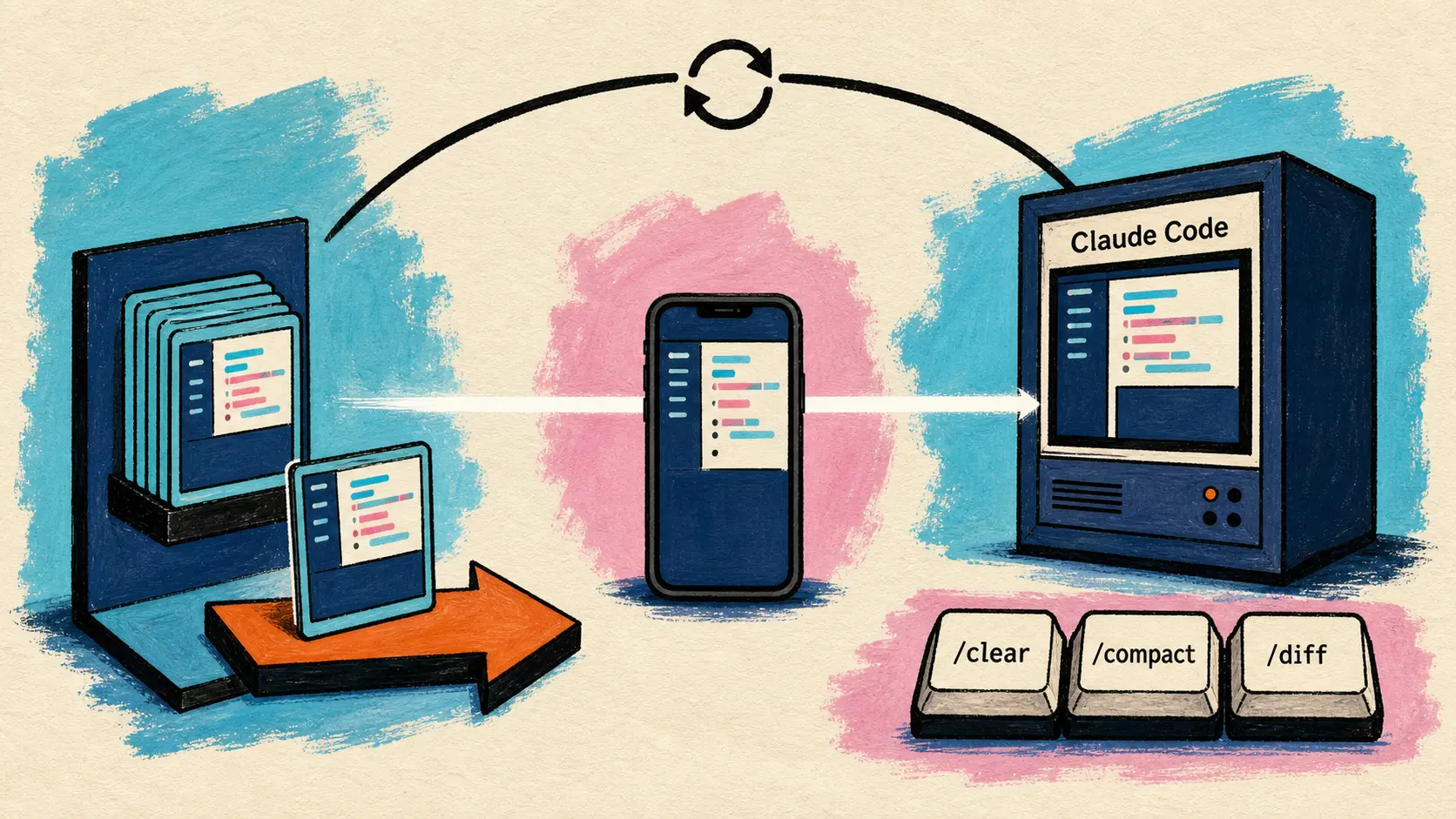
August 22 — Anthropic publishes a thread on X detailing several reliability fixes for Remote Control, the feature that lets you control a Claude Code session from a phone while it runs on a remote computer. State synchronization between the phone and the machine no longer leaves a ghost session displayed after Claude Code closes, network interruptions (Wi‑Fi changes, closing the lid) now trigger automatic reconnection, and opening large sessions is significantly faster on iOS. Three slash commands gain dedicated mobile behavior (/clear, /compact, /diff). Product update: it is now possible to start a session directly from the phone — any machine running claude remote-control appears as a device card in the Code tab, selectable to launch the session remotely.
Your phone now stays in sync with what’s running on your machine. Resuming a session on your laptop keeps the phone on the live session instead of archiving it. When Claude Code exits, your phone shows it offline within seconds instead of leaving a stale session hanging around. — @ClaudeDevs on X
🔗 Full thread on X 🔗 Remote Control documentation
Replit: Conversations, renamed Agent modes (Power/Max), and Routines and Memories in beta
August 22 — Replit publishes its weekly This Week in Replit recap, with three new features. Conversations makes it possible to start an app idea with a conversational research and ideation phase before switching to building, without losing the accumulated context — a common problem when this phase started in another AI assistant. The Agent modes are renamed: the former Economy mode becomes Power, the former Power mode becomes Max, at the same cost on both. Finally, Routines and Memories arrive in beta: Routines schedule the execution of a task from a conversation and automatically return the result, powered by a persistent memory system. These announcements were presented live during Replit’s Friday Showcase.
Together AI compares GLM-5.3 with GPT-5.6 Sol and Claude Fable 5 on DeepSWE
August 21 — Together AI publishes two independent comparisons on the same day pitting GLM-5.3, Zhipu/Z.ai’s latest open model, against two closed references on DeepSWE, its software engineering benchmark (113 tasks, 4 runs per configuration, maximum effort, 904 launches in total). Against GPT-5.6 Sol, GLM-5.3 trails on the first run but catches up by the second and surpasses it on the fourth, at a much lower cost. Against Claude Fable 5, the initial gap is nearly zero and widens clearly in GLM-5.3’s favor with multiple runs — Claude Fable 5 emerges as the most expensive configuration in the comparison. A GLM-5.3-to-Sol cascade, which escalates only if tests fail, reaches an 85.9% success rate at $6.61 per task, a better result than a perfect oracle router (83.8%).
| Test comparison | Score on first run | Score after 4 runs | Cost per launch |
|---|---|---|---|
| GLM-5.3 vs GPT-5.6 Sol | 69.0% vs 72.7% | 87.6% vs 85.8% | $3.99 vs $8.37 (2.1× cheaper) |
| GLM-5.3 vs Claude Fable 5 | 69.0% vs 69.7% | 87.6% vs 84.1% | $3.99 vs $21.63 (5.4× cheaper) |
Don’t pick one. Run GLM-5.3 first, escalate to GPT-5.6 Sol when the tests fail. That cascade solves 85.9% of DeepSWE tasks at $6.61 each. Sol alone solves 72.7% at $8.37. Thirteen points better, 21% cheaper. — Together AI, official blog
🔗 GLM-5.3 vs Claude Fable 5 comparison
NotebookLM available to all users, integrated into Google Search AI Mode
August 21 — The NotebookLM X account, renamed Gemini Notebook, announces that the revamped “Notebook” experience is now available to all users on the web (a mobile version is said to be coming), following a gradual rollout. Another structural change: notebooks are now directly accessible from Google Search’s AI Mode, bringing the document-summarization tool closer to Google’s main search engine. The announcement also includes two Chat-side fixes: better rendering and copy-paste for mathematical equations, and a fix for a bug that displayed numbers backward in right-to-left languages (Arabic, Hebrew). More new features are promised in the coming weeks.
OpenAI adds spend tracking by API key to Usage and Spend dashboards
August 21 — OpenAI adds per-API-key granularity to the Usage and Spend dashboards on its developer platform. Previously aggregated at the organization or project level, spend tracking can now isolate the contribution of each individual API key, making it possible to identify precisely which applications or workflows weigh most heavily on the bill. The feature comes with configurable spending limits at the organization or project level, including the ability to set hard limits that automatically cut traffic once the cap is reached. These controls are available from the API Platform interface and via the Admin API, so they can be integrated into programmatic workflows. OpenAI presents this update as complementary to the GPT-5.6 Sol price cut announced the same day.
Codex Security: practical guide and open source CLI for cyber defense (Daybreak)
August 21 — OpenAI publishes a guide detailing the Daybreak ecosystem, its AI-assisted cyber defense platform, from initial triage in ChatGPT through the production of a verified fix. The most concrete point for developers is the Codex Security CLI, an open source tool published as an npm package (@openai/codex-security), usable to scan a local repository (npx @openai/codex-security scan .) and integrable into CI/CD (GitHub Actions, GitLab CI/CD) with SARIF export. Notable new feature: bulk-scan, which audits an entire portfolio of repositories from a CSV inventory, with resume-on-interruption and configurable concurrency parameters. OpenAI also distinguishes two access levels: Daybreak Blue (vulnerability triage, fix validation) for approved defenders, and Daybreak Red (advanced vulnerability research, red teaming), reserved for a smaller number of authorized uses. Codex Security cloud has already analyzed more than 30 million commits across more than 30,000 codebases.
Grok Bot expands access to more plans and becomes free to try
August 21 — Ten days after its beta launch, Grok Bot expands access to a wider range of plans: SuperGrok Plus, SuperGrok Heavy, as well as Cursor plans (Pro+, Ultra, and all Teams plans). Users outside these plans now get a limited-use free trial. These autonomous AI agents have their own cloud environment with browser and terminal access, for tasks such as sales prospecting, building full websites (including domain purchase and deployment), inbox triage, customer support, or meeting note-taking. Multiple Bots can run in parallel within the same group, and a “routine” mode lets a Bot learn a task by observing the user perform it once. An enterprise waitlist is open for larger-scale deployments.
Runway details its enterprise strategy and a model licensing offer
August 21 — Runway’s new chief commercial officer, Sean Holcombe, details in a post the company’s enterprise strategy: revenue more than doubled over the year, net retention above 300%, and marked international expansion (Europe above 20% of the enterprise base, Japan becoming the top Asian market). The most structural announcement is the launch of a model licensing offer: rather than usage-based API access, some enterprise customers will be able to receive closed model weights and a proprietary training/inference framework to host and fine-tune directly in their own environment. Runway is targeting four profiles: companies with their own creative IP, platforms that already have compute capacity, organizations subject to strong regulatory constraints, and very high-volume players.
Perplexity details Brain, the agentic memory system of Computer
August 19 — Perplexity details how Brain works, the persistent memory system of Computer, its local agent. Rather than a classic vector database, Brain organizes memory as a versioned knowledge wiki with Git, spread across three layers in the sandbox file system: knowledge/ (the wiki), notes/ (distilled excerpts), and sessions/ (raw transcriptions). A dedicated “Memory Agent” loads relevant files on demand instead of copying the entire tree at every startup, while background agents called “Dream” keep the wiki offline in four steps, with checks before publication.
| Metric evaluated | Without Brain | With Brain |
|---|---|---|
| Accuracy (internal benchmark, 640 questions) | 0.600 | 0.661 |
| Evidence recall (internal benchmark) | 0.573 | 0.625 |
| Production accuracy (last 30 days) | baseline | +9.3 points |
Briefs
- Devin (Cognition) — additional 20% discount on GPT-5.6 Sol — OpenAI adds a 20% price cut on GPT-5.6 Sol for 3 months, on top of the 70% discount already in place since August 18: the cumulative reduction on Devin Desktop and CLI now reaches 76% through October 3, 2026. 🔗 Announcement
- Google Antigravity 2.9.1 — Remote Control for controlling agents remotely — New feature that lets you start and monitor a local agent session from any browser, with performance gains and better recovery after errors. 🔗 Changelog
- Auto model selection at -30% for Copilot Max — Promotion on automatic model selection (Claude, GPT, or Microsoft AI) for Copilot Max subscribers, valid through September 30, 2026. 🔗 Announcement · 🔗 End date
- GitHub Universe 2026 — ticketing relaunch — Marketing relaunch of the GitHub Universe 2026 conference via a short video, with no associated product announcement. 🔗 Video
- Midjourney — major changelog for the site alpha — Two weeks of UX fixes on alpha.midjourney.com: project folders, return of Upscale/Zoom/Vary, settings persistence, and performance fixes. 🔗 Changelog
- MiniMax hints at the launch of the M3 model on SambaNova — In response to an enigmatic SambaNova announcement, MiniMax hints at the upcoming arrival of an M3 model, with no specifications or release date communicated. 🔗 Tweet
- Grok 4.6 available on Google Enterprise Agent Platform — The model joins Model Garden (formerly Vertex AI), with a 500,000-token context window and pricing of $2 / $6 per million input/output tokens. 🔗 Announcement
- Cohere enables a local mode for voice dictation via superwhisper — The “Go Local” mode combines Cohere Transcribe and superwhisper’s open S1-mini model (0.6 billion parameters), with transcription fully on-device. 🔗 Announcement
What it means
Two independent announcements, unrelated to each other, are converging today on the same shift: decoupling the control of an AI agent from the machine it is actually running on. At Anthropic, Claude Code Remote Control now makes it possible to start a session directly from a phone, with automatic reconnection and state synchronization across devices. At Google, Antigravity introduces its own “Remote Control” feature: control and monitor a local agent session from any browser. In both cases, computation and execution remain anchored on the workstation — it is the control window that becomes mobile. This decoupling addresses a use case that is now commonplace: launching a long task on your development machine, then monitoring and resuming control from another device without ever interrupting the ongoing execution.
The second visible shift today concerns the economics of models. Together AI’s two comparisons show GLM-5.3, an open model from Zhipu/Z.ai, matching or outperforming GPT-5.6 Sol and Claude Fable 5 on the same software engineering benchmark, at a cost 2 to 5 times lower. This is not an isolated case: in the same week, xAI multiplies cloud integrations for Grok 4.6 (Google Enterprise Agent Platform after GitHub Copilot and Amazon Bedrock), OpenAI grants a cumulative 76% discount on GPT-5.6 Sol to Devin users, and Replit expands its own agent modes. Competition is no longer just about raw model capability, but about cost-effectiveness and cross-platform availability — a field where open models, combined with model-cascade strategies, are becoming fully fledged commercial arguments against closed models.
A third thread, more discreet, also runs through the day: persistent memory is becoming a full-fledged infrastructure building block for AI agents. Perplexity details the architecture of Brain, a versioned knowledge wiki with Git that structures the memory of its Computer agent rather than stacking it in a classic vector database, with measured gains in accuracy and evidence recall. At the same time, Google expands access to the redesigned Notebook experience in NotebookLM and integrates it directly into Google Search’s AI Mode, bringing the document synthesis tool even closer to the main search engine. In both cases, the added value no longer comes only from the underlying model, but from how accumulated history and knowledge are organized, retrieved, and reused from one session to the next.
One final angle concerns the maturity of tools intended for enterprise technical and security teams. OpenAI adds spending tracking by API key and configurable strict limits to its dashboards, at the very moment it publishes a detailed guide on Codex Security, with an open source CLI capable of auditing an entire portfolio of repositories. These two announcements, published the same day by the same team, outline a coherent response to a concern shared by organizations deploying AI agents at scale: keeping tight control over costs and the security surface, without giving up the speed these tools promise.
Sources
- Claude Code Remote Control — full thread
- Claude Code Remote Control — synchronization citation
- Remote Control documentation
- Replit — This Week in Replit
- Together AI — GLM-5.3 vs GPT-5.6 Sol on DeepSWE
- Together AI — GLM-5.3 vs Claude Fable 5 on DeepSWE
- NotebookLM — announcement on X
- OpenAI — Usage and Spend by API key
- OpenAI — Codex Security and Daybreak
- Grok Bot — announcement on X
- Grok Bot — x.ai details
- Runway — enterprise strategy and model license
- Perplexity — Brain, agentic memory for Computer
- Devin — additional discount on GPT-5.6 Sol
- Google Antigravity — changelog 2.9.1
- GitHub — Auto model selection at -30%
- GitHub — Auto model selection, end date
- GitHub Universe 2026 — ticket sales restart
- Midjourney — alpha changelog
- MiniMax — M3 model announcement
- Grok 4.6 — Google Enterprise Agent Platform
- Cohere — superwhisper local mode