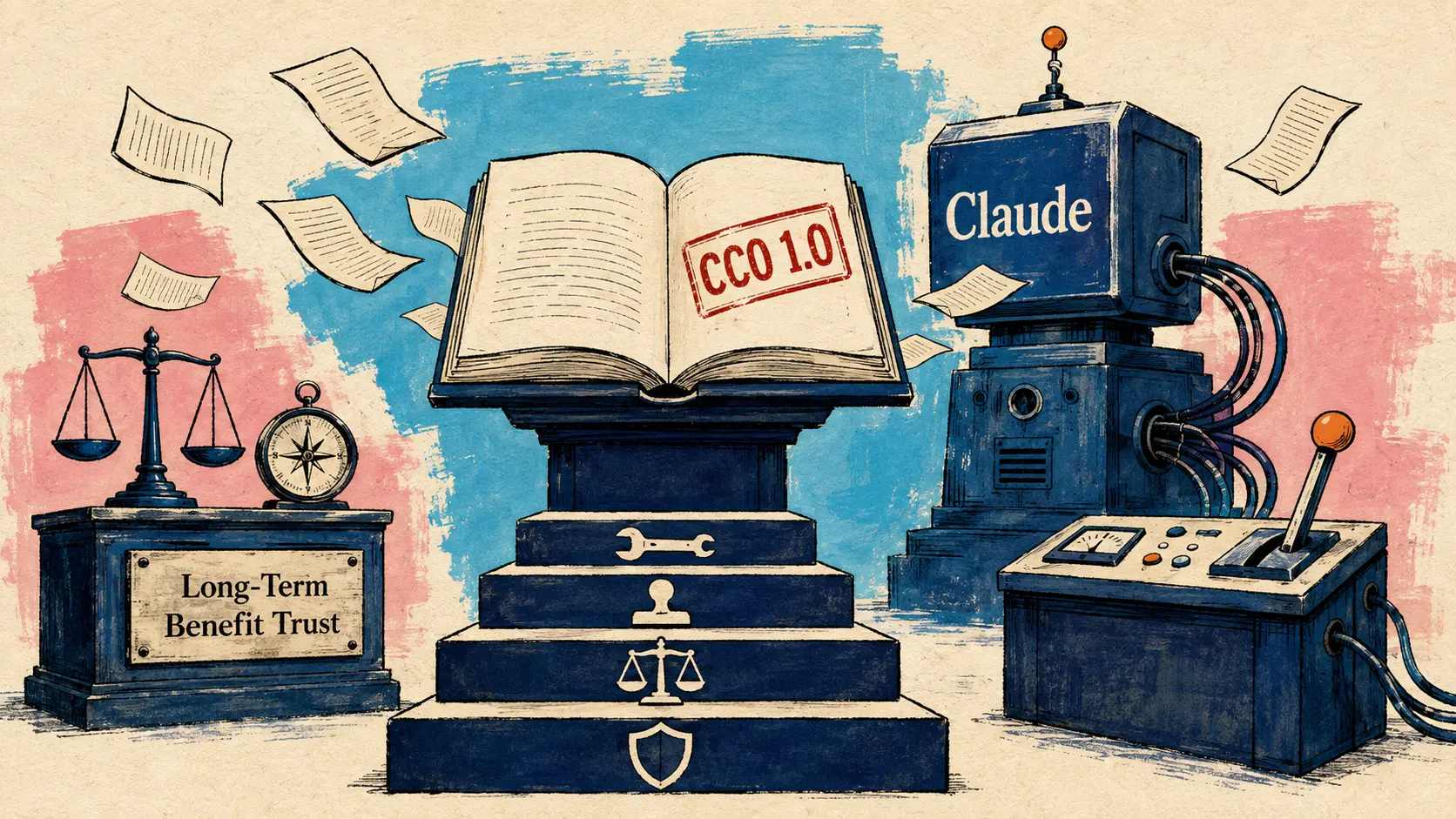
This week marks a turning point in educational and ethical AI. Anthropic unveils a new foundational constitution for Claude, while OpenAI and Google launch major global educational initiatives.
Anthropic: New Constitution for Claude
January 22, 2026 — Anthropic publishes a new constitution for Claude, a founding document that defines the model’s values and behavior. This constitution represents a major evolution from the list of principles used previously.
The Four Priorities of Claude
The constitution establishes a clear order of priorities:
- Broadly safe: Do not compromise human AI oversight mechanisms
- Broadly ethical: Honesty, good values, avoidance of harmful actions
- Compliant: Adherence to Anthropic’s guidelines
- Genuinely helpful: Real benefit for users
An Innovative Approach
Unlike a rigid legal document, this constitution is written for Claude itself. It explains the context, Anthropic’s motivations, and offers advice for navigating difficult situations like balancing honesty and compassion.
The document also includes a section on the nature of Claude, acknowledging the uncertainty regarding potential AI consciousness and the importance of its psychological well-being.
Open source: The constitution is published under the CC0 1.0 license, allowing anyone to use it freely.
Anthropic: New Member of the Long-Term Benefit Trust
January 21, 2026 — Anthropic appoints Mariano-Florentino (Tino) Cuéllar to the Long-Term Benefit Trust, the independent body that helps Anthropic achieve its public benefit mission.
An Exceptional Profile
Cuéllar brings unique expertise:
- Justice of the Supreme Court of California
- President of the Carnegie Endowment for International Peace
- Co-leader of the California Working Group on AI Frontier Models (with Fei-Fei Li)
- Experience in three US presidential administrations
The Trust also announced the departure of Kanika Bahl and Zachary Robinson, founding members who contributed to establishing Anthropic’s governance.
Claude Code: VS Code Extension in General Availability
January 21, 2026 — The Claude Code extension for VS Code is now generally available, with over 3,2 million installations.
New Features
- @-mention files: Mention files to add context
- Slash commands: Familiar commands like
/model,/mcp,/context - Improved Interface: Closer to the CLI experience
- MCP Support: Integration of the Model Context Protocol
The extension allows using Claude directly in the IDE with a Pro, Max, Team, or Enterprise subscription, or via pay-as-you-go.
Anthropic and Teach For All: Global Educational Initiative
January 21, 2026 — Anthropic partners with Teach For All to train over 100,000 teachers in 63 countries, reaching more than 1.5 million students.
AI Literacy & Creator Collective (LCC)
The initiative includes three programs:
- AI Fluency Learning Series: 6 live episodes on Claude and its applications (530+ participants)
- Claude Connect: Community hub with 1,000+ educators from 60+ countries
- Claude Lab: Claude Pro access for innovative teachers, with monthly office hours
Concrete Examples
- Liberia: A teacher created an interactive climate curriculum with Claude Artifacts
- Bangladesh: A gamified math app with boss battles and XP rewards
- Argentina: Interactive digital workspaces for secondary education
OpenAI: Education for Countries
January 21, 2026 — OpenAI launches Education for Countries, a program to integrate AI into national education systems.
First Cohort
Eight countries/consortia are participating:
- Estonia: 30,000+ students, longitudinal study with Stanford on 20,000 students
- Greece, Italy (CRUI), Jordan, Kazakhstan, Slovakia, Trinidad & Tobago, United Arab Emirates
Program Components
- AI Tools: ChatGPT Edu, GPT-5.2, study mode, canvas
- Research: National studies on the impact of AI on learning
- OpenAI Certifications: Practical training for teachers and students
- Global Network: Sharing experiences between governments and researchers
OpenAI: Age Prediction for Teen Safety
January 20, 2026 — OpenAI rolls out age prediction on ChatGPT to determine if an account likely belongs to a minor and apply appropriate protections.
How it Works
The model analyzes several signals:
- Account age
- Typical activity hours
- Usage patterns over time
- Age declared by the user
Protections Applied to Minors
- Reduced exposure to violent or gore content
- Blocking of dangerous viral challenges
- Restriction of sexual, romantic, or violent role-play
- Protection against content promoting extreme beauty standards
Incorrectly classified users can verify their age via Persona. Deployment in the EU will follow in the coming weeks.
Gemini: Free SAT Practice with The Princeton Review
January 21, 2026 — Google launches comprehensive SAT tests directly in the Gemini app, in partnership with The Princeton Review.
Features
- Free Full Tests: Entire SAT exams, available on demand
- Immediate Feedback: Identification of strengths and areas for improvement
- AI Explanations: Gemini explains each correct answer
- Personalized Study Plans: Automatic creation based on results
The content is rigorously verified by The Princeton Review to match the actual exam format. Other standardized tests will be added in the future.
Google: Gemini and Google Classroom Updates
January 21, 2026 — At the BETT 2026 conference, Google announces updates for Gemini and Google Classroom aimed at teachers and students.
BETT 2026 Announcements
- Transform teaching and learning: New AI features in Google Classroom
- ChromeOS Tools: Improved support for classroom collaboration
- Security and AI Detection: New features for Google Workspace for Education
- Khan Academy Partnership: Collaboration to create the best educational AI tools
- Oxford University Partnership: AI tools for students and teachers
Manus: App Publishing without IDE
January 19, 2026 — Manus launches App Publishing, allowing mobile apps to be published without complex configuration.
Simplified Workflow
- Build: Create your app in Manus
- Publish: Click publish
- Test: Test on your phone via Google Play or TestFlight
No need for: Xcode, Android Studio, or certificate management.
This feature makes mobile development accessible to everyone by eliminating traditional technical barriers to app publishing.
Sources
- Claude’s new constitution — Anthropic, January 22, 2026
- Mariano-Florentino Cuéllar LTBT — Anthropic, January 21, 2026
- Claude Code VS Code Extension — Visual Studio Marketplace
- Anthropic and Teach For All — Anthropic, January 21, 2026
- Education for Countries — OpenAI, January 21, 2026
- Age Prediction — OpenAI, January 20, 2026
- Practice SAT in Gemini — Google Blog, January 21, 2026
- Google Education Updates — Google Blog, January 21, 2026
- Manus App Publishing — X/Twitter, January 19, 2026