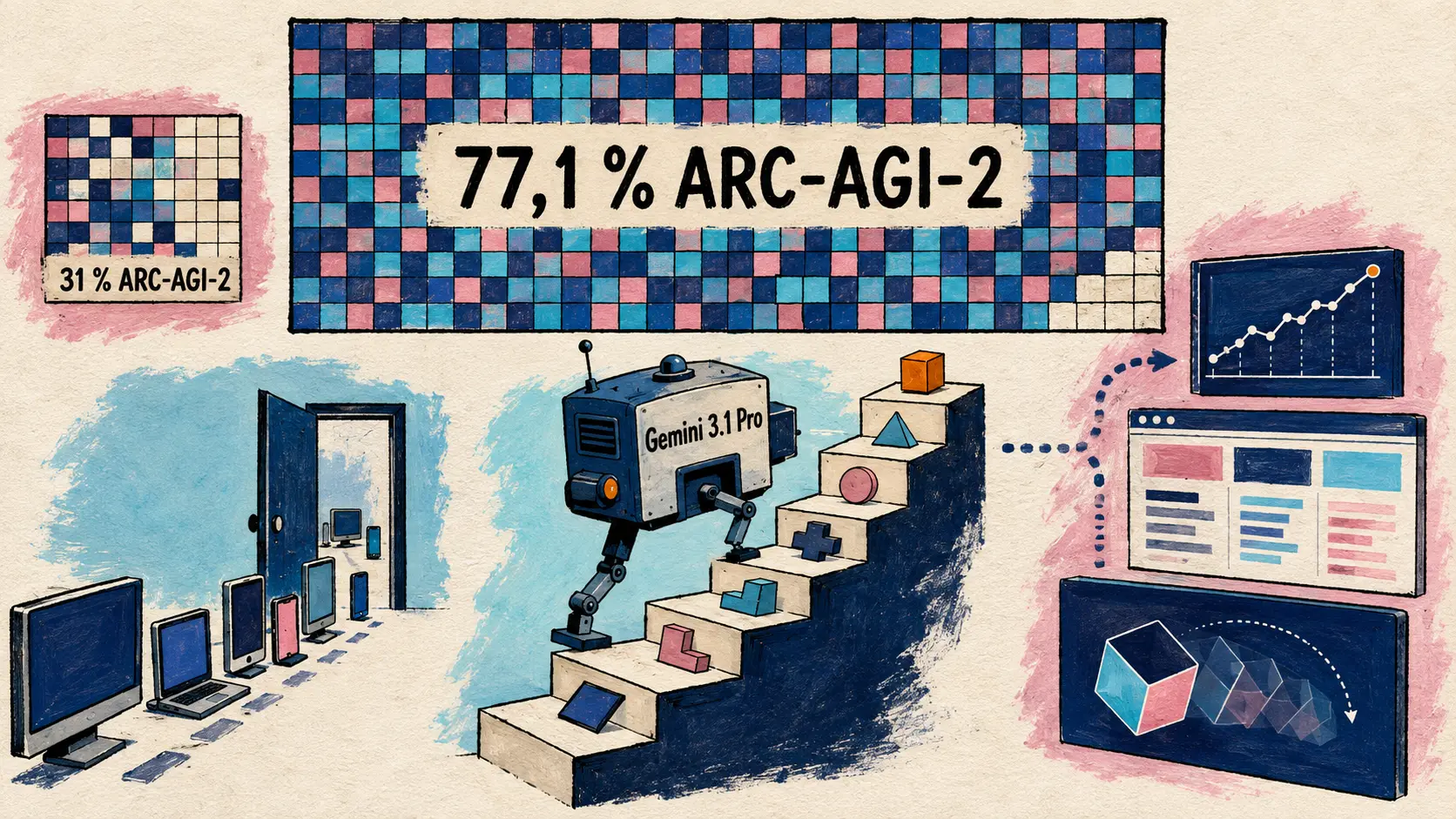
February 19, 2026 marks the launch of Gemini 3.1 Pro in preview, with an ARC-AGI-2 benchmark of 77.1% — more than double its predecessor. Simultaneously, OpenAI announces its foothold in India with Tata Group and Stargate infrastructure, while Anthropic opens Claude in PowerPoint to all its Pro subscribers.
Gemini 3.1 Pro: Major leap in reasoning
February 19 — Google DeepMind launches Gemini 3.1 Pro in preview, presented as a significant improvement in core reasoning compared to Gemini 3 Pro. The model targets complex tasks where a simple answer is not enough: multistep reasoning, data synthesis, problems requiring advanced reflection.
The most striking result is its score on ARC-AGI-2 at 77.1% — a benchmark designed to measure generalization ability, especially tasks that humans solve easily but AI struggles to learn. Gemini 3 Pro peaked at about 31% on this same benchmark, representing more than double the progress.
Availability starting today (in preview):
| Surface | Access |
|---|---|
| Developers | Gemini API (AI Studio), Gemini CLI, Android Studio |
| Enterprises | Vertex AI, Gemini Enterprise |
| Consumers | Gemini app (AI Pro and Ultra plans), NotebookLM (Pro and Ultra only) |
General public deployment is limited to paid plans for now, with GA announced “soon”. Examples demonstrated at launch give an idea of the reasoning level targeted: generating SVG animations from a text prompt, building an aerospace dashboard live with ISS telemetry data, and creating a web portfolio inspired by Wuthering Heights with coherent layout.
“Gemini 3.1 Pro is a significant upgrade in our core reasoning, the intelligence that underpins the recent Deep Think advances.” — @GoogleDeepMind on X
🔗 Google Blog — Gemini 3.1 Pro
Gemini 3.1 Pro already in GitHub Copilot
February 19 — Alongside the Google launch, GitHub announces the immediate availability of Gemini 3.1 Pro in public preview in GitHub Copilot, described as Google’s “latest agentic coding model”.
GitHub’s preliminary tests show notable results on edit-then-test loops, with high tool precision and fewer tool calls per benchmark. The model is available on all Copilot plans (Pro, Pro+, Business, Enterprise) in VS Code, Visual Studio, github.com, and GitHub Mobile (iOS and Android). Enterprise and Business administrators must enable the Gemini 3.1 Pro policy in Copilot settings — deployment is progressive.
🔗 GitHub Changelog — Gemini 3.1 Pro in Copilot
OpenAI for India: Tata Group, Stargate and 100k+ Edu licenses
February 18 — During the India AI Impact Summit 2026 in Delhi, OpenAI launched OpenAI for India, a national initiative with Indian partners to develop AI in a country that now counts over 100 million weekly ChatGPT users.
The central partnership is with Tata Group. On the infrastructure side, TCS is deploying a high-availability HyperVault data center: OpenAI becomes its first customer, with an initial capacity of 100 MW scalable up to 1 GW, positioning India as one of the first Stargate hubs outside the United States.
Record enterprise deployment
Tata Group plans to deploy ChatGPT Enterprise for hundreds of thousands of TCS employees in the coming years, which would make it one of the largest enterprise AI deployments in the world. TCS will also use Codex to standardize AI software development across its teams.
| Track | Details |
|---|---|
| Infrastructure | TCS HyperVault Data Center, 100 MW → 1 GW potential |
| Enterprise | ChatGPT Enterprise, hundreds of thousands of TCS employees |
| AI Dev | Standardized Codex at TCS |
| Certifications | TCS = first non-US organization to deploy OpenAI Certifications |
| Education | 100,000+ ChatGPT Edu licenses (IIM Ahmedabad, AIIMS Delhi, Manipal…) |
| Local Presence | Mumbai + Bengaluru offices opening in 2026 |
Beyond Tata, the initiative integrates existing partners like JioHotstar, Pine Labs, Cars24, HCLTech, PhonePe, CRED, and MakeMyTrip.
🔗 Introducing OpenAI for India
Claude in PowerPoint available on Pro, with connectors
February 19 — Claude in PowerPoint, previously in limited access, is now available for all Pro, Max, Team, and Enterprise subscribers. The integration allows creating, editing, and iterating on presentations directly from PowerPoint.
Notable new feature: support for connectors, which allows Claude to fetch context from your daily tools (CRM data, internal documents…) to inject directly into your slides. Claude reads the template’s slide master — fonts, colors, layouts — so that every modification remains on-brand.
| Feature | Description |
|---|---|
| Generation from template | Creates slides from your corporate template |
| Targeted editing | Modifies a selected slide while keeping context |
| Native charts | Produces editable PowerPoint charts (not images) |
| Connectors | Imports context from your tools into slides |
| Plans | Pro, Max, Team, Enterprise |
“Claude in PowerPoint is now available on the Pro plan. It also now supports connectors, bringing context from your daily tools directly into your slides.” — @claudeai on X
🔗 claude.com/claude-in-powerpoint
Voxtral Realtime: technical report and Mistral Studio playground
February 18 — Two weeks after the launch of Voxtral Realtime (real-time transcription, precision diarization), Mistral publishes its technical report and opens two new access doors: a playground in Mistral Studio to test without code, and an integration in Hugging Face Transformers for teams wanting to use the model locally.
“Since launching Voxtral Realtime, the community response has been remarkable. Today, we share the technical report, launch the Realtime playground in Mistral Studio, and share the model in Hugging Face Transformers.” — @MistralDevs on X
OpenAI donates $7.5M to independent alignment research
February 19 — OpenAI announces a donation of $7.5 million (about £5.6M) to The Alignment Project, a global fund managed by the UK AI Security Institute (UK AISI) to fund independent research on the risks of misaligned AI.
The total fund exceeds £27 million, with contributions from public, philanthropic, and industrial actors. Individual projects can be funded from £50,000 to £1 million, with optional access to compute resources. The areas covered are deliberately broad: computational complexity theory, game theory, cognitive sciences, information theory, and cryptography. OpenAI specifies that its funding does not alter the UK AISI’s selection process, which remains independent.
🔗 OpenAI — Advancing independent research on AI alignment
Perplexity Comet: iOS pre-orders open
February 19 — Perplexity has opened pre-orders for its Comet AI browser on the Apple App Store iOS. Available since November 2025 on Android and then on desktop version, Comet arrives on iPhone.
GitHub Copilot Updates
February 18-19 — Beyond Gemini 3.1 Pro (see previous section), GitHub released two updates to the Copilot coding agent:
- Windows Support: the agent can now use a Windows environment via
copilot-setup-steps.yml, useful for .NET projects. Note: the built-in firewall is not compatible — recommended only with self-hosted runners or Azure private networking. 🔗 Changelog - Code referencing: if generated code matches code in a public repository, it is highlighted in logs with a link to the original code. “Block” mode is not supported — matches are flagged, not blocked. 🔗 Changelog
Claude Code v2.1.47: reduced memory in long sessions
February 19 — Claude Code v2.1.47 brings a reduction in memory consumption for long sessions (external contribution from @cirospaciari). Two other fixes: FileWriteTool now preserves intentional empty lines at the end of files (removal of trimEnd()), and a line counter display bug on Windows linked to os.EOL ( ) is fixed.
In context: Claude Code was launched exactly one year ago and today writes 4% of all GitHub commits, with a daily active user count that doubled last month.
Ideogram: transparent background design editing
February 18 — Ideogram launches the ability to edit transparent background designs via a text prompt, without the background being replaced by white during generation. Available for free to all users.
What this means
Gemini 3.1 Pro marks a clear acceleration in general reasoning: going from 31% to 77.1% on ARC-AGI-2 in one model generation is an unusual leap. The immediate integration into GitHub Copilot confirms that Google is accelerating in the developer tools market, where Claude Sonnet and GPT-4o were previously the references. Developers will be able to compare directly in their IDE.
The OpenAI for India initiative illustrates another strategic stake: local foothold. With 100M+ weekly users, India is already a major market for OpenAI. The local Stargate (100 MW → 1 GW with TCS) and the enterprise deployment at Tata Group signal a desire for sovereign infrastructure, on the model of what is being built in the United States and the UAE.
On Anthropic’s side, opening Claude in PowerPoint to the Pro plan — with connector support — extends Claude’s usage surface towards office workflows that GPT-4o and Copilot previously occupied. OpenAI’s donation to The Alignment Project UK AISI is also significant: funding independent alignment research, without influence on project selection, is a signal of institutional maturity.
Sources
- Google Blog — Gemini 3.1 Pro
- Tweet @GoogleDeepMind
- GitHub Changelog — Gemini 3.1 Pro in Copilot
- Tweet @github
- OpenAI for India
- OpenAI — Advancing independent research on AI alignment
- Tweet @OpenAINewsroom
- claude.com/claude-in-powerpoint
- Tweet @claudeai
- Tweet @MistralDevs — Voxtral Realtime
- Tweet @perplexity_ai — Comet iOS
- GitHub Changelog — Copilot coding agent + Windows
- GitHub Changelog — Copilot coding agent + code referencing
- Tweet @jarredsumner — Claude Code v2.1.47
- Tweet @ideogram_ai — Transparent editing