A week rich in announcements
From January 14 to 17, 2026, announcements multiplied: OpenAI democratizes access to ChatGPT with an $8/month subscription, Anthropic establishes itself in India, Google launches its MedGemma medical models, and Claude accelerates scientific research.
OpenAI: ChatGPT Go available worldwide
January 16, 2026 — OpenAI announces the global rollout of ChatGPT Go, its most affordable subscription, now available in 170+ countries.
Expanded access to advanced AI
Initially launched in India in August 2025, ChatGPT Go becomes OpenAI’s fastest-growing plan. At 8 USD per month, it offers:
| Feature | Details |
|---|---|
| Model | GPT-5.2 Instant |
| Messages | 10x more than free plan |
| Files | 10x more uploads |
| Images | 10x more creations |
| Memory | Extended for long conversations |
| Context | Increased limit |
Three subscription tiers
OpenAI now offers three levels:
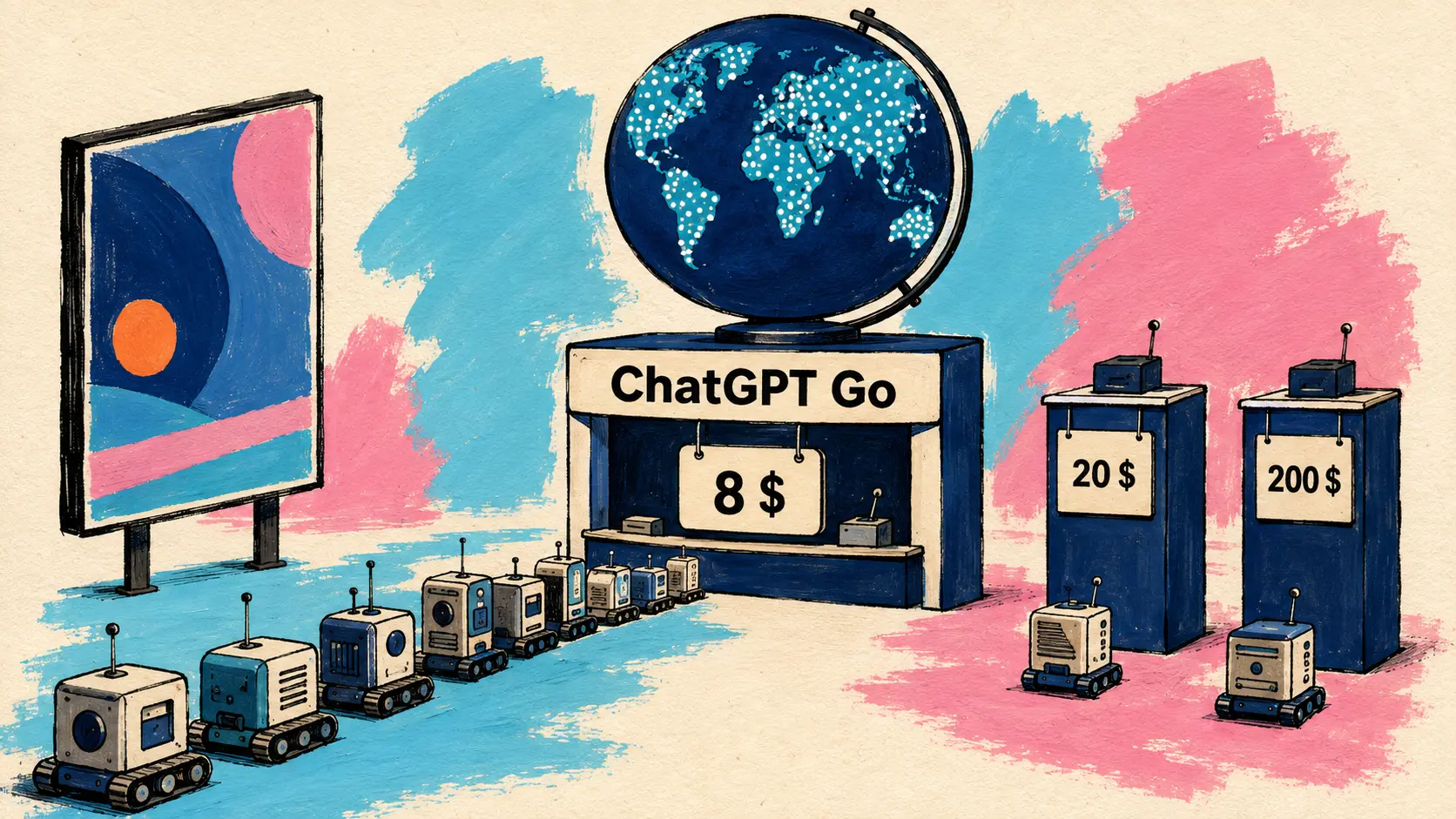
- ChatGPT Go: $8/month — GPT-5.2 Instant, extended access
- ChatGPT Plus: $20/month — GPT-5.2 Thinking, Codex agent, legacy models
- ChatGPT Pro: $200/month — GPT-5.2 Pro, full access, preview features
Advertising comes to ChatGPT
OpenAI plans to test ads in ChatGPT Go in the US soon. This strategy aims to keep free and affordable rates. Plus, Pro, Business, and Enterprise plans will remain ad-free.
Anthropic establishes itself in India
January 16, 2026 — Anthropic appoints Irina Ghose as Managing Director of India and prepares to open an office in Bengaluru.
An experienced leader
Irina Ghose brings more than three decades of experience in scaling technology businesses. She was previously Managing Director of Microsoft India, where she led enterprise AI adoption in banking, healthcare, manufacturing, and government sectors.
“India has a real opportunity to shape how AI is built and deployed at scale. Indian organizations are moving beyond experimentation toward applied AI, where trust, safety, and long-term impact matter as much as innovation.” — Irina Ghose, Managing Director India, Anthropic
India, a strategic market
India represents the second largest global market for Claude.ai. According to Anthropic’s fourth Economic Index, nearly 50% of Claude.ai usage in India focuses on coding and mathematical tasks.
The Indian team will work with policymakers, academic institutions, and develop partnerships with local businesses.
Claude accelerates scientific research
January 15, 2026 — Anthropic publishes a detailed case study showing how researchers use Claude to transform their scientific workflows.
Biomni: a universal biomedical agent
Developed at Stanford University, Biomni is an agentic platform that gives Claude access to hundreds of tools, packages, and biological databases. Researchers formulate their queries in natural language; Biomni automatically selects the appropriate resources.
Spectacular result: a genome-wide association study (GWAS) that normally takes months was completed in 20 minutes.
The system has been validated on several cases:
- Molecular cloning experiment design at a senior postdoc level
- Analysis of 450+ wearable data files in 35 minutes (vs 3 weeks for a human)
- Discovery of new transcription factors in embryonic development
MozzareLLM: CRISPR interpretation at scale
At the Cheeseman Lab (MIT/Whitehead Institute), the tool MozzareLLM automates the interpretation of large-scale CRISPR experiments.
Dr. Iain Cheeseman, who can recall the functions of about 5,000 genes from memory, used to spend hundreds of hours analyzing this data. MozzareLLM reproduces his approach and regularly detects patterns he had missed.
Lundberg Lab: hypothesis generation by AI
The Lundberg Lab (Stanford) is testing a reverse approach: instead of relying on existing literature, their system uses Claude to navigate a complete molecular map and identify candidate genes based on their biological properties.
The team is currently conducting a comparative experiment on primary cilia to validate this approach.
🔗 Accelerating Scientific Research
Google launches MedGemma for medical
January 14, 2026 — Google releases MedGemma, a collection of Gemma 3 models optimized for medical text and image understanding.
Architecture and variants
MedGemma is available in several variants:
| Model | Parameters | Capabilities |
|---|---|---|
| MedGemma 4B | 4 billion | Multimodal (text + images) |
| MedGemma 27B | 27 billion | Text only |
Medical specialization
Multimodal versions use a SigLIP image encoder pre-trained on de-identified medical data:
- Radiology: chest X-rays
- Dermatology: skin images
- Ophthalmology: retinal images
- Pathology: histological slides
The model is distributed under the Health AI Developer Foundations license and aims to accelerate the development of AI applications for health.
ElevenLabs powers MasterClass On Call
January 15, 2026 — ElevenLabs reveals that MasterClass On Call, MasterClass’s new AI coaching feature, is powered by its voice technology.
Real-time coaching with AI instructors
MasterClass On Call allows real-time conversations with AI versions of world-renowned instructors:
- Gordon Ramsay (cooking)
- Mark Cuban (entrepreneurship)
- Chris Voss (negotiation)
Massive voice adoption
Since the deployment of ElevenLabs, 75% of users now interact by voice rather than text chat.
“It is extremely critical for us to make sure that the personality of our instructors comes through in the voice - that means the pacing and tone needs to be right, and all of our instructor AIs should feel empathetic during the conversations. ElevenLabs delivered on all these attributes way above everyone else.” — Mandar Bapaye, CPO & CTO, MasterClass
What this means
This week illustrates several trends:
- Democratization of AI: ChatGPT Go at $8/mo makes advanced AI accessible globally, with an advertising model for funding
- International expansion: Anthropic establishes itself in India, its second largest market, with an experienced leader
- AI for science: Claude transforms research workflows from months to hours (Biomni, MozzareLLM)
- Open-source medical AI: Google’s MedGemma targets specifically health applications
- Natural voice: ElevenLabs shows that 75% of users prefer voice interaction when available