ai-powered-markdown-translatorArticle translated from fr to en with gpt-6.1-sol.
OpenAI launches ChatGPT Wallet: its personal agents, dots, can now complete payments, with each purchase approved through biometric verification and paid for using a token that hides the actual card. On the same day, Google connects the Gemini app to Google Wallet with read-only access. Claude Code 2.1.323 adds Code Mode, where Claude writes JavaScript to chain its tools together, DeepSeek makes its app’s search, files and voice features available through its API, and llama.cpp reaches version 1.0.0 with a stable API. GitHub Copilot welcomes Gemini 4 Hydrogen and announces six model retirements for December 14.
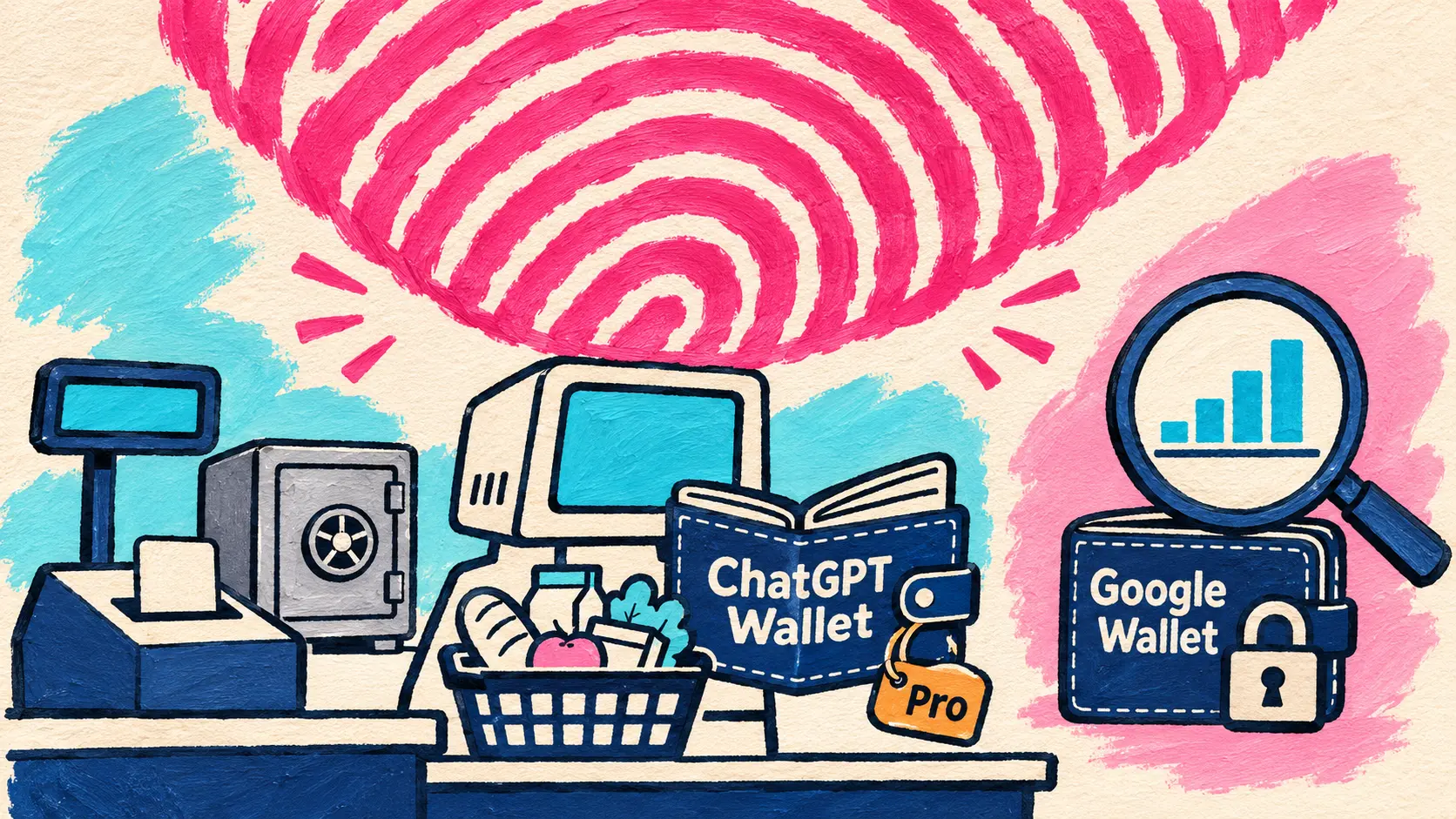
ChatGPT Wallet: OpenAI’s dots can complete payments, using a token that hides the actual card
November 13 — OpenAI launches ChatGPT Wallet, a wallet that lets dots, its personal agents, complete purchases for the user. The card is registered once. Before each payment, the dot presents the merchant, items, total and selected card; the user approves through biometric verification (Face ID, Touch ID or fingerprint), and each approval leaves a record of the authorized purchase.
We’re introducing ChatGPT Wallet, setting a new bar for secure payments by agents. It’s the first wallet that lets agents pay without access to users’ actual card details and that requires a security check for every purchase, while also preserving existing card rewards and protections for eligible disputes. — OpenAI, ChatGPT Wallet launch post
The mechanism relies on payment network tokenization. Once the purchase is approved, the network provides a payment token with a substitute card number, security code and expiration date: the card is charged without either the agent or the merchant seeing its actual details. Card rewards and dispute protections remain in place. The wallet was built with American Express, Mastercard and Visa; for American Express, this is the first integration of its Agentic Commerce Experiences offering. The claim that this is the first wallet of its kind remains OpenAI’s.
| Launch detail | Conditions as of November 13 |
|---|---|
| Where to use it | Conversations with a dot; excludes Chat, Work and standalone Codex threads |
| Eligible subscribers | ChatGPT Pro, ages 18 and over, in the United States, rolling out gradually |
| Accepted cards | American Express, Chase, Mastercard and Visa credit cards issued in the United States |
| Cards excluded at launch | Debit cards and virtual cards |
| Approval of each purchase | Biometric verification: Face ID, Touch ID or fingerprint |
| Data received by the merchant | A substitute payment token |
The help article warns that approval does not constitute order confirmation, which must be checked with the merchant; the launch post adds that some sites may still unintentionally block agent purchases. Later, with no date specified, users will be able to delegate entire purchases within preset limits: spending cap, categories and time period.
For merchants, OpenAI publishes a Commerce Partner Playbook: claim their listing through Businesses in ChatGPT (launched on November 10) and publish a product feed, recognize signed Web Bot Auth requests from ChatGPT agents in their CDN or firewall, and have these purchases accepted by fraud prevention tools (Forter, Riskified, Sardine, Signifyd) and payment providers (Adyen, Checkout.com, Stripe). Following the visual shopping features and Agentic Commerce Protocol introduced in March, OpenAI is now moving into completing purchases.
🔗 Shopping with ChatGPT Wallet (OpenAI help) · ChatGPT release notes · Commerce Partner Playbook (OpenAI)
Google Wallet in the Gemini app: view spending without being able to move money
November 13 — On the same day, Google takes the opposite approach: the assistant reads the wallet without ever making payments. Google Wallet joins the connected apps in Personal Intelligence, alongside Gmail, Photos, YouTube and Search, for all Gemini app users in the United States, on the web, Android and iOS. Mentioning @Google Wallet lets users get cash flow, asset allocation or budget charts, identify recurring subscriptions and price increases, or plan a holiday budget based on last year’s transactions. Bank and credit card accounts can be linked to Wallet through Plaid.
Gemini can only read information from your accounts; it can’t move, manage, or invest your money. — Google’s post on blog.google
The connection is optional and can be disabled at any time in Personal Intelligence settings. The same post launches Memory Summary, a page that shows what Gemini has remembered (preferences, interests, ongoing goals) and lets users correct it, on the web and mobile, wherever Personal Intelligence is available.
Coding agents: Claude Code 2.1.323 launches Code Mode, alongside Codex CLI 0.169, Antigravity 2.32, Devin Apps and Devin Teams
November 12 — Claude Code version 2.1.323, published on GitHub on the evening of November 12 with 294 entries including 195 fixes, introduces Code Mode, an experimental option that changes how Claude uses its tools. Without it, Claude requests each call (Bash, Read, Edit) and reads its result before deciding what to do next. With Code Mode, it writes a piece of JavaScript that chains several calls together in a single step: running commands in parallel, reusing one call’s result in the next, and returning only the useful part of the output. The documentation recommends it for repeated changes across many files, searches that need filtering before reading, and independent commands. The conversation continues to display tool calls; the code itself can be read in the transcript view (Ctrl+O).
| Code Mode requirement | Value according to the documentation |
|---|---|
| Activation | Variable CLAUDE_CODE_EXPERIMENTAL_CODE_MODE=1, then confirmation on first launch |
| Minimum version | Claude Code 2.1.323, native build |
| Required account | Claude subscription or Console account |
| Supported models | Opus 5.5, Sonnet 5.5, Haiku 5.5, Fable 5.2 |
| Supported interface | Interactive terminal session (excludes -p, Agent SDK, VS Code, Desktop and cloud sessions) |
| Excluded configurations | Gateways, Amazon Bedrock, Google Cloud Agent Platform, Microsoft Foundry, HIPAA, zero data retention |
| Maximum code runtime | 10 minutes in the foreground, up to 2 hours in the background |
On security, each tool call launched by the code still goes through deny and ask rules and PreToolUse hooks. In auto mode, the classifier examines the code before execution, but not each call: it cannot see values computed along the way, such as a path retrieved from a search, and the documentation recommends keeping rules or hooks for sensitive calls. Administrators can block the mode across the organization by setting the variable to 0 in managed settings, but cannot enable it this way. The documentation also describes a refusal when the mode is not yet available to the account, with advice to try again another day. The stable npm channel remains on 2.1.311 for now.
The rest of the release closes permission loopholes. A session launched in auto mode when that mode is unavailable now starts in Manual mode, which asks before acting, instead of a more permissive mode; Write and Edit can no longer write to a path protected by a Read deny rule, and deny and ask rules can no longer be bypassed through sudo or env. The assumed context window for an unknown model increases from 200,000 to 1 million tokens, the MCP v1 client is removed, and plugins can declare which Claude Code versions they support (engines["claude-code"]). Outside the terminal, Claude Tag adds its Slack sessions to the Enterprise Compliance API, in beta, and Code Review exports costs by repository as CSV.
🔗 Claude Code 2.1.323 (GitHub) · Code Mode documentation
Claude Code 2.1.325: sandboxed Bash commands go through permissions again, and a zstd vulnerability is fixed
November 13 — The following day, Claude Code 2.1.325 changes a default behavior: Bash commands executed in the sandbox now follow the normal permission flow instead of running without a prompt. To retain the previous behavior, set sandbox.autoAllowBashIfSandboxed: true, in the highest-priority managed settings source when the organization enables the sandbox. The release also fixes a vulnerability in decoding zstd-compressed responses, without further details.
Other changes tighten permissions: read-only git commands require confirmation in a repository that is neither the project repository nor a trusted repository, and scheduled tasks such as /loop ask before launching a skill that declares allowed tools or hooks (Skill(name) in permissions.allow for unattended use). A background session opened with a claude.ai account could use, and bill, an API key inherited from the shell: this is fixed. Of 139 entries, 88 are fixes, including several for Code Mode; 2.1.324, published on npm less than two hours earlier, has no release notes.
🔗 Claude Code 2.1.325 (GitHub)
Codex CLI 0.168 and 0.169: side conversations in tabs, and codex exec requires project trust
November 13 — OpenAI publishes two stable Codex CLI releases in less than five hours. Version 0.168.0 (03:54 UTC, 226 listed PRs) introduces an optional (features.tui_workspace) side conversation displayed next to the main conversation; 0.169.0 (08:37 UTC, 243 PRs) turns these into tabs that reopen after a restart. A Sessions → Model providers panel selects the model provider for new conversations without affecting those already open, and custom providers can now be created from the terminal, with a device code for SSH connections.
The change that matters for scripts and CI arrives with 0.169.0: in an untrusted folder, codex exec no longer loads the project configuration or its MCP servers, even with --sandbox workspace-write. Users must pass --trust to codex exec or codex review to record trust in the project. Both releases also add optional animated GIFs, audio recordings with a compatible model, search for past tasks in the agent command center, and a local diagnostic ZIP (Ctrl+S). The features.multi_agent option is being phased out in favor of agents.enabled, and a PR title mentions a local migration of Claude Code skills, without an entry in the release notes.
🔗 Codex CLI 0.168.0 (GitHub) · Codex CLI 0.169.0 (GitHub)
Antigravity 2.32 and Antigravity CLI 1.5.8: Dynamic Workflows in Python, Hydrogen and Carbon with a Gemini API key
November 13 — The Antigravity app moves to 2.32.0 with Dynamic Workflows: the agent orchestrates parallel subagents and multistep tasks by writing Python, executed by the runtime bundled with the app. The idea echoes the dynamic workflows already offered by Claude Code, Copilot CLI and Devin; the changelog does not explain how the feature works with /swarm, in preview since November 10. The release also protects browser tabs controlled by the agent: embedded frames from other sites load without being signed in and remain hidden from its screenshots without explicit permission. In total, there are 11 improvements and 13 fixes, including Everforest themes and local cloning of cloud GitHub repositories for remote agents.
On the same day, Antigravity CLI 1.5.8 makes Gemini 4 Hydrogen (Low to XHigh levels) and Gemini 4 Carbon (Low to High) available through GEMINI_API_KEY key authentication, with Hydrogen also available through Google Cloud credentials (ADC) and behind an enterprise gateway. Its 22 fixes close several security bypasses: the sandbox network proxy being fooled by encoded slashes (%2F) or “..” segments in a URL, “always allow” rules being exploited on Windows through cmd or PowerShell, MCP permission rules being ignored for certain tools, and a blocking hook written with double quotes being silently skipped on Windows.
Devin Apps: private web applications hosted on Devin’s cloud machine
November 13 — Cognition launches Devin Apps: describe the tool the team needs (dashboard, review queue, project status page), Devin builds and deploys it, and the team opens it from a stable URL. An App can also emerge from an ongoing session, based on a browser preview already shown. Apps remain private: signing in to Devin is required, with sharing by person, organization, or across the entire company. Each change produces a new version at the same address, and if it fails to start, the previous version continues serving requests.
Apps rely on the memory snapshots that allow Devin to hibernate: the machine sleeps 5 minutes after the last request and wakes within seconds on the next visit. Billing follows awake time, with no specific rates given. Any stack that serves HTTP works, with SQLite or Postgres on the same machine; an App runs on a single machine and targets internal tools and staging environments, rather than high-traffic services. The announcement follows Cursor’s Apps (November 5) and Amp’s Boxes (November 10).
🔗 Introducing Devin Apps · Devin Apps documentation
Devin Teams: Devin Desktop without paid seats, Free mode on SWE-2, and a seat cap reduced to 100
November 12 — The previous evening, Cognition revamped its Devin Teams plan. Devin Desktop no longer requires paid seats, and a Free mode, powered by its in-house model SWE-2, gives each user two free simultaneous sessions. Free SWE-2 usage in Devin Desktop and the CLI becomes permanent for Teams, Pro, and Max plans, following several temporary free periods since September.
| Teams plan component | Change announced by Cognition |
|---|---|
| Devin Desktop seats | Included for the whole team, no more paid seats |
| Free mode | 2 simultaneous sessions per user, on SWE-2 |
| Single sign-on | Okta, Microsoft Entra ID, any SAML or OIDC provider |
| Usage limits | Up to 3 levels, extensions approved manually or automatically |
| Seat cap | 100, down from 200 previously |
| Quota-based seats | Removed in 30 days |
The plan also adds Devin Coach, which might suggest a lighter mode for a small task, and a standard health data processing agreement (BAA) that can be requested from settings. No pricing is given.
DeepSeek brings its app’s features to its API: search, files, link reading, safety, and voice
November 13 — DeepSeek makes the features behind its app experience available to developers. Since October 17, the API had already offered search and page reading (Search and Fetch). DeepSeek now adds all the app’s features, enabled through a few parameters on deepseek-flash (DeepSeek-V4.1-Flash-1017), across the three APIs: Messages, Responses, and Chat Completions; the service handles tool calls and context assembly itself.
The capabilities behind the DeepSeek App are now available through the DeepSeek API. Enable built-in features with a few parameters, or call standalone APIs such as OCR, ASR, and TTS. — @deepseek_ai on X
The deepseek_web_search tool searches the web or images and responds with citations when reasoning is disabled; with reasoning enabled, the model performs multiple searches and reads links itself. The deepseek_read_url tool retrieves pages referenced in the message. Files (PDFs, Office documents, images) are analyzed and then added to the context. A safety control parameter checks input and output and returns a refusal marker if a risk is detected; DeepSeek asks publicly available services to enable it and fulfill their obligations (content safety review, large-model registration, AI labeling).
These components are also sold separately, with three new APIs for OCR, speech recognition (ASR), and speech synthesis (TTS). Tool fees are added to token charges, whose pricing remains unchanged: for deepseek-flash, 0,30 dollars per million uncached input tokens and 1,20 dollars for output during peak hours, half price during off-peak hours.
| Billed feature | List price | Temporary price (-50 %) |
|---|---|---|
| Web search (text, image) | 0,75 dollars per 1 000 | No discount |
| Web reading (fetch) | 0,75 dollars per 1 000 | No discount |
| File analysis and OCR | 0,225 dollars per 1 000 pages | No discount |
| Speech synthesis (TTS) | 0,45 dollars per 10 000 characters | 0,225 dollars |
| Speech recognition (ASR) | 0,116 dollars per hour of audio | 0,058 dollars |
To showcase the whole package, DeepSeek releases chat-demo under the MIT license, a static chat client with no server that calls the API directly from the browser, with search, link reading, attachments, voice, and app history import. On the same day, a preview of DeepSeek Harness adds an experimental plugin that imports these conversations into a workspace. For developers, this offers the ability to reproduce the DeepSeek app in their own product, or use just one component.
🔗 DeepSeek API changelog · DeepSeek API pricing · Guide to building a chatbot (DeepSeek) · chat-demo (GitHub)
llama.cpp and ggml reach 1.0.0 with a stable API; SGLang, Transformers, and Diffusers round out the open tooling
November 13 — After three and a half years of build-numbered releases, llama.cpp and its compute library ggml publish their first major release, 1.0.0. The engine, which runs models locally on devices from phones to workstations, serves as the foundation for a long list of applications. The team, now at Hugging Face, commits to semantic versioning (semantic versioning) for the public C API: any API or ABI incompatibility will require a new major version.
| Release type | What triggers it |
|---|---|
| Major | Incompatible change to the public C API or ABI |
| Minor | Compatible feature, new backend, new model, or API addition |
| Patch | Bug fix without an API change |
The move to 1.0 cleans house: 35 deprecated functions disappear, and the NextN speculative decoding API enters the main header llama.h. The release adds FP8 KV caches, a MoE expert cache in host memory with an adjustable share assigned to the CPU, and support for Kimi-K3.1-Pro, Ripple-65B-Preview, drama-3 speech synthesis, and vision in MageVL-Cowork and Kimi-K3.1. The llama-server server gains protections against SSRF, CORS, and DNS rebinding attacks, an OpenAI-compatible /v1/audio/speech endpoint, and a redesigned web interface.
According to the post, the engine supports more than 150 architecture variants and all common speculative decoding methods. The library is distributed through Homebrew, Winget, conda-forge, Debian, Docker, or MacPorts, and the team tests every change with HF Jobs and machines loaned by NVIDIA, AMD, Qualcomm, Arm, IBM, and Intel. Clément Delangue describes this v1 as the first fully stable major release of the most widely used library for running models locally. Cohere welcomed the release, noting that its small North Micro Vision model is now supported. For developers integrating llama.cpp into a product, it promises a stable API between major versions.
🔗 ggml-org post on Hugging Face · llama.cpp v1.0.0 (GitHub) · Georgi Gerganov’s announcement
SGLang Consortium: eight founding members around LMSYS’s inference engine
November 12 — LMSYS Org, the nonprofit organization developing the open source SGLang inference engine, launches the SGLang Consortium at the opening of the first SGLang Summit, held November 12 and 13 in San Francisco. Its eight founding members: NVIDIA, AMD, Intel, Google, Meta, Cloudflare, Modal, and RadixArk. Each appoints a technical representative and attends two roadmap meetings per year; maintainers retain control over technical decisions and accepted code, and the project remains open to everyone. The priorities: new models, reasoning and multimodality, distributed inference, hardware optimization.
NVIDIA, which shared the announcement on November 13, reports collaboration across five generations of accelerated computing, from Ampere to Vera Rubin, and support for more than 100 models from their release date. According to LMSYS, citing Deloitte, inference is expected to account for roughly two-thirds of AI compute in 2026, up from half in 2025.
🔗 LMSYS Org Launches SGLang Consortium · Post shared by @NVIDIAAI
Transformers v5.23.0: a single ExportedModel for ONNX Runtime, OpenVINO, ExecuTorch, and Dynamo
November 13 — Transformers v5.23.0 unifies model exports. Whether targeting ONNX Runtime, OpenVINO, ExecuTorch, or PyTorch’s Dynamo graph, exports now return an ExportedModel that is called like the original model (same arguments, same output class), can be published on the Hub, and loads directly on the target engine. This is a breaking change: export() no longer returns the same object. ONNX exports can be fused for CPU, CUDA, WebGPU, or DirectML.
| Engine and hardware (EmbeddingGemma2, release notes) | Speedup over PyTorch eager | Speedup over torch.compile |
|---|---|---|
| ONNX Runtime with TensorRT, A100 | 7,6 times | 1,4 times |
| OpenVINO, Xeon Platinum 8570 | 4,1 times | 2,2 times |
| OpenVINO with int8 weights, same Xeon | 4,9 times | 2,6 times |
The release adds seven models, including Thinking Machines’ Inkling 2 Small, Liquid AI’s LFM3 and LFM3-VL, Dots 3 Note Preview (text, image, video, and audio), IQuest-Coder-V1, and InternLM3; the JEV decision head remains experimental.
🔗 Transformers v5.23.0 (GitHub)
Diffusers 0.43.0: five modular pipelines, from MiniMax-H3-Image to the PAN 2 simulator
November 12 — Diffusers 0.43.0 adds five generative models as modular pipelines. MiniMax-H3-Image and Pruna AI’s P-H3-Image generate and edit images from text and reference images (up to eight for P-H3-Image), in six or eight steps. Pika H3 Flex, built on MiniMax-H3, produces video with synchronized stereo sound in six steps. Kandinsky S2V 1.0 animates a person from a photo and a recording of their voice, including body movements, in five-second segments. PAN 2, a 29-billion-parameter simulator, generates scenes from actions and camera movements, with safety checks enabled by default. The release also improves tensor parallelism, LoRA, and attention backends.
GitHub Copilot catalog: Gemini 4 Hydrogen reaches even the Pro plan, six models will leave on December 14
Gemini 4 Hydrogen in Copilot, including the Pro plan
November 13 — The day after its launch by Google, Gemini 4 Hydrogen becomes generally available in GitHub Copilot. GitHub presents it as Google’s latest Flash model, designed for fast agentic coding, tool use, and multistep workflows, with better instruction following than Gemini 3.8 Flash, without providing figures. One difference from the two previous additions, Gemini 4 Carbon and Claude Fable 5.2: the Copilot Pro plan is included, alongside Pro+, Max, Business, and Enterprise.
The model appears across eleven interfaces: Carbon’s ten, ranging from Visual Studio Code to Eclipse, including Copilot CLI, the coding agent, the GitHub Copilot app, and GitHub Mobile, plus the Copilot SDK. It is billed at the provider’s list price, based on usage, and enabled automatically for Business and Enterprise unless the administrator has turned off default activation of new models. The rollout is gradual. On the same day, Hydrogen also arrives in Perplexity’s Agent API and Antigravity CLI.
🔗 Gemini 4 Hydrogen in GitHub Copilot (GitHub Changelog)
Six models removed from Copilot on December 14
November 13 — GitHub announces the removal of six models from all Copilot experiences (Chat, inline edits, ask and agent modes, code completions) on December 14. Each has a suggested replacement, often added in recent weeks.
| Deprecated model | Replacement suggested by GitHub |
|---|---|
| Claude Fable 5 | Claude Fable 5.2 |
| Claude Haiku 4.5 | Claude Haiku 5.5 (Haiku 4.5 remains available to individual subscribers on annual plans) |
| Gemini 3.8 Flash | Gemini 4 Hydrogen |
| Gemini 4 Argon | Gemini 4 Carbon |
| Grok 4.6 | Grok 4.7 |
| Kimi K3 | Replacement to be announced |
For Business and Enterprise, replacements are enabled automatically under the default activation setting for new models, and no action is needed to remove the old ones. GitHub had already removed four models on October 2 and six on October 19 following the same pattern; Gemini 4 Argon, added in mid-October, will have spent just two months in Copilot.
🔗 Upcoming deprecation of selected GitHub Copilot models in December (GitHub Changelog)
Evaluating models: Anthropic’s safety recommendations and Ai2’s XYBench
Anthropic: ten recommendations for reliable safety evaluations
November 13 — On its Engineering blog, Anthropic has published a guide to designing, running and presenting safety evaluations, with ten recommendations according to its tweet. The starting point: saying a model is “safer than the previous one” is only as meaningful as the evaluation used to measure it, and AI evaluations are easy to game and hard to reproduce. The post draws on reforms in psychology following its replication crisis, including the preregistration (preregistration) of hypotheses before seeing the data.
Anthropic favors an appropriate response rate over a refusal rate, measured across multi-turn conversations where a single bad turn means the entire conversation fails: a Claude model plays a simulated user described by an expert, and an automated evaluator, validated against human labels, scores each transcript. Following internal incidents, many evaluations with Internet access were temporarily suspended.
| Metric cited by Anthropic | Published value |
|---|---|
| Harmless responses, single-turn tests on the API | 94 % to 98 % for all recent models (saturated) |
| Romance scams on claude.ai | Opus 5: 98 %, Opus 5.5: 94 % (difference not significant) |
| Gap between the API and claude.ai for Fable 5.1 | Up to 34 points |
| Suicide and self-harm, new system prompt | 60 % on the API, 94 % on claude.ai |
| Minimum sample size | 100 items in multi-turn tests, 1 000 in single-turn tests |
🔗 Building strong safety evaluations (Anthropic) · Announcement from @AnthropicAI
XYBench: assistants rarely see the real question behind a poorly framed request
November 13 — Ai2 has released XYBench with Carnegie Mellon, NVIDIA and Johns Hopkins (Best Resource Paper Award at EMNLP 2026). The benchmark focuses on the “XY problem”: someone wants to achieve goal X, assumes method Y will work and asks for help with Y. Its 8 115 questions range from programming (Stack Overflow) to cooking and DIY (WikiHow). The five models tested, from earlier generations, often suggest a solution to the real problem but remain focused on the literal request.
| Model evaluated (Stack Overflow questions) | Solution to the real goal | Goal-focused response | Misconception flagged |
|---|---|---|---|
| Best human answer | 67 % | 55 % | 79 % |
| GPT-5 | 71 % | 41 % | 60 % |
| Qwen3.5-9B | 64 % | 41 % | 60 % |
| DeepSeek-V4 Pro | 66 % | 35 % | 55 % |
| Gemini 3.1 Pro | 62 % | 40 % | 54 % |
| Claude Sonnet 4.6 | 59 % | 36 % | 47 % |
When asked to choose between two answers, the models prefer the one addressing the real goal in 71 to 84 % of cases, yet they write such answers themselves only 35 to 41 % of the time: recognizing a good answer is not enough to produce one.
🔗 XYBench (Ai2) · Announcement from @allen_ai
Prompt injection: IBM releases LLMON and two Granite 4.1 previews with better resistance
November 12 — IBM has introduced LLMON, a markup language designed for language models. Over the course of a long task, a model’s context mixes system prompts, conversation, retrieved documents, tool responses, output constraints and reasoning, with no explicit structure or in formats such as JSON that were not designed for models, according to IBM. LLMON tags each of these elements so the model knows what it is reading, which should help it avoid following instructions injected into its context.
IBM has released two experimental previews derived from the Granite 4.1 base models, granite-4.1-3b-LLMON-preview and granite-4.1-8b-LLMON-preview, trained to read and produce LLMON-tagged text. On its prompt injection benchmark, IBM reports that they avoid 47 % more attacks than the best frontier model tested and 95 % more than the best open source model, while matching Granite 4.1 Instruct on general benchmarks. These are the developer’s measurements on its own benchmark.
🔗 LLMON, an LLM-native markup language, now in Granite (Hugging Face)
PARDIG and SatWeave: Google DeepMind releases the datasets behind WeatherNext 3
November 13 — Google DeepMind has made the two datasets underpinning WeatherNext 3, its global weather model launched in September, freely available. SatWeave combines images from geostationary satellites (GOES, Meteosat, Himawari) into a global mosaic of 17 channels, updated hourly: this enables WeatherNext 3 to produce a new global forecast every hour, while other models start from analyses refreshed every six hours.
PARDIG estimates precipitation across the planet every 15 minutes, at a resolution of about 10 km. It learns from measurements taken by the spaceborne radar on NASA’s GPM mission rather than ground instruments alone, so it remains useful where there are no radars or rain gauges. Compared against three radar networks (United States, Europe, Japan) and more than 36 000 stations, it improves hourly detection of light to moderate rain by more than 30 % over IMERG-Final, NASA’s reference product.
| Open dataset | Content and frequency | Available archive |
|---|---|---|
| SatWeave | Geostationary mosaic of 17 channels, hourly | More than ten years |
| PARDIG | Global precipitation every 15 minutes, about 10 km | 1999 to 2026 |
Live feeds and archives are on Google Cloud Storage, with PARDIG also available in Google Earth Engine.
🔗 Opening the datasets behind our AI weather models (Google DeepMind) · Thread from @GoogleDeepMind
Generative audio: Suno Bridge in Ableton Live, Stable Audio revamped with Generate and Sampler
Suno Bridge: generate Suno tracks in an Ableton Live 12 session
November 13 — Suno has launched Suno Bridge, a standalone beta application that brings its music models into the user’s production software. At launch, it works only with Ableton Live 12 on Mac; other operating systems and DAWs are planned, with no timeline. Bridge runs alongside Ableton Live and synchronizes with the open session, whose files are uploaded to Suno so it can understand the musical context. Prompts produce new instrumental or vocal parts matched to the session’s tempo, key, style, harmony and groove, within the loop selected using Arrangement View markers (for example, 8 bars, from the 9th to the 16th). The result lands directly on the timeline. Bridge is included in all Premier subscriptions, with no separate charge.
🔗 Suno Bridge: Your DAW, Suno-powered · Announcement from @suno
Stable Audio: a single workspace, Generate for tracks and Sampler for kits
November 12 — Stability AI has announced a revamp of Stable Audio, detailed in its November release notes (the page is dated November 4 in its metadata, with the announcement made on the 12th). The site now brings projects and sounds together in a single workspace, with a home page and a library shared across all applications.
| Stable Audio application | What it produces |
|---|---|
| Generate | A track or sound effect, from text or “paints” of genres, styles and instruments; Lens to trim, replace or extend |
| Sampler | Up to 8 variations per prompt or a kit of 8 sounds, an 8-instrument sequencer with 16 steps, patterns up to 32 bars, ZIP export |
| Sessions (Labs, beta) | A full mix or 8 editable tracks, with a chat-driven producer |
Stability has not introduced a new model or pricing.
🔗 Stable Audio November release notes · Announcement from @stableaudio
Cohere completes its acquisition of AISLE and welcomes the cubic team to build a secure coding division
November 13 — Cohere has announced the completion of its acquisition of AISLE, a company developing autonomous systems for discovering and fixing vulnerabilities, one month after the October 15 letter of intent. In the same post, the company welcomes the team from cubic, an AI code review platform founded and led by Paul Sanglé-Ferrière, which will create its secure coding division (secure coding vertical). According to Cohere, AISLE and cubic bring its strategic M&A transactions this year to four, alongside Aleph Alpha and Reliant AI. No financial terms have been disclosed.
AISLE’s cofounders are taking leadership roles: Ondrej Vlcek becomes Senior Vice President of Cohere Cyber, a new cybersecurity business serving enterprises, governments and critical infrastructure operators; Jaya Baloo is Chief Information Security Officer, as announced the previous day; Stanislav Fort becomes Vice President of AI Security. Cohere plans a long-term investment in Prague, described as its future global hub for AI-powered cybersecurity. cubic’s code review agents run on premises and in isolated environments (air-gapped); Cohere says they are among the best on code review benchmarks, without providing figures.
🔗 Cohere Expands Sovereign AI Platform with AISLE and cubic
Perplexity: Teammates arrive in the Mac app for Max subscribers
November 13 — Perplexity is bringing Teammates, its personal agents for long-running work launched on the web on November 5, to its Mac app, still for Max subscribers. According to the announcement, they work alone or with other teammates, for example on quality assurance, customer service, research or growth marketing.
The product page had not yet been updated when we checked: it lists them as available on the web and iOS, with desktop and Android “coming soon.” The iOS version was not announced at launch, and its release date remains unknown. The pricing model is unchanged: Teammates are free during a promotional period, after which they consume the credits included in Max. The previous evening, Perplexity also showed that the browsing agent in Computer and Teammates now displays its work live and lets the user take over.
🔗 Announcement from @perplexity_ai · Teammates product page
Google AI Studio: Pro and Ultra subscribers can claim Google Cloud credits without leaving the tool
November 13 — Google AI Pro and Ultra subscribers already had access to monthly Google Cloud credits through the Google Developer Program, but claiming them required visiting several sites. They can now be managed from Google AI Studio: creating a Developer Program profile, linking a billing account, claiming credits and tracking the balance are all part of a single flow, and subsequent allocations are applied automatically.
Each monthly credit remains valid for 12 months, and allocations accumulate; credits closest to expiration are used first. They pay for the Gemini API and paid-tier models when the subscription quota runs out. There are two conditions: a minimum prepayment of 5 dollars on Cloud billing, and only the primary subscription holder can use them, not family members. The amount depends on the subscription tier and is not specified in the post.
🔗 Claim your Google Cloud Credits in Google AI Studio (blog.google)
Praxis-1 on the SO-101 arm: Runway releases the checkpoint announced two days earlier
November 13 — Two days after the open-weight release of Praxis-1, covered on November 11, Runway has released the version for the SO-101, the low-cost, open source robotic arm widely used by hobbyists and researchers. The November 11 README listed this checkpoint as “coming soon”: praxis-1-so101 (Apache 2.0 license) and its NVFP4 variant are now on Hugging Face, with the benchmark code (server, LeRobot client) in the GitHub repository. According to Runway, the model runs on a single RTX 5090 in NVFP4.
To fine-tune it, Runway drew on data from the LeRobot community: 3 956 public SO-100 and SO-101 datasets from 1 783 contributors, totaling about 1 260 hours; fine-tuning used about 1 070 hours from 3 814 datasets. The model controls the five joints and the gripper at 15 Hz, with or without a wrist camera. Runway provides no success rate for this arm, only videos (folding a towel, wiping a plate). The repository also received inference optimizations and Jetson Thor support, credited to NVIDIA.
🔗 Announcement from @runwayml · praxis-1-so101 on Hugging Face · Praxis-1 technical report
Briefs
Coding agents and CLIs
- Copilot CLI 1.0.111 — Released as stable on November 13, it accepts regular expressions in enterprise-enforced Shell, Bash and PowerShell permission rules, and prevents a dynamic workflow from copying itself indefinitely. Preview 1.0.112-0 defaults to each model’s recommended context window; on the SDK side, sessions using Claude Haiku 5.5 now default to 936K prompt tokens instead of 100K, which may cost more according to the notes. 🔗 source
- Qwen Code v0.27.3 — 113 entries with no breaking changes: an outbound-only DingTalk channel for notifications, GitLab as a repository channel in the Web Shell,
/prto link a session to a pull request; auto-edit mode now respectspermissions.ask, andgit commit --amendrequests approval in AUTO mode. 🔗 source - Kimi Code 2.6.1 and 2.6.2 — Two patch releases: reopening long sessions no longer takes several seconds, sessions no longer stall instead of compacting, the Swarm panel is fixed, and
/feedbackno longer accepts plain-text responses. 🔗 source - Gemini CLI — Still no release since v0.68.0 on November 10, and the nightly build is still failing. Three fixes merged into the main branch finally make gemini-3.8-flash appear in
gemini models list; no sign of Gemini 4 Hydrogen in the repository. 🔗 source - DeepSeek Harness 0.2.2-rc.3 — This 39th preview, still without a stable release, adds an experimental plugin that imports conversations from the DeepSeek app or website into a workspace so they can be continued, and fixes updates to the Windows app. 🔗 source
- Delta 0.26 and Zed — Delta now creates threads from its web version and phones, customizes its shortcuts and previews a worktree merge; Zed announces, without a date, that agents will be able to trace a line of code back to the thread that wrote it, and demonstrates attribution highlighting backed by DeltaDB. 🔗 source
- Replit’s Performance Agent — The agent looks for slowdowns in code and logs from the Monitoring tab, even before publishing, on paid plans; on Enterprise, a project can now be shared with designated Viewers. 🔗 source
- Codex on Durable Objects — Cloudflare announces that Codex can run on its Durable Objects “just like on a laptop”; the November 11 tweet, reposted by OpenAI Developers, shows only a screenshot of code, with no blog post or pricing. 🔗 source
- GitHub Agentic Workflows 1.2.3 — This preview defaults workflows that do not specify a model to Copilot in a cost-focused mode, replaces its Jira, Linear and Azure DevOps integrations with declarative connectors, and blocks merges of PRs that touch protected files. 🔗 source
SDKs, APIs and platforms
- Agents SDK JS 0.22.0 — The stable release tightens types, potentially breaking existing TypeScript code, and sets reasoning effort to
noneby default for tools and handoffs on Chat Completions withgpt-6-solandgpt-6-luna. 🔗 source - OpenAI Python SDK 3.51.0 and Node SDK 7.57.0 — They prepare support for prompt cache lifetimes in agent sessions, SVG output for image editing, safety identifiers for Live sessions and OCI Vault external keys, which are still absent from the API changelog. 🔗 source
- Gemini 4 Hydrogen in Perplexity’s Agent API — $1.50 per million input tokens, $0.075 for cached input and $7.50 for output, including reasoning; Gemini 3.6, 3.7 and 3.8 Flash disappear from the documentation, with no announced removal from the API. 🔗 source
- GitHub AI Scan through the REST API — In public preview, repository AI Scan can be enabled or disabled through an
repository_scansetting at the organization and repository levels; enabling it does not start a scan, and each analysis consumes Code Security AI credits. 🔗 source - GitHub Copilot app and GitHub Enterprise Server — Support for adding GHES accounts to the app is generally available for repositories, issues and pull requests, starting with version 1.2.0; no cloud sessions for GHES. 🔗 source
Assistants and agents
- Grok Bot in meetings — SpaceXSI opens Grok Bot meeting participation to Super, Ultra, Team and Enterprise plans, as well as equivalent legacy plans; the Grok Bot 1.0 post mentioned only Team, Enterprise and Ultra. 🔗 source
- Perplexity’s browsing agent — The agent in Computer and Teammates now shows its work live; users can take over, log in to a website themselves, then return control to it. 🔗 source
- Manus Side chat — A side conversation opens next to the current task, with its context, for asking questions without cluttering the main thread; no plan or credit details provided. 🔗 source
Guides and use cases
- Always-on agents — A claude.com guide describes five building blocks (event inbox, timers, memory in persistent files, permissions, outbox); on an unnamed coding benchmark, Opus 5.5 costs 78% less per solved task than Opus 5, compared with 40% on typical workloads. 🔗 source
- Claude Tag at eight startups — At NavigateAI, Claude Tag runs in around 90 channels and has opened around 223 PRs since June, including 134 that were merged; the guide reiterates that the beta is limited to Team and Enterprise, excluding ZDR, CMEK and HIPAA. 🔗 source
- Guide to agent skills — The GitHub Blog explains how to write a skill once, in a version-controlled directory centered on a SKILL.md file, and run it across multiple agents, while reiterating that it grants neither tools nor permissions. 🔗 source
- Gondola and Codex — According to this case study published by OpenAI, the engineering team’s monthly output increased by around 25%, and revenue more than doubled in a year without an increase in payroll, according to Gondola. 🔗 source
- Perplexity’s guide to search engines — It distinguishes crawler-based search engines, metasearch engines and AI answer engines, using StatCounter market shares for October 2026 (Google at 91.05%), with no product news. 🔗 source
Images, video and audio
- Seedance 2.5 Flash on Runway — This variant of ByteDance’s video model is presented as faster and cheaper, with no figures for speed, cost or resolution. 🔗 source
- Pika H3 Flex in Reactor’s API — Reference images, first- and last-frame control, and user-provided audio for a music video or dialogue; no pricing. 🔗 source
- MiniMax H3-Image on Picsart and HyperFrames Studio — Picsart announces 4K generation and editing in around ten seconds; HyperFrames Studio, HeyGen’s tool, announces 16-megapixel images with up to 16 reference images. 🔗 source
- Redraw in Genspark Media Studio — Users paint over the area of an image to fix and describe what should replace it, while the rest is preserved; no launch date or credit cost. 🔗 source
- Luma’s organizer — Luma’s agent groups and labels a creative board by product, concept, campaign or channel, handling up to 10,000 items without moving anything without approval. 🔗 source
- ElevenLabs’ Forward Deployed Creatives — Creative producers and strategists work with brand teams in ElevenCreative or deliver finished ads, across three packages, with no public pricing. 🔗 source
- ElevenMusic for people who have lost their voices — People with permanent voice loss get free access to ElevenMusic; NYU Langone Health joins 1 Million Voices, the voice restoration program that says it has helped more than 11,000 people, and Wounded Warrior Project becomes a partner in the Impact program. 🔗 source
- SOFIA for Business — A voice agent built on ElevenAgents makes interviews from Oxford Saïd’s Inspiring Female Founders initiative searchable through questions, and conducts new interviews itself. 🔗 source
Open models, research and robotics
- TRL v1.18.0 — AsyncGRPOTrainer, which separates generation handled by vLLM from training, becomes a stable trainer importable from
trl; the old experimental path remains supported until v2.0.0. 🔗 source - North Micro Vision in llama.cpp — While welcoming v1.0.0, Cohere says its smallest vision-language model is now supported by llama.cpp, with no date or link to the change. 🔗 source
- Déjà View demo — NVIDIA publishes an interactive, no-code demo on Hugging Face of its 117-million-parameter 3D reconstruction model introduced on November 11. 🔗 source
- FLUX-mimic — Startup mimic and BMW Group introduce a video-action model built on FLUX 3 for automotive assembly: a 77.5% success rate with 2 hours of demonstrations on a parts-sorting task, and 95% with 8 hours. 🔗 source
- OpenMed — Two 73.9-million-parameter extractors, for medications and anatomy, under the Apache-2.0 license; on 200 previously unseen PubMed abstracts, F1 rises from 45.09 to 66.81 and from 26.20 to 61.74. 🔗 source
- TiHon-TTS — A Vietnamese speech synthesis model with 100,118 parameters (402 KB) runs 40 times faster than real time on one x86 core and can run on a Cortex-M microcontroller, according to its author. 🔗 source
- YOLO26 on NXP i.MX 95 — With its EdgeFirst software, Au-Zone goes from around 40 to 84 frames per second on the 2 TOPS NPU, with a 7-point mAP improvement, according to its measurements. 🔗 source
- s1d1-bench — An open benchmark compares a multilingual prompt router with three local LLM judges: agreement of 0.807 (QWK), versus 0.774 between judges and 0.278 for RouteLLM’s BERT router, according to the author. 🔗 source
Ecosystem
- Black Forest Labs in the AI 100 — Following Synthesia, the lab behind FLUX appears in Newcomer and Bessemer’s first ranking of private AI companies, with no rank specified. 🔗 source
What this means
Pay or read: on the same day, OpenAI and Google connect their assistants to users’ money, with two opposing levels of trust. ChatGPT Wallet lets an agent complete a purchase, but every payment goes through biometric verification and a substitute token, so neither the agent nor the merchant sees the card; full delegation, with spending limits, is announced without a date. Gemini reads accounts linked to Google Wallet and has no permission to act. The day before, Replit Agent had also started making purchases, with Link and Visa. Merchants still need to follow suit: OpenAI publishes a guide to help websites recognize signed agents and antifraud tools accept their purchases.
Coding agents are handing over to a program what they used to do turn by turn. Code Mode has Claude write JavaScript that chains its tools together, and Antigravity’s Dynamic Workflows do the same in Python to orchestrate subagents. The gain comes at the cost of visibility: in Claude Code, the auto-mode classifier evaluates code before execution without seeing values computed along the way, and the documentation points to rules and hooks for sensitive calls. The day’s other releases tighten controls: sandboxed Bash commands go through permission checks again in Claude Code 2.1.325, codex exec ignores an untrusted project’s configuration without --trust, and Antigravity CLI 1.5.8 closes bypasses of its proxy and rules on Windows.
Open tooling is establishing rules for stability and governance. llama.cpp promises that a breaking change to its C API will require a major release, SGLang brings together eight industry players in a consortium where maintainers retain control of the code, and Transformers provides a common export interface for four runtimes. DeepSeek is moving in the same direction on the service side: it no longer sells just a model, but the building blocks of its application, from search to voice, with an MIT-licensed demo client.
The measurements themselves are being questioned. Anthropic considers its single-turn safety tests saturated, with all recent models scoring 94 to 98%, and shows that the same model can display a 34-point gap between the API and claude.ai. XYBench measures another blind spot: models recognize the answer that addresses the underlying goal in 71 to 84% of cases, but write it themselves in only 35 to 41%. The gains claimed by IBM on prompt injection or by Transformers on export come from the vendors, on their own benchmarks, and Runway publishes no success rate for the SO-101: Anthropic’s recommendation to report uncertainty applies to them too.
Sources
- ChatGPT Wallet launch post (OpenAI)
- Shopping with ChatGPT Wallet (OpenAI Help)
- ChatGPT release notes
- Commerce Partner Playbook (OpenAI)
- Google Wallet in the Gemini app (blog.google)
- Claude Code 2.1.323 (GitHub)
- Code Mode documentation
- Claude Code 2.1.325 (GitHub)
- Codex CLI 0.168.0 (GitHub)
- Codex CLI 0.169.0 (GitHub)
- Antigravity changelog
- Introducing Devin Apps
- Devin Apps documentation
- Devin’s new Teams plan
- DeepSeek API changelog
- App features in the API (@deepseek_ai)
- DeepSeek API pricing
- Guide to building a chatbot (DeepSeek)
- chat-demo (GitHub)
- ggml-org post on Hugging Face
- llama.cpp v1.0.0 (GitHub)
- Announcement by Georgi Gerganov
- LMSYS Org Launches SGLang Consortium
- Repost by @NVIDIAAI about the SGLang Consortium
- Transformers v5.23.0 (GitHub)
- Diffusers 0.43.0 (GitHub)
- Gemini 4 Hydrogen in GitHub Copilot (GitHub Changelog)
- Upcoming deprecation of selected GitHub Copilot models in December (GitHub Changelog)
- Building strong safety evaluations (Anthropic)
- Recommendations announcement (@AnthropicAI)
- XYBench (Ai2)
- XYBench announcement (@allen_ai)
- LLMON, an LLM-native markup language, now in Granite (Hugging Face)
- Opening the datasets behind our AI weather models (Google DeepMind)
- PARDIG and SatWeave (@GoogleDeepMind)
- Suno Bridge: Your DAW, Suno-powered
- Suno Bridge announcement (@suno)
- Stable Audio November release notes
- Announcement by @stableaudio
- Cohere Expands Sovereign AI Platform with AISLE and cubic
- Teammates in the Mac app (@perplexity_ai)
- Teammates product page (Perplexity)
- Claim your Google Cloud Credits in Google AI Studio (blog.google)
- Praxis-1 on SO-101 (@runwayml)
- praxis-1-so101 on Hugging Face
- Praxis-1 technical report (Runway)
- Copilot CLI 1.0.111 (GitHub)
- Qwen Code v0.27.3 (GitHub)
- Kimi Code 2.6.2 (GitHub)
- Gemini CLI, PR 30271 (GitHub)
- DeepSeek Harness 0.2.2-rc.3 (GitHub)
- Delta 0.26.0 release notes
- Replit changelog for November 13
- Codex on Durable Objects (@CloudflareDev)
- GitHub Agentic Workflows v1.2.3 (GitHub)
- Agents SDK JS 0.22.0 (GitHub)
- openai-python 3.51.0 (GitHub)
- Perplexity API changelog
- Manage AI Scan for repositories using the REST API (GitHub Changelog)
- GitHub Enterprise Server support in the GitHub Copilot app (GitHub Changelog)
- Grok Bot in meetings (@bot)
- Perplexity browsing agent (@AskPerplexity)
- Manus side chat (@ManusAI)
- Building always-on agents (claude.com)
- The Claude Tag guide for startups (claude.com)
- A practical guide to agent skills (GitHub Blog)
- Gondola (OpenAI)
- Types of search engines (Perplexity)
- Seedance 2.5 Flash on Runway (@runwayml)
- Pika H3 Flex in Reactor (@reactorworld)
- MiniMax H3-Image on Picsart (@Picsart)
- Redraw in Genspark Media Studio (@genspark_ai)
- A smart organizer for your Luma canvas
- Introducing Forward Deployed Creatives (ElevenLabs)
- ElevenLabs Impact Program at the New York Summit
- SOFIA for Business (ElevenLabs)
- TRL v1.18.0 (GitHub)
- North Micro Vision in llama.cpp (@cohere)
- Déjà View demo (@NVIDIAAI)
- FLUX-mimic with BMW Group (@mimicrobotics)
- Drug and anatomy extractors (OpenMed)
- TiHon-TTS (Hugging Face)
- YOLO26 on NXP i.MX 95 (EdgeFirst)
- s1d1-bench (Hugging Face)
- Black Forest Labs in the AI 100 (@bfl_ai)