ai-powered-markdown-translatorTranslated article from fr to en with gpt-5.4-mini.
On August 13, 2026, DeepSeek launches its flagship model DeepSeek-V4-Pro, released in open weights under the MIT license on the very day of its announcement, while Google unveils Gemini 3.7 Flash, its new everyday workhorse model for code and agents — also available today in GitHub Copilot. OpenAI, for its part, previews Ultrafast, a service tier that runs GPT-5.6 Sol up to 14 times faster thanks to Cerebras hardware. Also on the menu: Anthropic syncs Claude sessions across devices, Cursor speeds up its cloud agents with Builds, Grok 4.6 continues its rollout at Perplexity, Warp and Genspark, and Hugging Face multiplies model releases and open studies.
DeepSeek-V4-Pro: flagship model launch, open weights on Hugging Face
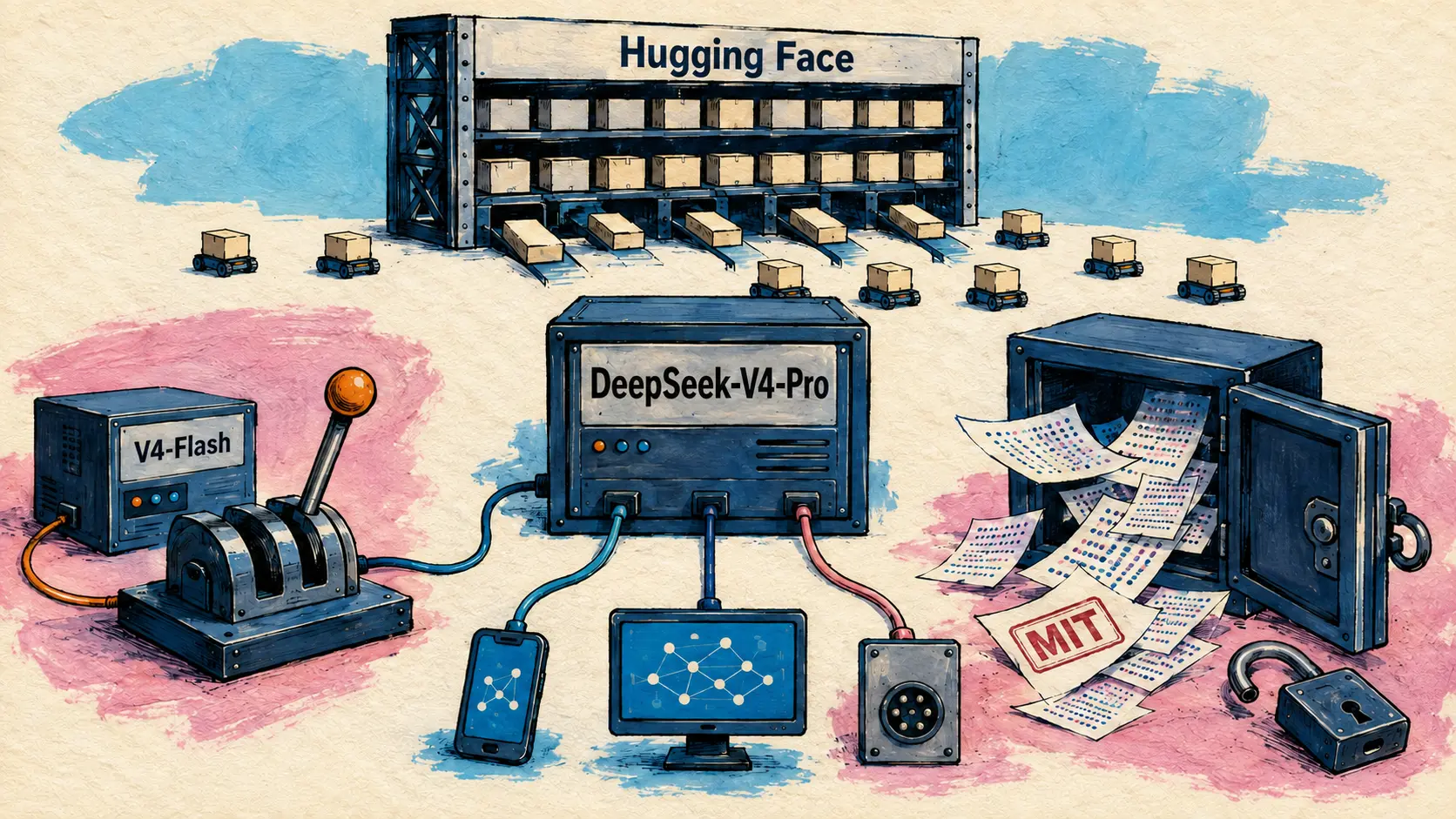
August 13 — DeepSeek launches its flagship model DeepSeek-V4-Pro, available immediately on the app, the web (via “Expert Mode”), and the API, with model names remaining unchanged in the documentation. The announcement highlights major agent-side improvements, with a reasoning effort setting now adjustable for V4-Pro and for the lighter V4-Flash version.
| Effort level | Recommended use |
|---|---|
| Low | Simple tasks |
| High | Daily agent workflows |
| Maximum | Complex tasks |
Another technical addition: native support for the OpenAI Responses API, optimized for Codex with a one-click setup — a signal that DeepSeek is directly targeting the ecosystem of agentic code tools built around OpenAI’s format rather than offering its own isolated API.
Hugging Face researcher Elie Bakouch confirms that V4-Pro is also released in open weights on Hugging Face, under the MIT license. He does, however, qualify the “V4” label: the previous version was only a preview, whereas this one received much more training — “it feels more like a V4.5,” he says. This launch is part of a busy day for DeepSeek, which on the same day publishes an overhaul of its API pricing and its first open-source agent harness, DeepSeek Harness (see below) — a coherent package that repositions the company as a full player in the agent ecosystem, not just a model provider.
We’re launching DeepSeek-V4-Pro today! Major Agent upgrades with strong production gains! Flexible reasoning effort for V4-Pro & V4-Flash: low for simple tasks, high for daily Agent workflows, max for complex tasks. Native OpenAI Responses API support, optimized for Codex with one-click setup. — @deepseek_ai on X
🔗 Open weights and MIT license confirmation
Gemini 3.7 Flash: new everyday workhorse model for code and agents
August 13 — Google launches Gemini 3.7 Flash, presented as its smartest everyday workhorse model to date for code and agents, only three weeks after Gemini 3.6 Flash. The model targets three main uses: software engineering, web development, and complex knowledge work (document analysis, business workflows).
| Benchmark | Evaluated domain | 3.6 Flash | 3.7 Flash |
|---|---|---|---|
| FrontierCode 1.1 Main | Product code quality | 34.4% | 43.6% |
| DeepSWE v1.1 | Software engineering (debugging) | 49.0% | 65.3% |
| WebDev Arena | Web development (Elo score) | 1538 | 1588 |
| GDP.pdf | Document understanding | 22.0% | 34.0% |
| AutomationBench | Automated business workflows | 17.0% | 30.4% |
On pricing, Gemini 3.7 Flash gets an introductory rate through December 31, 2026, at half the price of 3.6 Flash: $0.75 per million input tokens and $3.75 per million output tokens (versus $1.50 and $7.50 at the standard rate starting in January 2027). The model is available today in Google Antigravity, via the Gemini API in Google AI Studio and Android Studio, in Gemini Enterprise Agent, and in Gemini Spark — the proactive personal assistant offered to Google AI Pro and Ultra subscribers in more than 160 countries. Google also says it has strengthened the model’s safety guardrails against malicious use in chemical, biological, radiological, and nuclear domains, as well as against offensive cybersecurity capabilities.
On the same day, Gemini 3.7 Flash is also rolling out in GitHub Copilot: according to GitHub, early tests show improvements in web and app development as well as in agentic coding compared with the previous version. The rollout covers Copilot Pro, Pro+, Max, Business, and Enterprise subscriptions, accessible via the model picker in VS Code, Visual Studio, Copilot CLI, the Copilot cloud agent, the Copilot app, JetBrains, Xcode, and Eclipse. For Enterprise and Business plans, administrators must enable the “Gemini 3.7 Flash Preview” policy before organization members can access it; billing follows provider rates under pay-as-you-go usage.
Today we’re introducing Gemini 3.7 Flash, our most intelligent workhorse model yet for coding and agents. This model brings substantial gains across software engineering, web development, and complex knowledge work. — @Google on X
🔗 Official Google announcement · GitHub Copilot changelog
Ultrafast: GPT-5.6 Sol up to 14x faster, powered by Cerebras
August 13 — OpenAI unveils Ultrafast, a new service tier for the API that runs GPT-5.6 Sol up to 14 times faster than standard processing. Powered by Cerebras hardware, this mode reaches up to 750 generated tokens per second. Until now, achieving real-time speed meant choosing a smaller or specialized model at the expense of intelligence; Ultrafast changes that equation by aiming for more useful work per second without sacrificing the capabilities of OpenAI’s most advanced model.
| Feature | Detail |
|---|---|
| Model | GPT-5.6 Sol |
| Speed | Up to 14 times standard processing |
| Throughput | Up to 750 output tokens per second |
| Hardware partner | Cerebras |
| Availability | Preview, OpenAI API, sign-up access |
OpenAI identifies several scenarios where this speed opens up new uses: incident response (analyzing logs, recent code changes, and engineer reports while an incident is still ongoing), financial research (analyzing market signals and transactions in real time), voice customer support (resolving complex issues without breaking the conversation), commerce (answering product questions before cart abandonment), and experimental research (turning an overnight calculation into an interactive session). An initial group of customers is already testing GPT-5.6 Sol in Ultrafast mode on code, commerce, financial research, and support use cases in real production conditions. OpenAI says it already uses Ultrafast internally, notably for incident response.
Access is currently limited to a small group of customers via the API, with a sign-up form to be notified as capacity expands to more companies.
Previewing Ultrafast mode: GPT-5.6 Sol at up to 14x the speed. Launching first in the OpenAI API to a select group of customers with expanded access to more businesses as capacity grows. — @OpenAI on X
🔗 Previewing Ultrafast — official announcement
Claude extends continuity across devices
Anthropic pushes two announcements on the same day that point in the same direction: a Claude session that now follows the user rather than the device.
Claude in Chrome — synced sessions across desktop, web, and mobile
August 12 — Sessions in Claude in Chrome, Anthropic’s browser extension, are no longer tied to the device on which they were opened. Conversations are now saved and automatically reappear on desktop, web, and mobile, with the user’s skills and connectors remaining directly available in the browser. The feature is available today for Max and Team subscriptions, with rollout to Pro subscribers planned in the coming weeks.
Claude Cowork — the side panel shares the session with desktop, web, and mobile
August 12 — Claude Cowork’s side panel now runs the same session as the desktop, web, and mobile apps. Sessions are tied to the user account rather than to a single device, making it possible to start a task in a browser tab and continue it later from another device, without losing context.
Agentic development tools: Cursor, Devin, and DeepSeek move forward
Several AI-assisted development tools are advancing in parallel on August 13, between agent infrastructure, strategic hiring, and direct access to live data.
Cursor launches Builds — cloud agents up to 3 times faster to first token
August 13 — Cursor introduces builds: pre-prepared copies of the development environment (cloned repository, dependencies installed, installation script already run) that cloud agents start instantly. Cursor reports internally an environment startup that is 10 times faster, with time to first token 3 times faster. The system remains resilient: if a build fails, agents continue working with the last functional build while the failure is fixed in the background. The feature is included in Cloud Agents at no additional cost.
Cursor welcomes the Firetiger team
August 13 — Cursor announces the arrival of the Firetiger team, with the goal of building agents capable of following their code all the way to production and fixing what does not work — a logical extension of today’s Builds announcement: Cursor is aiming to cover the entire lifecycle, from development through production monitoring. No financial details are disclosed.
Devin (Cognition) works directly on MongoDB Atlas live data
August 13 — Cognition adds a MongoDB Atlas integration to Devin: the agent can now query and manage a live database, and provision a new cluster while a task is underway, without a fixed schema or manually copied context. The goal is to remove a common point of friction for code agents — waiting for a human to set up a test database.
DeepSeek Harness v0.1: DeepSeek’s first open-source agent harness
August 13 — DeepSeek releases DeepSeek Harness v0.1 in Developer Preview, an agent harness it opens to developers worldwide by open-sourcing the code under the MIT license. The architecture is based on the internal meta-framework “Cordis” and on a central idea: everything is a plugin — models, tools, skills, sessions, sandboxes, file systems, execution loops, orchestration, and user interface. This is DeepSeek’s first public foray into the tooling layer for agents, a space previously occupied by harnesses like Claude Code or Codex CLI.
Open models and research: Hugging Face multiplies initiatives
Several labs publish open models and studies back to back, with Hugging Face at the center of several announcements.
MiniMax-Music3: open-weights music generation model
August 13 — MiniMax releases MiniMax-Music3, the new generation of its music generation model, this time in open weights and presented as production-ready. According to Hugging Face, the architecture combines an 8-billion-parameter LLM and a 2.7-billion-parameter DiT (Diffusion Transformer) to turn a prompt and lyrics into a complete song, designed to run on modest consumer GPUs, with support for the diffusers libraries and ComfyUI. MiniMax thanks the Hugging Face team for integrating it on day one; the weights, an audio demo, and the code are available on Hugging Face, GitHub, and ModelScope.
🔗 MiniMax announcement · Hugging Face confirmation · Audio demo
Sakana Chat: major update with Fugu, Namazu, and code execution
August 12-13 — Sakana AI rolls out a major update to Sakana Chat, its free, no-login-required consumer product, now powered by Fugu, its orchestrator model, paired with a new generation of Namazu, its in-house Japanese LLM. The big new feature is full code execution: users can vibe-code interactive web apps, games, and tools directly in the browser, including in Japanese. Sakana highlights two use cases: educational review games (math, kanji) and business analysis from a simple Excel file.
🔗 Announcement on X · Blog post
Hugging Face: Strands Agents, LeRobot, and Storage Buckets for the robotics data loop
August 13 — Amazon (the AWS Strands team) and Hugging Face publish a joint post describing a robotics workflow combining Strands Agents (AWS Apache 2.0 SDK), LeRobot (Hugging Face’s robotics framework, whose data format is used by more than 90,000 datasets and models), and Xet Storage Buckets. The post gives concrete figures: changing 1% of the bytes in a 500 MB file requires only 5.5 MB of re-upload, and a “hot” bucket reaches about 1,086 MB/s of streaming throughput without local copying.
Reproduction hackathon review of 2,226 ICML 2026 papers
August 13 — Hugging Face publishes the recap of its community hackathon (July 15 – August 2), where 1,221 participants attempted to reproduce 2,226 papers accepted at ICML 2026 using AI agents. Mixed results: about 51% of the papers had at least one independently verified claim, but 23% contained at least one invalidated or contested claim. The headline takeaway: AI agents work best under human supervision, with successful reproductions involving humans who guided the agents and made perceptual judgments that metrics alone could not capture.
FineBooks: leaderboard for evaluating open OCR models on historical documents
August 10 — Hugging Face and EleutherAI release FineBooks, a leaderboard evaluating 14 open OCR models on 2,165 pages transcribed by experts, sourced from the Biodiversity Heritage Library. The goal: answer whether open OCR models are good enough to make digitized historical archives usable, using a reference dataset rather than vendor marketing claims.
GitHub improves the quality of license data in the dependency graph
August 13 — GitHub is changing its primary source of license information: instead of relying mainly on ClearlyDefined, the dependency graph now queries package registries directly — npmjs.org, PyPI, crates.io, RubyGems, nuget.org, pkg.go.dev, Maven, and pub.dev, as well as Packagist for PHP. ClearlyDefined remains as a fallback. This change significantly improves coverage: the share of packages without license data drops from 45% to 24% across a set of 170 million packages. The system now tracks version ranges rather than requiring one entry per individual version, automatically covering future versions not yet published. Affected features include dependency information, software bill of materials (SBOM), license compliance in GitHub Advanced Security, and dependency review actions.
Media generation: integrations and regulatory compliance
Several generative media announcements converge on August 13, between product integrations and regulatory compliance.
HeyGen natively integrates Cartesia into LiveAvatar
August 13 — HeyGen and Cartesia announce a native integration: Cartesia’s real-time voice engine now runs directly inside LiveAvatar, HeyGen’s real-time avatar product. The goal is to give an already built voice agent an animated face, without technical rework, accessible via the web app or the API.
Luma and Dumbstruck launch Creative Intelligence for advertising
August 13 — Luma partners with Dumbstruck, an emotional analytics platform, to create “Creative Intelligence”: Dumbstruck uses emotion analysis on viewer panels to identify the exact moments in a video ad where audience attention drops, then Luma regenerates only those sequences from the existing footage, with no new shooting.
Synthesia details its compliance with Article 50 of the AI Act
August 13 — Synthesia, one of the first AI companies to sign the Code of Practice for Article 50 of the European AI Act, details its transparency measures: C2PA provenance signals (Content Credentials) embedded by default in eligible videos, forthcoming signed downloads so this information travels with the video file, exploration of invisible watermarking, and customizable AI labels based on the EU reference design.
Suno Studio 2.0 is officially launched
August 13 — After a teaser on August 11, Suno launches Studio 2.0 in general availability, its browser-based music production workstation (DAW), offering fine-grained control over each track rather than only one-click generation. Studio already offers stem downloads exempt from the usual restrictions.
GeForce NOW: native Linux app out of beta and cloud optimizations
August 13 — NVIDIA brings the native Linux app for GeForce NOW out of beta, with support for Ubuntu 24.04+ and a new Flatpak repository. On the performance side, NVIDIA is optimizing DLSS Frame Generation image generation on the server side for streaming to reduce latency in 1440p and 4K, and is giving access to more than 2,000 PC games from Chromebooks through the Chromebook Fast Pass program.
The builder’s guide to GPT-5.6
August 13 — OpenAI publishes a guide for developers on model selection within the GPT-5.6 family. On the BrowseComp benchmark (searching for obscure facts on the web), the cost savings are clear:
| Evaluated model | BrowseComp score | Cost |
|---|---|---|
| GPT-5.5 Extra High (3 months ago) | 84.36% | $33.27 |
| GPT-5.6 Luna Extra High (at launch) | 84.04% | $1.33 |
In other words, nearly identical performance for one twenty-fifth the cost. OpenAI recommends reserving the lighter models (Terra, Luna) for high-volume, latency-sensitive workflows, and the flagship Sol model for the most demanding tasks. The guide also details three new features in the Responses API: reasoning persistence across calls combined with native compaction, native multi-agent orchestration, and programmatic tool calling to move deterministic work into code rather than the model.
🔗 The builder’s guide to GPT-5.6
Grok 4.6 continues its rollout: Perplexity, Warp, and Genspark
xAI’s Grok 4.6 model, launched on August 12, continues spreading into third-party tools on August 13 — three distinct integrations in a single day.
August 13 — Perplexity adds Grok 4.6 as an available model in Perplexity and in Perplexity Computer, its agentic layer. On its internal WANDR benchmark, Perplexity says Grok 4.6 sits on the Pareto frontier between performance and efficiency, with results equivalent to Fable 5 at a cost more than 60% lower.
Grok 4.6 is now available in Perplexity and Perplexity Computer. On WANDR, it sits on the Pareto frontier of performance and efficiency, matching Fable 5 results at over 60% lower cost. — @perplexity_ai on X
Warp adds support for Grok 4.6 via the existing /connect-grok command, with login through X Premium or SuperGrok. 🔗 Warp announcement
Genspark makes Grok 4.6 available in AI Chat, Code Agent, and Genspark Claw, directly accessible from the model picker. 🔗 Genspark announcement
Perplexity Computer: faster and more reliable Search as Code
August 13 — Perplexity details optimizations to Search as Code (SaC), its broad and deep search feature launched in June, cutting the cost per task by nearly 10% while preserving result quality. Two waves of Search SDK updates raise action execution reliability from 81.9% to 92.6%, leading to higher user satisfaction and an 8% lower cost per task in Perplexity Computer.
Briefs
- Amp — small improvements (GLM-5.2 fast mode, media cache, dictation, themes) — Amp’s Low mode (GLM-5.2) gets a fast mode at around 200 tokens/second, agent-generated media is cached for instant loading, and new dictation and theme options appear. 🔗 Tweet
- DeepSeek updates its API pricing with peak/off-peak rates — off-peak rates will be 50% lower than peak rates, effective August 16, 2026 at 16:00 UTC. 🔗 Tweet
- TRL adds an asynchronous GRPO trainer, 2 to 4x faster — Hugging Face recommends migrating any ongoing GRPO training to this new asynchronous trainer. 🔗 Tweet
- Gradio 6.24 automatically saves and replays app runs — run history is kept in the browser, with the ability to replay it without going back through the server queue. 🔗 Tweet
- Hugging Face Science adds demo Spaces to selected models — highlighted models, datasets, and papers become directly testable, without going only through their page. 🔗 Tweet
- Gemini Omni: three DeepMind experts go behind the scenes of the model — a “behind the scenes” format that illustrates the versatility of Gemini Omni Flash through creative examples of video generation and editing. 🔗 Google post
- GitHub guide: writing your first prompt in the Copilot app — a practical guide to writing a first prompt, choosing context and model, and resuming a session from another device. 🔗 GitHub guide
- Grok Imagine Image 2.0 available on Runway — xAI’s image model joins the catalog of already integrated image and video models on the platform. 🔗 Tweet
- NVIDIA opens more than 300 skills to Cursor — Cursor agents can now access more than 300 skills spanning more than 30 NVIDIA products. 🔗 Tweet
- MiniMax H3 claims first place on Video Edit Arena — an all-category ranking, with no methodological details disclosed. 🔗 Tweet
- Runway reveals speakers for its September 30 SF Summit — representatives from Physical Intelligence, NVIDIA, Anyscale, Google DeepMind, and CoreWeave join the list of announced speakers. 🔗 Tweet
- OpenAI appoints Dali Rajic as Chief Revenue Officer — the former president and COO of Wiz and Zscaler succeeds Denise Dresser as head of global revenue. 🔗 OpenAI announcement
- RingCentral rolls out ChatGPT Work and Codex for AI-native development — an “AI-Native Challenge” gave ChatGPT Work and Codex to all employees, including non-technical staff, to deliver a full project. 🔗 OpenAI case study
What this means
The race for inference speed and cost shapes a large part of today’s news. OpenAI’s Ultrafast promises up to 14x standard speed for its most advanced model thanks to dedicated Cerebras hardware, while Google halves the entry price of Gemini 3.7 Flash to accelerate production adoption, and DeepSeek releases V4-Pro as open weights under the MIT license on the same day as its commercial launch. Three different strategies — specialized hardware acceleration, aggressive pricing, full weight openness — converge on the same goal: making frontier inference cheaper and faster at scale, each relying on a distinct lever rather than just the race to bigger models.
AI-assisted developer tools are converging toward deeper, more interconnected infrastructure layers. Cursor is preparing agent environments in advance with Builds and hiring Firetiger’s team to track code through production, Devin is gaining direct access to live databases through MongoDB Atlas, and DeepSeek is publishing its own open-source agent harness built entirely around interchangeable plugins. Anthropic, meanwhile, is detaching Claude sessions from the device and attaching them to the user account. The common thread: these tools are no longer just isolated assistants, but infrastructure layers where the execution environment, session continuity, and data access matter as much as code generation itself.
The open research ecosystem is gaining depth as well as breadth. Hugging Face is multiplying structural initiatives on August 13: a robotics workflow combining Strands Agents and LeRobot with quantified throughput gains, an honest review of the ICML 2,226-paper reproduction hackathon — where 23% of the papers examined contained an invalidated claim, underscoring the limits of purely automated oversight — and an OCR leaderboard (FineBooks) designed for concrete archival use cases rather than marketing. Add to that highly specialized open models such as MiniMax-Music3 for music or the update to Sakana Chat for Japanese vibe coding: openness is no longer limited to general-purpose language models; it is extending into entire niches.
Finally, the industry is increasingly negotiating its rules rather than simply absorbing them. Synthesia goes deep into its compliance with Article 50 of the AI Act with default C2PA provenance signals, GitHub is improving the reliability of its license data by querying package registries directly, and Grok 4.6 is spreading on the same day through three distinct integrators (Perplexity, Warp, Genspark) without any of them trying to make it exclusive. This rapid normalization — a model available almost everywhere within days, a regulation anticipated rather than endured — sketches out a sector that is maturing its distribution and governance practices at the same pace as its technical capabilities.
Sources
- DeepSeek — announcement of V4-Pro on X
- Elie Bakouch — MIT open-weight confirmation
- Google — official announcement of Gemini 3.7 Flash
- @Google on X — Gemini 3.7 Flash
- GitHub — Gemini 3.7 Flash in Copilot
- @OpenAI on X — Ultrafast
- OpenAI — Previewing Ultrafast
- Anthropic — Claude in Chrome on X
- Anthropic — Claude Cowork on X
- Cursor — Builds changelog
- Cursor — Firetiger team on X
- Cognition — Devin x MongoDB Atlas on X
- DeepSeek — Harness v0.1 on X
- MiniMax — MiniMax-Music3 on X
- Hugging Face — MiniMax-Music3 confirmation on X
- MiniMax — audio demo on X
- Sakana AI — Sakana Chat update on X
- Sakana AI — blog post
- Hugging Face — Strands Agents, LeRobot, Storage Buckets
- Hugging Face — ICML 2026 hackathon wrap-up
- Hugging Face/EleutherAI — FineBooks on X
- GitHub — license data quality
- Cartesia — HeyGen integration on X
- Luma — Creative Intelligence with Dumbstruck on X
- Synthesia — Article 50 AI Act compliance on X
- Suno — Studio 2.0 on X
- NVIDIA — native Linux GeForce NOW
- OpenAI — builder guide for GPT-5.6
- Perplexity — Grok 4.6 on X
- Warp — Grok 4.6 on X
- Genspark — Grok 4.6 on X
- Perplexity — Search as Code optimizations on X
- Amp — improvements on X
- DeepSeek — API pricing on X
- TRL — asynchronous GRPO trainer on X
- Gradio 6.24 on X
- Hugging Face Science — demonstration Spaces on X
- Google — Gemini Omni, behind the scenes of the model
- GitHub — first prompt guide for Copilot app
- Runway — Grok Imagine Image 2.0 on X
- NVIDIA — 300+ skills for Cursor on X
- MiniMax — H3 on Video Edit Arena on X
- Runway — SF Summit speakers on X
- OpenAI — Dali Rajic CRO
- OpenAI — RingCentral study