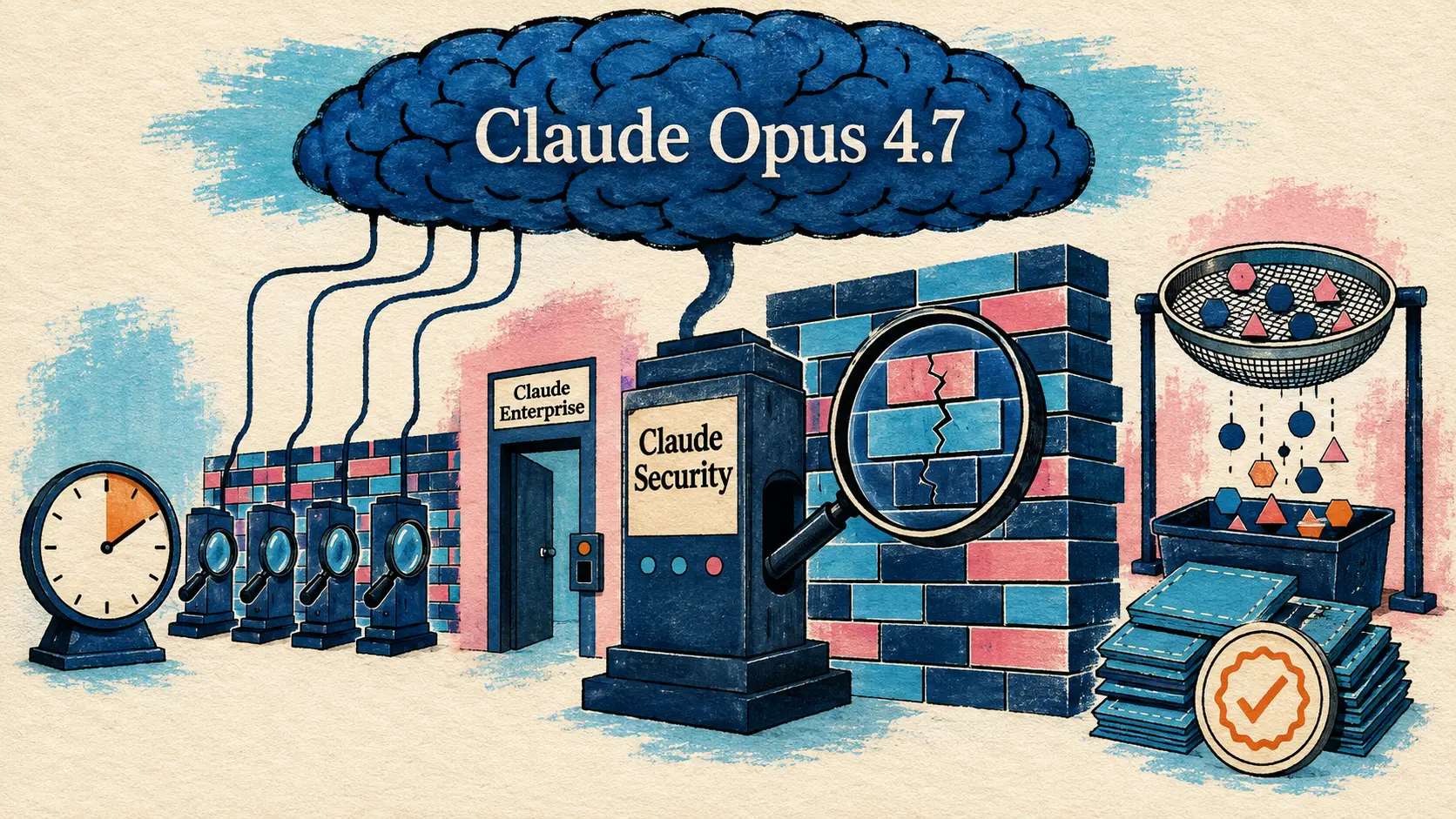
The week of April 29 to May 2, 2026 marks several important milestones: Claude Security moves from preview to an enterprise public beta, Manus launches an always-on Ubuntu cloud machine with no technical skills required, and NVIDIA open-sources a security sandbox for AI agents. On the multimodal side, xAI opens voice cloning via API with a record engagement of 19.7 million views.
Claude Security in Public Beta — code audit by Claude Opus 4.7
April 30 — Anthropic is opening Claude Security in public beta for Claude Enterprise customers. This product, formerly known as Claude Code Security, analyzes codebases for vulnerabilities by reasoning like a human security researcher — not by simple static pattern matching.
“Claude Security is now in public beta for Claude Enterprise customers. Claude scans your codebase for vulnerabilities, validates each finding to cut false positives, and suggests patches you can review and approve.” — @claudeai on X
The tool uses Claude Opus 4.7 to run multi-agent scans in parallel across code, validate each result to reduce false positives — one of the main criticisms of traditional scanners — and suggest concrete fixes that teams can review and approve. Since the February 2026 preview, hundreds of organizations have tested the tool on production code, reporting scan-to-patch cycles in just a few hours.
New features in the public beta include scheduled scans (for continuous coverage, not just one-off audits) and the ability to target a specific repository directory.
| Aspect | Detail |
|---|---|
| Availability | Public beta, Claude Enterprise only |
| Model | Claude Opus 4.7 |
| Access | claude.ai/security or claude.ai sidebar |
| Preview | Since February 2026 — hundreds of organizations |
| New features | Scheduled scans, directory targeting |
| Integrated partners | CrowdStrike, Palo Alto Networks, SentinelOne, TrendAI, Wiz |
Anthropic is also integrating Opus 4.7 into partner security platforms: CrowdStrike (Falcon platform, Project Quiltworks), Palo Alto Networks, SentinelOne (Wayfinder AI), TrendAI, and Wiz (Red Agent). Enterprise administrators can enable Claude Security from the admin console.
🔗 Official Claude Security blog
Manus Cloud Computer — an Ubuntu machine without coding, 24/7
April 30 — Manus is launching Cloud Computer, a dedicated always-on cloud virtual machine that fundamentally changes what non-developers can build and automate.
Until now, running a program continuously 24/7 required renting servers, configuring an operating system, and writing code — a barrier reserved for developers. Cloud Computer removes that barrier by letting users describe an objective in natural language: Manus writes the code and configures the environment.
“Introducing Cloud Computer for Manus. Your always on machine in the cloud, so anything you build keeps running.” — @ManusAI on X
The 24/7 persistence contrasts with the temporary Manus sandbox, which closes after each session. Cloud Computer maintains a shared Ubuntu file system between sessions, allowing Manus to build on previous work.
| Manus environment | Use case |
|---|---|
| Temporary Sandbox | Analyses, documents, one-off web apps |
| Manus Desktop | File and application control on local machine |
| Cloud Computer | 24/7 bots, persistent databases, scheduled scrapers |
Documented real-world use cases include continuously running Slack, Discord, or WhatsApp bots, MySQL databases with automatic weekly reports, price-monitoring scrapers, and self-hosting of open source tools (Home Assistant, Metabase, WordPress, Plausible). Three plans (Basic, Standard, Advanced) let users choose CPU, memory, and storage resources according to their needs. Access is available via SSH or a web terminal from the Manus dashboard.
NVIDIA OpenShell — open source sandbox for enterprise AI agents
May 2 — NVIDIA announces OpenShell, an open source sandbox environment designed to secure AI agents deployed in enterprise settings. Presented by Jensen Huang, CEO of NVIDIA, in a video published on May 2, 2026, the tool precisely controls what agents can access, share, and send.
By choosing open source, NVIDIA is betting on transparency and auditability: any company can inspect the code, adapt it to its needs, and trust it. This positioning directly addresses the concerns of security teams that slow enterprise LLM adoption out of fear of data exfiltration or unwanted actions.
OpenShell fits into NVIDIA’s broader strategy around securing agentic inference, alongside Dynamo (KV-aware routing) and NIM (Blackwell-optimized APIs). The blocker it addresses is precisely the one that delays the deployment of autonomous agents in sensitive environments: the inability for IT teams to supervise and constrain the agents’ scope of action.
| Aspect | Detail |
|---|---|
| Type | Open source sandbox |
| Presented by | Jensen Huang (CEO NVIDIA) |
| Function | Control agent AI access / sharing / sending |
| Positioning | Complementary to Dynamo and NIM |
| Engagement | 13K+ views in a few hours |
🔗 NVIDIA OpenShell announcement
xAI Voice Cloning via API — custom voice in under 2 minutes
May 2 — xAI launches voice cloning via its public API. Developers can now create a custom voice in under two minutes or choose from a selection of predefined voices.
“Voice Cloning is now live via the xAI API! Create a custom voice in less than 2 minutes or select from our preset voices.” — @xai on X
The announcement generated exceptional engagement of 19.7 million views in just a few hours, making it one of the week’s most viral announcements in the AI ecosystem. This feature fits into xAI’s strategy of offering advanced multimodal capabilities via API, following the launch of Grok Voice Think Fast 1.0 the previous week.
| Metric | Value |
|---|---|
| Views | 19.7 M |
| Reposts | 820 |
| Likes | 5 641 |
| Bookmarks | 2 481 |
| Creation time | Under 2 minutes |
Use cases range from audio content creation to personalized assistants and interactive applications. API availability opens the door to integration into third-party products.
Claude Code — Lessons on prompt caching
April 30 — The Claude Code team publishes a technical article by Thariq Shihipar (Claude Code technical staff) on its prompt caching practices. Core message: for a long-running agent, prompt caching is not an optional optimization — it is the base architecture.
The prompt structure is organized from the most stable to the most dynamic: tools and system prompt (global cache shared across sessions), project context (project-level cache), session context, then dynamic conversation. Any change in the stable part invalidates everything that follows — which the team treats as an internal incident.
Three documented patterns: (1) never modify tools during a session — Claude Code uses EnterPlanMode/ExitPlanMode as model-callable tools; (2) the dozens of MCP tools are loaded as defer_loading: true stubs rather than removed from the prompt; (3) context compaction uses a fork with an identical prefix to the parent to maximize cache hits.
🔗 Claude Code Prompt Caching article
Claude API Skill in CodeRabbit, JetBrains, Resolve AI and Warp
April 29 — Anthropic extends the claude-api skill to four new development environments: CodeRabbit, JetBrains (and its Junie agent), Resolve AI, and Warp. The skill was already available in Claude Code.
| Tool | Integration |
|---|---|
| Claude Code | Already available |
| CodeRabbit | New |
| JetBrains / Junie | New |
| Resolve AI | New |
| Warp | New |
Its role: give developers a Claude API expert integrated into their usual tool, one that knows prompt caching rules, agent patterns, Claude Managed Agents configuration, and model migrations. The skill stays automatically up to date with every API change. It is open source on GitHub (anthropics/skills).
Code with Claude — Developer conference week of May 5
May 1 — Anthropic announces the return of its developer conference Code with Claude for the week of May 5, 2026. The event is aimed at all experience levels with Claude Code — beginners and experienced developers alike — and will be livestreamed. Registration is open at claude.com/code-with-claude.
The announcement sparked more than 630,000 views in a few hours, a sign of sustained interest in the developer community. The conference follows a first edition that had marked the Claude Code ecosystem, with Tokyo mentioned by attendees as a possible physical location for some sessions.
🔗 Code with Claude registration
Anthropic — Study on personal guidance via Claude (1M conversations)
April 30 — Anthropic publishes a study analyzing how Claude users ask for personal guidance, based on the analysis of one million conversations. The analysis is conducted with Clio, the privacy-preserving insights tool developed in-house. This study is part of an effort to understand Claude’s societal impact in order to inform future model training — closing the loop between real-world usage and responsible AI development.
BioMysteryBench — Bioinformatics benchmark by Anthropic
April 30 — Anthropic publishes BioMysteryBench, a new benchmark for evaluating Claude’s bioinformatics research capabilities. The eval includes 99 problems built from real biological data, in which Claude must infer the data type and design creative solutions — simulating the work of a researcher faced with unknown data. The goal is to measure whether Claude can compete with human experts in bioinformatics on real, open-ended research tasks rather than standard benchmarks.
🔗 BioMysteryBench announcement
Google DeepMind AI co-clinician — multimodal medical agents
April 30 — Google DeepMind announces a new research initiative called AI co-clinician. The goal is to explore how multimodal agents could better support healthcare professionals in their day-to-day work.
To ensure patient safety, the system relies on a dual-agent architecture: a main agent performs analyses, while a second integrated agent checks and validates decisions before any action. This supervision architecture aims to keep human oversight at the center of the system, a prerequisite for medical adoption. The announcement generated more than 314,000 views in a few hours.
🔗 Google DeepMind AI co-clinician announcement
NotebookLM Notebooks in the Gemini app — Free and Paid mobile availability
April 30 — NotebookLM announces that its Notebooks are now available on mobile in the Gemini app, for all Free and Paid users. Rollout to additional European countries is planned soon. This mobile availability follows the initial April 8, 2026 desktop integration and marks a significant step: users can now organize their projects, access their personal notebooks, and use NotebookLM on the go, from the Gemini smartphone app.
🔗 NotebookLM mobile announcement
Gemini CLI v0.40.0 — offline ripgrep search, 4-level memory, local Gemma
April 28 — Version v0.40.0 of Gemini CLI introduces several improvements for developers.
| Feature | Detail |
|---|---|
| Version | v0.40.0 |
| Offline search | ripgrep integrated in bundle |
| Memory | New 4-level hierarchical system |
| Local models | Simplified gemini gemma command |
| Themes | GitHub-inspired colorblind-friendly themes |
| MCP resources | MCP resource tools introduced |
Gemini CLI now bundles ripgrep, enabling local code search without a network connection. The memory system moves to a prompt-driven four-level architecture. Configuring and using Gemma models locally is simplified thanks to the dedicated gemini gemma command.
GitHub Copilot in Visual Studio — April 2026 Update
April 30 — GitHub releases the April update for Copilot for Visual Studio, focused on agentic workflows.
| Feature | Description |
|---|---|
| Cloud agent from the IDE | Start cloud agent sessions without leaving Visual Studio |
| Portable custom agents | User-level definitions in %USERPROFILE%/.github/agents/ |
| Expanded agent skills | Discovery from .claude/skills/ and .agents/skills/ |
| Debugger agent | Reproduces, instruments, diagnoses, and fixes from an issue |
| C++ Code Editing Tools | General availability (get_symbol_call_hierarchy, etc.) |
The cloud agent lets you select “Cloud” in the agent picker, describe a task, and Copilot automatically creates a GitHub issue and a pull request on remote infrastructure while the developer keeps working. The debugger agent validates fixes against actual runtime behavior.
🔗 GitHub Copilot Visual Studio April 2026 changelog
Genspark × Microsoft — global strategic partnership on Azure
April 30 — Genspark announces Microsoft as a global strategic partner. Built on Azure, this partnership aims to integrate Genspark AI agents directly into everyday Microsoft tools — notably PowerPoint and other Microsoft 365 applications. The stated goal is to embed AI execution directly into existing tools, without forcing users to change their work habits. This announcement closely follows the Salesforce partnership announced on April 29 and represents a significant expansion of Genspark into the Microsoft ecosystem.
🔗 Genspark × Microsoft announcement
NVIDIA NeMo-RL + vLLM Speculative Decoding — 1.8× RL throughput
May 1 — NVIDIA Research publishes a paper on accelerating reinforcement learning post-training. The core issue: the generation phase (rollout) creates a bottleneck that slows down the entire RL loop.
The solution combines NeMo-RL and vLLM with speculative decoding — a technique that generates candidate tokens in parallel without loss of quality.
| Metric | Value |
|---|---|
| Measured throughput (8B models) | 1.8× |
| End-to-end projection | 2.5× |
| Code | Open source on NVIDIA-NeMo/RL |
Runway — Mobile app on Android and iOS
May 2 — Runway announces the launch of its mobile app on Android, in addition to the already available iOS app. The AI video generation platform is now accessible on both major mobile platforms, making it possible to create content from any device.
This mobile availability significantly broadens Runway’s accessibility, which until now was mainly used via a web browser. The announcement slogan — “Make anything. From anywhere. On any device.” — sums up the point: bring AI video creation out of the office and into creators’ pockets. The Android app is available on the Google Play Store.
ElevenCreative Flows — Real-time collaboration and Basic Seats
May 1 — ElevenLabs enables real-time collaboration in ElevenCreative Flows, its AI-assisted audio and video content creation platform. Multiple team members (creators, marketers, stakeholders) can now work simultaneously on the same projects. Basic Seats allow reviewers and managers to access projects without a full ElevenCreative subscription. The announcement generated 769,000 views, a sign of strong interest in this collaborative feature.
🔗 ElevenCreative Flows announcement
Grok Imagine — Agent Mode on infinite canvas
May 1 — Grok Imagine launches its Agent Mode on an infinite canvas for desktop. This unified interface lets you carry out the full creative flow — ideation, writing, image generation, editing, and video creation — without ever leaving grok.com/imagine.
The infinite canvas represents an evolution in the design of AI creation tools: instead of chaining multiple specialized tools, the entire creative process happens continuously in a single workspace, available only on desktop.
| Metric | Value |
|---|---|
| Views | 7.9M |
| Likes | 3,825 |
| Availability | Desktop only |
🔗 Grok Imagine Agent Mode announcement
Qwen-Scope — Open-source suite of sparse autoencoders
April 30 — Qwen releases Qwen-Scope, an open-source suite of sparse autoencoders (SAE) dedicated to interpretability and control of models in the Qwen family. SAEs break down a model’s internal activations into understandable features, which Qwen-Scope turns into practical tools for four areas:
| Area | Application |
|---|---|
| Inference | Steer outputs without prompt engineering |
| Data | Classify and synthesize targeted data |
| Training | Identify problems at the source (code-switching, repetition) |
| Evaluation | Analyze activation patterns to choose the right benchmarks |
The code, weights, and technical report are available on HuggingFace and ModelScope.
Codex CLI v0.128.0 — persistent goals, keymaps, MultiAgentV2
April 30 — Version 0.128.0 of Codex CLI brings several substantial improvements.
The main new feature is the /goal command, which lets you define persisted goals managed by app-server APIs. A goal can be created, paused, resumed, or deleted directly from the TUI.
| Feature | Description |
|---|---|
/goal persistent | Goals managed by app-server APIs with TUI controls |
codex update | In-place update |
| Configurable keymaps | Customizable TUI keyboard shortcuts |
| Expanded MultiAgentV2 | Thread caps, wait-time controls, sub-agent depth |
| Import external agents | Imported agent sessions in the background |
Installation: npm install -g @openai/codex@0.128.0
OpenAI Advanced Account Security — enhanced opt-in protection
April 30 — OpenAI launches Advanced Account Security, a set of enhanced opt-in protections for ChatGPT and Codex accounts. This setting targets users at high risk of digital attacks: journalists, elected officials, political dissidents, researchers.
Once enabled: password logins are disabled (only passkeys or FIDO-compliant physical security keys are accepted), recovery via email and SMS is removed, sessions are shortened, and conversations are automatically excluded from model training. A partnership with Yubico offers YubiKeys at a preferential rate from the security settings. Starting June 1, 2026, members of the Trusted Access for Cyber program will need to enable this protection.
🔗 OpenAI Advanced Account Security
GPT-5.5 — One-week report: API revenue doubles, Codex doubles its revenue
May 1 — OpenAI shares a one-week update on GPT-5.5 after launch: API revenue is growing at more than twice the pace of any previous launch.
| Metric | Value |
|---|---|
| API revenue vs previous launches | Growth >2x faster |
| Codex revenue in 7 days | 2x |
| OpenAI qualifier | ”The strongest launch in our history” |
Codex doubled its revenue in less than seven days — a sign of sustained enterprise demand for agentic coding tools. These figures confirm the momentum around GPT-5.5, launched on April 23.
🔗 OpenAI GPT-5.5 update announcement
Perplexity Computer at Work — Teams, Professional Finance, 70+ workflows
April 30 — Perplexity publishes a blog post detailing the expansion of its Computer automation agent to new surfaces.
| Extension | Detail |
|---|---|
| Microsoft Teams | After Slack (launched in early April) |
| Available workflows | Library of 70+ enterprise workflows |
| Computer for Professional Finance | Market finance, due diligence, private equity |
| Identity security | New partnership announced |
Computer was first available in Slack. Perplexity is extending it to Microsoft Teams, making it possible to automate tasks directly in the messaging tool. The next announced surfaces are documents and spreadsheets. For professional finance, the offering targets private-equity teams, financial analysts, and due-diligence teams.
🔗 Perplexity Computer at Work blog
Briefs
-
Claude Code Opus 4.7 Hackathon — winners announced — Co-organized with Cerebral Valley, the “Best Use of Claude Managed Agents” award goes to ARIA, a maintenance agent developed by the French team Idriss Benguezzou and Adam Hnaien. 🔗 Announcement
-
Anthropic Fellows — introspection adapters — Anthropic Fellows researchers publish work on “introspection adapters”: adapters that allow an LLM to report undesirable behaviors that it may have learned during training. 🔗 Announcement
-
Claude Cowork enterprise deployment guide — Anthropic publishes a new practical guide on deploying Claude Cowork at scale across organizations. 🔗 Guide
-
Deprecation of GPT-5.2 and GPT-5.2-Codex in Copilot on June 1, 2026 — GitHub deprecates GPT-5.2 (replaced by GPT-5.5) and GPT-5.2-Codex (replaced by GPT-5.3-Codex) in all Copilot experiences, except GPT-5.2-Codex in Copilot Code Review. 🔗 Changelog
-
Midjourney V8.1 — quality and sharpness update — Midjourney rolls out an update improving image quality and sharpness for the V8.1 model. 🔗 Announcement
-
Qwen + Fireworks AI partnership — Official partnership between Qwen and Fireworks AI to deploy Qwen models with lower latency and reduced inference costs for enterprise teams. 🔗 Announcement
-
Mistral AI in the TIME100 Most Influential Companies 2026 — Mistral ranks in the top 10 for the AI category in TIME100’s ranking of the world’s most influential companies. 🔗 Announcement
-
Z.ai “Scaling Pain” — debugging GLM-5 in production — Z.ai publishes a technical postmortem on reproducing rare corrupted outputs, prefill throughput bottlenecks, and GPU memory consumption of GLM-5 at scale. 🔗 Blog · Announcement
-
Codex — import workflows from ChatGPT — Settings, plugins, agents, and project configurations can be imported into Codex in a few clicks, with fallback from ChatGPT in case of rate limiting. 🔗 Announcement
-
Codex for Work — roles and everyday apps — New work-oriented Codex experience: role selection, connecting the apps you use, prompt suggestions for docs, presentations, and spreadsheets. 🔗 Announcement
-
Codex Pets — interactive mascot — The
/petcommand in Codex wakes up an interactive virtual mascot. 1.57 million views, pinned tweet on @OpenAIDevs. 🔗 Announcement
What this means
The convergence of this week’s announcements points to a clear trend: enterprise security is becoming the main differentiator for AI players. Claude Security and OpenAI Advanced Account Security both target organizations and high-risk users — two complementary approaches, one at the code level, the other at the account level. NVIDIA OpenShell adds a third layer by controlling the scope of action of autonomous agents. Enterprise AI is entering a maturity phase where trust and auditability matter more than benchmark races.
The democratization of agentic infrastructure is moving forward in practical terms. Manus Cloud Computer and Perplexity Computer at Work both target non-developers capable of running services continuously — one via a persistent Ubuntu machine, the other via enterprise workflows in Teams and Slack. These two products reduce technical friction in complementary ways: Cloud Computer for those who build, Computer for Work for those who automate business processes.
Synthetic voice is entering a new phase of accessibility. xAI’s Voice Cloning via API in under 2 minutes, with 19.7 million engagement views, illustrates the market’s appetite for multimodal capabilities that can be integrated directly into third-party products. Grok Imagine Agent Mode and ElevenCreative Flows follow the same logic: reduce the friction between the idea and the creation of audio-visual content.
The GPT-5.5 launch numbers (API revenue 2x, Codex doubling its revenue in 7 days) confirm that enterprise demand for code agents is now a measurable business reality, not just a promise. This momentum justifies the corresponding investments in RL infrastructure (NeMo-RL speculative decoding at NVIDIA) and interpretability tools (Qwen-Scope), which tackle the bottlenecks of large-scale post-training.
Sources
- https://x.com/claudeai/status/2049898739783897537
- https://claude.com/blog/claude-security-public-beta
- https://claude.com/product/claude-security
- https://claude.com/blog/lessons-from-building-claude-code-prompt-caching-is-everything
- https://claude.com/blog/claude-api-skill
- https://github.com/anthropics/skills/tree/main/skills/claude-api
- https://x.com/claudeai/status/2050252933866930339
- https://x.com/AnthropicAI/status/2049927618397614466
- https://x.com/AnthropicAI/status/2049624600741560340
- https://x.com/claudeai/status/2049523899918934384
- https://x.com/AnthropicAI/status/2049576143653929153
- https://claude.com/blog/new-guide-deploying-claude-across-the-enterprise-with-claude-cowork
- https://x.com/ManusAI/status/2049870078896963962
- https://manus.im/fr/blog/manus-cloud-computer
- https://github.blog/changelog/2026-04-30-github-copilot-in-visual-studio-april-update/
- https://x.com/genspark_ai/status/2049747536303518194
- https://github.blog/changelog/2026-05-01-upcoming-deprecation-of-gpt-5-2-and-gpt-5-2-codex/
- https://x.com/GoogleDeepMind/status/2049867061279457761
- https://x.com/NotebookLM/status/2049904264731078912
- https://github.com/google-gemini/gemini-cli/blob/main/docs/changelogs/index.md
- https://x.com/NVIDIAAI/status/2050336285428998202
- https://x.com/NVIDIAAI/status/2050304249699950739
- https://github.com/NVIDIA-NeMo/RL
- https://x.com/runwayml/status/2050270993487212712
- https://x.com/ElevenLabs/status/2050100453589852452
- https://x.com/midjourney/status/2049973065094947125
- https://x.com/xai/status/2050355373052223585
- https://x.ai/news/grok-custom-voices
- https://x.com/imagine/status/2050327174629228889
- https://x.com/Alibaba_Qwen/status/2049861145574690992
- https://x.com/Alibaba_Qwen/status/2050232280082522505
- https://x.com/MistralAI/status/2049988769928056852
- https://x.com/Zai_org/status/2049601030170857891
- https://z.ai/blog/scaling-pain
- https://developers.openai.com/codex/changelog
- https://openai.com/index/advanced-account-security/
- https://x.com/OpenAI/status/2050250926888468929
- https://x.com/OpenAI/status/2050290618187055175
- https://x.com/OpenAI/status/2049928776147230886
- https://x.com/OpenAIDevs/status/2050275713824211041
- https://www.perplexity.ai/hub/blog/computer-at-work
This document was translated from the fr version into the en language using the gpt-5.4-mini model. For more information about the translation process, see https://github.com/jls42/ai-powered-markdown-translator